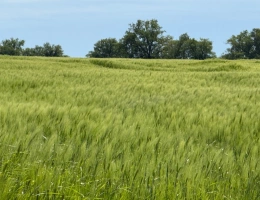
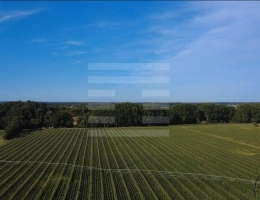
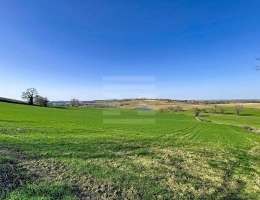
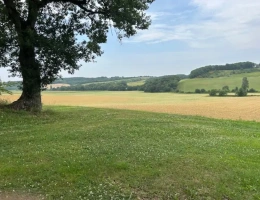

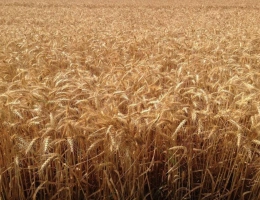
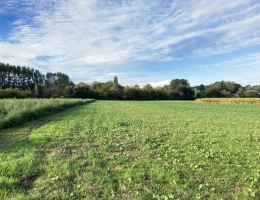
Looking for an arable farm for sale in France? This page brings together the cereal and crop farms currently offered by farmers preparing their handover, rural estate agencies and notaries: wheat, barley and rapeseed holdings in the Paris Basin, sugar-beet farms in the north and east, irrigated maize units in the South-West, organic farms and holdings run under conservation agriculture. Each listing states the arable area, the split between owned and rented land, the sheds and grain storage, the machinery included and, where relevant, the irrigation rights. It complements all the farms for sale in France on ma-propriete.fr.
Beyond the listings, you will find the benchmarks buyers usually lack when taking over a cereal farm: arable land prices region by region, the cropping basins where supply is densest, what to check on the parcels, the leases and the basic payment entitlements, and the steps of a takeover that goes through. Our white paper « Créer une exploitation agricole » (in French) explains what awaits a candidate, from funding plan to approval.
In an arable farm for sale in France, land almost always makes up the bulk of the price: unlike a livestock unit, there is no herd and no production right to carry the value, and the buildings are often limited to sheds and grain storage. The regional price of arable land is therefore the first benchmark to know.
Across France, 14,328 sales of agricultural land were recorded in 2025, at a median price of €5,307/ha (average €6,059/ha; 80% of transactions between €2,500 and €10,537/ha). The SAFER benchmark of land values puts vacant land and pasture at €6,460/ha (+0.9% year on year) and tenanted land at €5,350/ha (+2.5%), an average discount of around 17% where a tenant farmer is in place.
| Region | Sales 2025 (DVF) | DVF median price (€/ha) | SAFER vacant land (€/ha) | 1-year change | SAFER tenanted land (€/ha) |
|---|---|---|---|---|---|
| Brittany | 1,297 | 5,500 | 6,540 | +0.3% | 5,180 |
| Pays de la Loire | 1,873 | 3,267 | 4,100 | +1.5% | 3,350 |
| Normandy | 1,442 | 8,305 | 9,610 | +2.9% | 8,410 |
| Hauts-de-France | 1,365 | 7,976 | 10,890 | -0.5% | 7,650 |
| Grand Est | 1,233 | 5,611 | 6,510 | -4.4% | 6,120 |
| Île-de-France | 214 | 7,465 | 8,190 | +5.7% | 7,000 |
| Centre-Val de Loire | 1,195 | 5,480 | 6,260 | -6.1% | 5,700 |
| Bourgogne-Franche-Comté | 1,303 | 2,773 | 2,740 | -6.2% | 2,750 |
| Nouvelle-Aquitaine | 2,103 | 4,538 | 5,770 | +5.5% | 3,900 |
| Occitanie | 995 | 7,015 | 7,260 | -0.3% | n/a |
| Auvergne-Rhône-Alpes | 1,230 | 3,887 | 5,100 | +4.9% | 4,140 |
| Provence-Alpes-Côte d'Azur* | 59 | 13,518 | 12,260 | +2.8% | n/a |
| Corsica* | 19 | 5,012 | — | — | n/a |
The table confirms what grain growers know from experience: land in the main cropping regions, Hauts-de-France, Île-de-France, Grand Est and Centre-Val de Loire, trades well above the national average, and the gap with the livestock regions is wide. On this type of holding, however, value is not only a matter of hectares: soil depth, drainage, access to water and the consolidation of the parcels create marked differences between two farms of similar size. From one region to the next, the benchmark varies fourfold, from €2,740/ha in Bourgogne-Franche-Comté to €10,890/ha in Hauts-de-France. See the full analysis, department by department, on our agricultural land price observatory, estimate your plots with the land value tool, and work out notary fees and borrowing capacity with our financial calculators. * Fewer than 100 recorded sales: indicative value. n/a: no tenanted-land benchmark published for this region.
A crop farm is judged first by its land. The agronomic potential of the parcels, meaning the soil type (deep loams, chalk, clay-limestone), the water-holding capacity and the yield history in wheat, barley, rapeseed or maize, matters more than the gross area. A block of parcels grouped around the farmstead, accessible to wide machinery, is worth more than a scatter of distant fields. A borehole and an irrigation network, or a buried drainage system in good order, change the nature of the property: they secure spring crops and open the rotation to sugar beet, sunflower or protein crops.
The buildings are more modest than on a livestock farm, but they count: machinery sheds, on-farm bins and silos that allow the crop to be sold when prices suit rather than at harvest, a maize dryer, a compliant chemical store. The machinery (tractors, combine harvester, drill, sprayer) is sometimes included in the sale, sometimes held jointly or through a machinery cooperative (CUMA), which should be clarified at the first visit. Each item is valued separately: land at the local land price, buildings on condition, machinery at second-hand quotation.
Most grain farms for sale lie in the wider Paris Basin (Bassin parisien): Beauce and Champagne berrichonne in Centre-Val de Loire, Brie and the plateaux of Île-de-France, Picardie and Artois in Hauts-de-France, the chalk Champagne and the Lorraine plain in Grand Est. These areas offer large holdings, consolidated parcels, deep soils and a dense network of cooperatives, grain merchants, sugar factories and port silos. They also hold some of the dearest farmland in the country, where a takeover often relies on leases rather than on buying all the land outright.
Outside this core, the offer is more varied: the plains of Normandy and Bourgogne, Poitou-Charentes and the Limagne in Auvergne, where cereals, sunflower and protein crops alternate with livestock enterprises; the South-West, from the Gers to the Landes, and the Alsace plain for maize, often irrigated. Arable land for sale there is generally cheaper and holdings smaller, often mixed, which makes them accessible to a first purchase or to gradual enlargement.
The first point concerns rented land. On arable farms a large share of the area is often farmed under a rural lease: the tenancy passes to the buyer only if the landlord agrees to the assignment of the lease, and the takeover remains subject to the structures control and to SAFER's pre-emption right. Then check the transfer of the basic payment entitlements (DPB) under the CAP, without which the decoupled aid is lost, and the fate of contracts with the cooperative, the grain merchant or the sugar factory, which do not automatically follow the land.
On the technical side, the buyer should confirm that water abstraction is in order (declaration or authorisation of the borehole, allocated volumes), the state of the drainage, whether the commune lies in a nitrate vulnerable zone and, on an organic farm, the certification and the conversion period still to run. A soil analysis and the fertilisation records of recent seasons tell you the real potential and the residues left by the outgoing farmer.
The sale of a cereal farm takes several forms. When the seller owns the land, the sale covers land, buildings and machinery, each valued separately; when the farm is run as a company (EARL, SCEA, GAEC), the transaction goes through a transfer of shares, which keeps leases and contracts in the company's name but commits the buyer to its liabilities, as explained in our article selling the assets or the shares of a farming company. Many grain growers prefer to keep the land and let it to the buyer, an option compared in selling or letting your farm.
For the buyer of an arable farm for sale in France, the process follows a logical order: define the project and its financing, obtain the agricultural qualification, analyse the accounts, yields and leases, then secure the land with SAFER and the landlords before signing. Our complete guide to buying a farm in France details every step. For the seller, the handover is prepared years ahead: updating the parcel register, regularising leases, choosing the tax regime of the sale. The article preparing your farm for sale lists the points to settle before negotiations open.
The price depends first on the owned area and on the regional price of arable land: a Paris Basin farm whose land is owned has nothing in common with a holding of the same size taken over on leases in the South-West. Add the storage buildings, the machinery, the stocks and growing crops, and the payment entitlements transferred. The price table above gives the order of magnitude for the land; the rest is valued item by item.
Yes. There is no nationality restriction, and EU and non-EU buyers purchase French farmland every year. Nothing prevents a non-farmer from buying land or a farm, but farming it means passing the structures control, which may favour a new entrant or a neighbouring farmer, and obtaining the agricultural qualification to receive aid. Many non-farming buyers own the land and let it under a rural lease to a grain grower, or join him in a company.
Every sale of agricultural land or buildings is notified to SAFER, the rural land agency, by the notary. It may exercise its pre-emption right, including with a revised price offer, to set up a young farmer or consolidate a neighbouring holding, with exceptions such as a sale to the sitting tenant or to a family member. It can also assist the handover by calling for candidates. The structures control rules apply when a holding is set up and when it grows.
Valuation starts with the land, at the regional land price adjusted for agronomic potential, drainage, irrigation and parcel consolidation, with a discount on tenanted areas. Sheds and silos are valued on condition and usefulness, rarely at building cost; machinery at second-hand quotation. This breakdown is usually handled by a qualified rural valuer.
Basic payment entitlements are attached to the farmer, not to the parcels: their transfer to the buyer must be provided for in the deed or by a specific clause, otherwise the CAP aid is lost. Commitments with the cooperative or grain merchant, sugar-beet or seed contracts are negotiated case by case with the organisation, which may or may not accept the new farmer. These points are settled in writing before signing.
The arable farms for sale in France listed on ma-propriete.fr come from private farmers, rural estate agencies and notaries' offices. Filter by region, area, price or irrigation, and set up an e-mail alert to be told of every new cereal farm put on the market. Selling your farm? Post your listing so that buyers in France and abroad hear about it.