
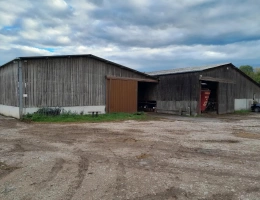
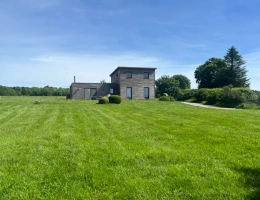
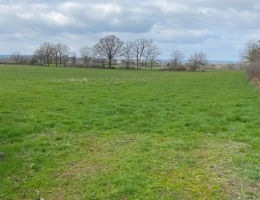
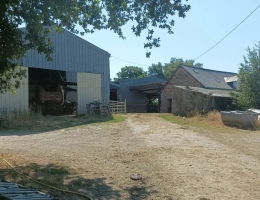
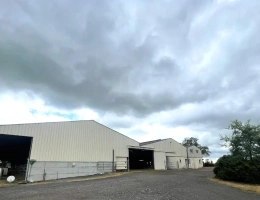
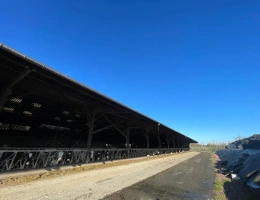
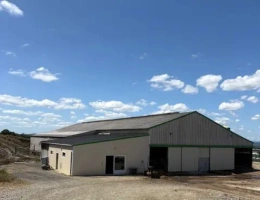
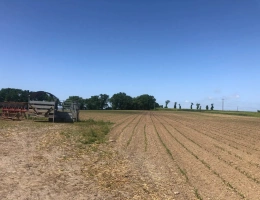
Looking for a dairy farm for sale in France? This page brings together the dairy holdings currently offered by retiring farmers, specialist rural agencies and notaries across the country: lowland and mountain dairy units, farms equipped with milking robots, holdings inside a cheese-appellation area, organic units and farms with on-site cheese making. Each listing states the herd, the milk reference, the livestock buildings and the forage area, so that you can compare offers before contacting the seller. It complements all the farms for sale in France on ma-propriete.fr.
Beyond the listings, you will find the benchmarks buyers usually lack when taking over a dairy farm: farmland and pasture prices region by region, the dairy basins where supply is densest, what to check in the milk contract and the buildings, and the steps of a successful farm takeover. Our white paper « Créer une exploitation agricole » (in French) walks through the full setting-up process, from financing to the agricultural qualification.
On a dairy farm, land often weighs more than the herd: permanent pasture, forage area, silage maize plots and grazing land accessible from the milking parlour determine feed self-sufficiency, and therefore profitability and sale price. Two sources help you place an offer. Our own statistics, computed from the sales recorded by the French tax administration (DVF, vineyards excluded), show the prices actually paid; the SAFER benchmark of land values (2025 figures, published in August 2026) gives the reference for vacant and tenanted land and pasture.
Across France, 14,328 sales of agricultural land were recorded in 2025, at a median price of €5,307/ha (average €6,059/ha; 80% of transactions between €2,500 and €10,537/ha). The SAFER benchmark puts vacant land and pasture at €6,460/ha (+0.9% year on year) and tenanted land at €5,350/ha (+2.5%), a discount of around 17% when a tenant farmer is in place, which is common in dairy farm takeovers.
| Region | Sales 2025 (DVF) | DVF median price (€/ha) | SAFER vacant land (€/ha) | 1-year change | SAFER tenanted land (€/ha) |
|---|---|---|---|---|---|
| Brittany | 1,297 | 5,500 | 6,540 | +0.3% | 5,180 |
| Pays de la Loire | 1,873 | 3,267 | 4,100 | +1.5% | 3,350 |
| Normandy | 1,442 | 8,305 | 9,610 | +2.9% | 8,410 |
| Hauts-de-France | 1,365 | 7,976 | 10,890 | -0.5% | 7,650 |
| Grand Est | 1,233 | 5,611 | 6,510 | -4.4% | 6,120 |
| Île-de-France | 214 | 7,465 | 8,190 | +5.7% | 7,000 |
| Centre-Val de Loire | 1,195 | 5,480 | 6,260 | -6.1% | 5,700 |
| Bourgogne-Franche-Comté | 1,303 | 2,773 | 2,740 | -6.2% | 2,750 |
| Nouvelle-Aquitaine | 2,103 | 4,538 | 5,770 | +5.5% | 3,900 |
| Occitanie | 995 | 7,015 | 7,260 | -0.3% | n/a |
| Auvergne-Rhône-Alpes | 1,230 | 3,887 | 5,100 | +4.9% | 4,140 |
| Provence-Alpes-Côte d'Azur* | 59 | 13,518 | 12,260 | +2.8% | n/a |
| Corsica* | 19 | 5,012 | — | — | n/a |
The gap between neighbouring dairy regions is striking: Pays de la Loire (€4,100/ha on the benchmark) and Normandy (€9,610/ha) are more than two to one apart, with Brittany close to the national average. The mountain areas producing protected-designation cheeses, in Auvergne-Rhône-Alpes and Bourgogne-Franche-Comté, show the cheapest land, but value there lies in production rights and buildings. See the full analysis, department by department, on our agricultural land price observatory, estimate your plots with the land value tool, and work out notary fees and borrowing capacity with our financial calculators. * Fewer than 100 sales: indicative value. n/a: no tenanted-land benchmark published for this region.
A dairy holding is read first through its buildings. The cubicle or straw-yard housing, the herringbone or rapid-exit parlour, or the milking robot that increasingly replaces the parlour on 60- to 120-cow units, the bulk tank, the slurry store and manure pad, the silage clamps and forage storage form a whole whose condition and compliance account for much of the price. A farm recently brought up to environmental standards, or with a new shed, sells well above an equivalent holding with ageing facilities.
The herd is the second item: cows in milk, replacement heifers, dominant breed (Holstein in the lowlands, Montbéliarde and Normande in cheese areas), yield level and herd health status. It is usually valued separately from buildings and land, as are machinery and forage stocks. Farms that process milk on site or sell direct add a cheese dairy and a customer base, valued in their own right.
Western France holds most of the dairy farms for sale: Brittany, Pays de la Loire and Normandy form the country's leading milk-producing basin, with well-equipped lowland units, numerous dairies and cooperatives, and an active takeover market. Grand Est and Hauts-de-France offer farms frequently combined with arable cropping, on dearer land but with consolidated parcels.
In the mountains the offer changes in nature: appellation herds in Franche-Comté (Comté, Morbier), in Savoie and Haute-Savoie (Beaufort, Reblochon, Abondance) or in the Massif Central (Cantal, Saint-Nectaire, Salers), where the price of a dairy farm depends as much on the right to produce under the appellation and on the cooperative cheese dairy as on the hectares. The South-West and Centre-Val de Loire have fewer, often mixed, holdings at more accessible land prices.
The first is the milk contract: since milk quotas ended in 2015, the collected volume rests on a contract with the dairy or cooperative, and its transfer to the buyer is never automatic. Check the contracted volume, the price formula, the remaining term and the transfer conditions before committing. Then come the farm's regulatory status (declaration or registration under the ICPE environmental regime depending on herd size), the manure-spreading plan, the compliance of effluent storage and the transfer of basic payment entitlements.
On land, a large share of the area is frequently rented: the rural lease continues with the new farmer, but the landlord's agreement is required, and the operation remains subject to the structures control and to SAFER's pre-emption right. Finally, the buyer must hold the agricultural professional qualification to receive setting-up aid, and should have the buildings, herd and machinery valued separately rather than accept a single global price.
The sale of a dairy farm is rarely a single transaction. Most often the seller sells the buildings and the land he owns, transfers the herd and machinery, and passes on the leases on rented land; when the farm is run as a company (GAEC, EARL), the purchase covers shares, with different tax treatment and warranties, explained in our article selling the assets or the shares of a farming company. Gradual takeovers, where the buyer first joins as a partner, are common in the dairy sector.
For the buyer, the process follows a set order: define the project and its financing, confirm the agricultural qualification, analyse the accounts and the milk contract, then secure the land before signing. Our complete guide to buying a farm and the article finding a farm to set up in agriculture detail each step. For the seller, the complete guide to selling a farm helps prepare the handover, set a consistent price and choose between sale, letting and share transfer.
There is no reliable average: a 50-cow mountain unit with old buildings and rented land and a 120-cow Breton farm with a milking robot and 80 owned hectares have nothing in common. The price is built item by item: land at the regional farmland price, buildings according to condition and compliance, herd and machinery at market value, plus the value of the milk contract and, in appellation areas, of the production right.
Yes. There is no nationality restriction, and EU and non-EU buyers purchase French farms every year. The conditions are the same for everyone: obtain the agricultural professional qualification or partner with a qualified farmer, and pass the structures control, which may favour a subsidised new entrant. Without a French agricultural diploma, training and a mentoring period are often required; setting-up aid is reserved for candidates who meet these conditions.
The contract binds the farmer and his dairy; it does not automatically follow the farm. Some cooperatives accept the transfer of the volume to a buyer who joins as a member, others renegotiate. The point must be settled in writing before the sale, because a farm without a milk outlet loses most of its operating value.
Every sale of agricultural property is notified to SAFER, the rural land agency, which may exercise its pre-emption right on the land, with exceptions (sale to a family member or to the sitting tenant, for instance). It can also assist the handover by seeking a candidate. The structures control rules apply in parallel to enlargement and to new entrants.
Livestock buildings are valued on rebuilding cost, age and compliance, rarely at new-build price; the herd is valued animal by animal according to age, lactation number and genetics; machinery at second-hand quotation. A rural chartered surveyor or a farm accounting centre can establish these values before negotiation.
The dairy farms for sale on ma-propriete.fr come from private farmers, rural estate agencies and notaries' offices. Filter by region, area, price or herd size, and set up an e-mail alert to be told of every new dairy holding put on the market. Selling your farm? Post your listing to reach the buyers and investors who use France's leading rural property portal.