A hunting property for sale in France is judged first on its ground: the size of the block, how undisturbed the woods are, the water on it and the game it holds matter more than the number of bedrooms in the lodge. ma-propriete.fr brings together hunting estates offered by private owners, specialist agents and notaires: large Sologne estates with a hunting lodge and ponds, woodland shoots without buildings, marshes with a wildfowling hide, wood-pigeon hides in the south-west and mountain ground. This section belongs to our category of woodland, forests and forest estates for sale, since most of these properties are woods first and foremost.
The price of a shoot cannot be read like the price of a house: it adds up the value of the woodland, the ponds, the buildings and the shooting infrastructure, then depends on rules that buyers sometimes discover too late, from communal hunting associations to fencing compliance. Below you will find forest prices by size of holding and the official big game bags, followed by France’s main hunting regions, the kinds of property on offer and the checks to make before you sign. For Sologne in particular, our article on the case for buying a forest in Sologne introduces its landscapes and its market.
The price of a hunting property adds up the value of the woodland, ponds, buildings and shooting facilities: there is no single price for a hunting estate. For the wooded land, our forest price observatory puts the median price of a hectare of forest in France at €4,936/ha in 2025. Above all, the price per hectare rises with size: large ring-fenced blocks, sought after by hunters, sell for more per hectare than medium-sized woods.
| Area sold (France, 2020-2025) | Share of sales | Median price | Average price |
|---|---|---|---|
| 10 to 20 ha | 9.2% | €4,010/ha | €5,365/ha |
| 20 to 50 ha | 5.4% | €5,330/ha | €6,445/ha |
| 50 to 100 ha | 1.7% | €6,810/ha | €7,537/ha |
| Over 100 ha | 0.9% | €7,361/ha | €8,016/ha |
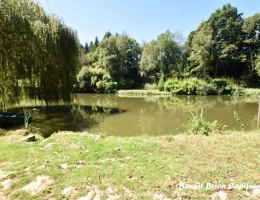
Ponds, which make the value of many shoots in Sologne, the Brenne or the Dombes, trade at a very different level: a median of €25,235/ha in 2025 for ponds sold without buildings. On the listings side, 18 hunting properties are offered on ma-propriete.fr as of 2 October 2026, mainly in Centre-Val de Loire (12), Occitanie (2), Nouvelle-Aquitaine (1), at a median asking price of €888,000 for a median size of about 68 ha. These asking prices cover complete estates, often with a house, ponds and facilities.
Source: DVF (French tax authority), processed by ma-propriete.fr; forests of 1 ha or more, cadastral type woodland; ponds without buildings of at least 2,000 m²; July 2020 to December 2025; Moselle, Bas-Rhin and Haut-Rhin are not covered by DVF. Listings recorded on ma-propriete.fr on 2 October 2026.
The game bag records published by the French Biodiversity Agency (OFB) measure hunting pressure on big game. In the 2024-2025 season, 880,102 wild boar, 569,433 roe deer and 90,386 red deer were taken in France. Red deer culls have risen markedly since 2021-2022, while roe deer culls are falling. The departments where most red deer are taken are, in order: Indre-et-Loire (3,847), Cantal (3,720), Vienne (2,917), Dordogne (2,876), Loir-et-Cher (2,840).
| Species | 2021-2022 season | 2024-2025 season | Change |
|---|---|---|---|
| Red deer | 75,397 | 90,386 | +20% |
| Roe deer | 602,866 | 569,433 | −6% |
| Wild boar | 842,802 | 880,102 | +4% |
| Fallow deer | 1,523 | 1,259 | −17% |
| Chamois | 12,206 | 12,174 | −0% |
| Pyrenean chamois | 2,695 | 2,762 | +2% |
| Mouflon | 2,512 | 2,420 | −4% |
Source: OFB, wild ungulates network, departmental big game bags (total culls, data.gouv.fr).
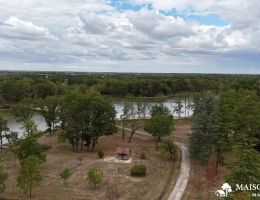
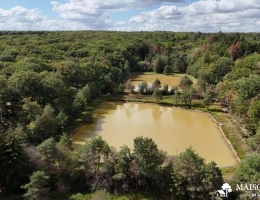
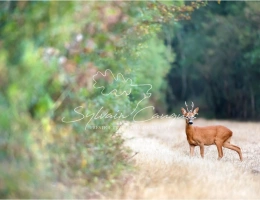
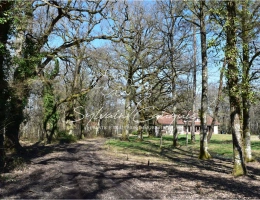
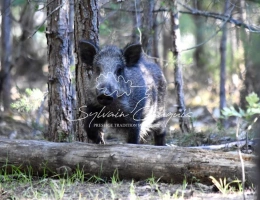
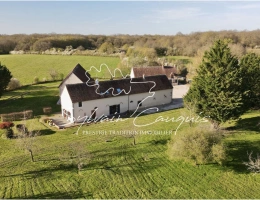
This is the flagship property: dozens or hundreds of hectares of woodland, heath and meadow in a single block, often dotted with ponds, with a hunting lodge (the French “rendez-vous de chasse”), a keeper’s cottage and kennels. Red deer, wild boar and roe deer are taken in driven hunts or stalked from high seats linked by rides. A compact block that no road cuts through is worth more than a patchwork of plots. The largest, with a château or a period house, also appear among our prestige forest estates.
More affordable, a woodland shoot is a hunting estate without a house, from a few hectares to a few dozen, bought by a hunter or by a small syndicate keen to secure its shoot. In open country, hunting land usually combines arable fields, hedges and copses suited to small game such as partridge, pheasant and hare. Access, the shape of the plot and any link to the communal hunting association then count for more than the acreage.
A marsh plot with its pond and fixed wildfowling hide, known as a “hutte” in Picardy and the Nord, a “gabion” in Normandy and a “tonne” in Charente-Maritime and the south-west, sells to duck and goose hunters, often on a modest area. In the Landes and neighbouring departments, the “palombière”, a hide perched in the oaks or set on the ground from which hunters wait for migrating wood pigeons in autumn, is sold together with its wood. Value then depends less on the hectare than on the rights attached to the hide.
A fully fenced shoot, sometimes called a hunting park, long allowed hunting outside the ordinary rules. That is no longer the case: since the act of 2 February 2023, enclosed ground is subject to open seasons and the cull plan, and any fence in a natural or forest zone must keep a 30 cm gap beneath the mesh, top out at 1.20 m and not block the movement of wild animals; fencing erected since 1993 has a grace period running to 1 January 2027. Have the cost of compliance estimated before making any offer: our article on the French fencing act and its exemptions covers the special cases.
Sologne, shared between Loir-et-Cher, Loiret and Cher, offers the widest choice of large estates: oak woods, Scots pine, heather heath and ponds make up big game country between Romorantin-Lanthenay, Salbris and La Ferté-Saint-Aubin. See our hunting estates for sale in Centre-Val de Loire, including the Loir-et-Cher shoots on the market. In Indre, the Brenne mixes ponds, heath and woodland within a regional nature park, where driven big game and evening duck flights go hand in hand: see our shoots for sale in Indre. In Ain, between Bourg-en-Bresse and Lyon, the Dombes alternates ponds in water with ponds drained and cropped: this is wildfowl country, covered on our page of hunting estates in Ain.
The maritime pine forest of the Landes de Gascogne, spread over Landes, Gironde and Lot-et-Garonne, is hunted mainly for roe deer and wild boar. What sets it apart is the wood pigeon (“palombe”): every autumn, above all in October, the migration brings the palombières to life as far as Gers and Pyrénées-Atlantiques. The local organisation of hunting matters as much as the property, because communal hunting associations cover a large part of Landes and Gironde. Browse our hunting properties for sale in Landes.
Across Aube, Marne and Haute-Marne, the Champagne humide combines large oak forests on clay, such as the forests of Orient, Le Temple and Le Der, with old ponds and the reservoir lakes of the Seine, the Aube and the Marne. Red deer and wild boar are plentiful: outside the national hunting reserve of Lac du Der, a sizeable wooded hunting ground remains in demand. The Argonne and the Ardennes extend this big game country: see our hunting estates for sale in Grand Est and, for the Aube side, our hunting land in Aube.
Shooting from a “hutte” is a tradition of the Baie de Somme, the marshes of the Somme valley and the Audomarois marsh around Saint-Omer: duck and geese are shot at night from a hide facing a pond. On the Atlantic side, the marshes of Rochefort and Brouage and the Gironde estuary offer plots with a “tonne”; in Normandy, the Cotentin and Bessin marshes are gabion country. Where night shooting is permitted, it is only allowed from a hide that existed on 1 January 2000 and was declared: ask for the official receipt and check that it can pass into your name. See our wildfowling hides and marshes for sale in Somme and our hunting properties in Charente-Maritime.
In the Alps, the Jura and the Vosges, chamois are stalked on the slopes; in the Pyrenees the quarry is the isard, its close relative. The mouflon, introduced in the twentieth century to several ranges such as the Caroux in Hérault or the Sancy, completes the picture. Large private estates are rare here, and hunting is often organised through communal associations, widespread in Savoie, Haute-Savoie and Ariège and compulsory in Isère and Hautes-Alpes; above the tree line, the area needed to withdraw your land from them is much larger than in the lowlands. Browse our hunting ground for sale in Savoie or our hunting properties in Ariège.
In principle, hunting rights belong to the landowner, who may exercise, assign or lease them. However, the loi Verdeille of 1964 created communal hunting associations (ACCA), compulsory in around thirty departments and present elsewhere wherever a commune chose to set one up. Land within their territory is pooled into the association unless an owner with at least 20 ha in a single block opts out; the threshold is lower for marshes and ponds, and higher in the mountains and in some departments. Withdrawal can only be requested at set intervals; where the seller opted out on grounds of conscience, the buyer has six months from the purchase to maintain that opt-out. Check with the town hall and the departmental hunting federation, and read any current hunting leases.
Red deer, roe deer, fallow deer, chamois, isard and mouflon are subject to the cull plan (“plan de chasse”): each season an allocation sets how many animals may be taken, each carcass carrying a tag. Ask for recent seasons’ actual culls: they say more than any description. Depending on the department, wild boar fall under the cull plan or under the departmental game management scheme, which also regulates supplementary feeding. Big game damage to crops is compensated by the departmental hunting federations, but whoever holds the hunting rights and lets numbers grow unchecked may have to bear part of the cost: with the rise in red deer shown above, raise the subject with the seller.
Any fencing on the land must be dated, because compliance will fall to the new owner; the financial stakes are highest in Sologne, where fences had multiplied. Ponds also come under water law, and many marshes are Natura 2000 sites or protected wetlands, where drainage and dredging are regulated. If water is central to your plans, see also our lakes and ponds for sale.
In Bas-Rhin, Haut-Rhin and Moselle, hunting rights are administered by the commune on the owners’ behalf: the commune leases the shooting over its whole territory, and owners in principle receive their share of the rent unless it is waived in favour of the commune. An owner can only reserve the shooting in specific cases, notably on a single block of at least 25 ha or on lakes and ponds of at least 5 ha. Below that, buying a wood means buying ground where others hunt; see our hunting properties for sale in Bas-Rhin.
There is no single price. The woodland is valued against the benchmarks in the table above, where each hectare costs more in large single blocks; ponds, buildings, facilities and the quality of the game come on top. Asking prices in our listings cover complete estates. Budget for running costs too: keepering, upkeep of rides and high seats, game crops, insurance and land tax.
As a rule, yes, but a current lease, a communal hunting association or, in Alsace-Moselle, the communal lease can limit their use: have the position of each plot set out in the preliminary contract.
France places no restriction on foreign buyers of rural land, and the purchase follows the same steps as for a French buyer, through a notaire. To hunt, however, you need a licence valid in France: a French hunting permit validated for the season or, for some non-resident hunters, a temporary authorisation based on their own country’s licence. Check the conditions with the departmental hunting federation before the season opens.
Rarely. Woodland is almost always zoned as natural or forest land, where new buildings are tightly controlled, and even a light shelter may need consent. Existing, lawfully built buildings therefore weigh heavily in an estate’s value; our article on what you may build in a French forest sets out the rules.
On ma-propriete.fr, hunting estate listings come from owners selling direct, rural agents and notaires’ offices; filter them by region, size or budget, and set up an email alert to hear as soon as a shoot matching your criteria goes online. If you are selling, describe what gives your shoot its value: size of the block, ponds, buildings, cull plan and fencing compliance. Show only the general area if discretion matters, and ask to be put in touch with a professional to value or negotiate.