
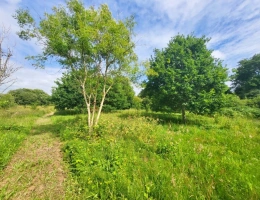
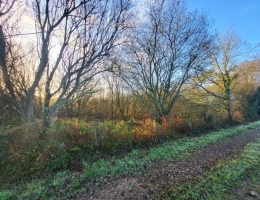

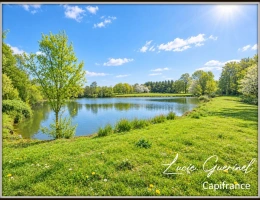

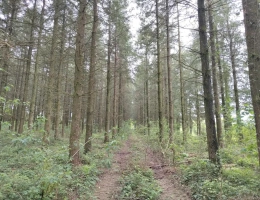

If you are looking for hunting property for sale in Brittany, start well away from the coast. The centre of the peninsula, from Quénécan and Loudéac across to Lanouée and Paimpont, holds the large woods where red deer live; around them, hedgerow country with its wooded banks and copses makes the region roe deer, wild boar and, above all, woodcock ground, as the mild Atlantic climate keeps the soil largely frost-free through the winter. On the coast, bays, marshes and salt meadows draw wildfowl. This page gathers the hunting estates for sale in Brittany, from a family hunting wood to a forest block with a lodge, posted by private owners, agencies and notarial offices.
Below this text, a data panel gives the price of woodland and ponds sold in Brittany and the red deer, roe deer and wild boar culls in each department. It is followed by a department-by-department look at the shooting country, then the checks to make before buying here: the role of communal hunting associations (ACCA), widespread in Ille-et-Vilaine, cull plans, wild boar damage to maize and fence compliance.
The price of a hunting property adds up the value of the woodland, ponds, buildings and facilities. For wooded land, the ma-propriete.fr forest price observatory, built from DVF data, gives a median of €5,208/ha for forests sold in Brittany in 2025 (222 sales), against €4,936/ha nationally, and €4,822/ha over 2020-2025 (1,298 sales). Nationally, the price per hectare rises with size: the large blocks sought by hunters sell for more per hectare than medium-sized woods.
| Size of forest sold (France, 2020-2025) | Median price | Number of sales |
|---|---|---|
| 10 to 20 ha | €4,010/ha | 3,161 |
| 20 to 50 ha | €5,330/ha | 1,850 |
| 50 to 100 ha | €6,810/ha | 581 |
| Over 100 ha | €7,361/ha | 320 |
Ponds, which make the value of many shoots, trade at a very different level: a median of €32,902/ha for the 109 ponds sold without buildings in Brittany between 2020 and 2025.
On the listings side, 18 hunting properties are offered on ma-propriete.fr across France as of 2 October 2026, none in Brittany at that date. Their median asking price is €888,000 for a median size of about 68 ha. These are advertised prices for whole properties, sometimes with a house or a pond, not recorded sale prices per hectare like those in the DVF database.
Source: DVF (French tax authority), processed by ma-propriete.fr; forests of 1 ha or more, cadastral type woodland; ponds without buildings of at least 2,000 m²; July 2020 to December 2025; Moselle, Bas-Rhin and Haut-Rhin are not covered by DVF. Listings recorded on ma-propriete.fr on 2 October 2026.
According to the game bag records of the French Biodiversity Agency (OFB), 775 red deer, 28,265 roe deer and 24,453 wild boar were taken in Brittany in the 2024-2025 season. Compared with 2021-2022, culls changed by +12% for red deer, +3% for roe deer, +84% for wild boar.
| Department | Red deer | Roe deer | Wild boar |
|---|---|---|---|
| Côtes-d’Armor (22) | 379 | 6,972 | 5,800 |
| Morbihan (56) | 293 | 9,597 | 6,225 |
| Ille-et-Vilaine (35) | 75 | 7,363 | 7,490 |
| Finistère (29) | 28 | 4,333 | 4,938 |
| Brittany | 775 | 28,265 | 24,453 |
2024-2025 season. Source: OFB, wild ungulates network, departmental big game bags (total culls, data.gouv.fr).
Côtes-d’Armor is the Breton department where the most red deer are culled. Big game follows a line of forests through the south and east of the department: the Loudéac forest, La Hardouinais north of Merdrignac and, towards Lamballe, the state forest of La Hunaudaye. Between these blocks, private woods of a few dozen hectares change hands with roe deer and boar shooting, sometimes red deer too when the cull plan allocates them tags. Further north, on the Trégor and Goëlo plateau, close-knit hedgerow country is mostly hunted for woodcock and small game. Listings for the department are on our page of shooting grounds in Côtes-d’Armor.
In Morbihan, the Lanouée forest, a private woodland that ranks among the largest in Brittany, keeps up a tradition of hunting with hounds recorded since the 19th century. To the north, the Quénécan massif, south of Lake Guerlédan, also holds red deer. Further south, the long ridge of the Landes de Lanvaux, running from the wooded Camors area towards Redon, carries pine plantations established since the 19th century, broken up by farmland in the valleys; roe deer and boar make up most of the game. On the coast, the Gulf of Morbihan, a regional nature park since 2014 that includes a game and wildlife reserve, hosts brent geese, ducks and waders in winter. See our hunting estates in Morbihan.
In Ille-et-Vilaine, the Paimpont forest, which tradition identifies with Brocéliande, remains mostly in private hands: red deer roar there in autumn, and the large estates that make it up combine timber growing with driven shooting. The north-east is taken up by the state forests of Rennes, Liffré and Fougères, where shooting is let by the ONF, the body that manages state forests; private woods on their fringes gain from game moving in and out. To the north, the Dol marshes and the salt meadows of the Bay of Mont-Saint-Michel, one of France’s main wintering grounds for waterbirds, draw ducks and waders. Around Redon, the Vilaine marshes, which the department shares with Morbihan and Loire-Atlantique, form another wildfowl area. Properties on offer appear on our page of hunting properties in Ille-et-Vilaine.
Finistère has the fewest red deer in Brittany, and properties there seldom take the form of a large estate. The larger natural areas come down to the heaths and peat bogs of the Monts d’Arrée, in the heart of the Armorique regional nature park, and a few state forests: Le Cranou, the largest in the department and badly hit by Storm Ciarán in November 2023, Huelgoat, and Carnoët near Quimperlé. The rest of the department is a patchwork of small fields, wooded valleys and coastal heath, where the quarry is roe deer, wild boar, whose culls have risen markedly in recent seasons, and woodcock, which Breton hunters follow closely every winter. A buyer is more likely to find a wood of a few hectares, a former farm with its woodland or a wooded valley, topped up if need be by renting neighbouring shooting; the page of shooting grounds in Finistère lists the offers.
Hunting rights are the first thing to clarify. Communal hunting associations (ACCA) cover much of Ille-et-Vilaine: land below the opt-out threshold, set there at 20 ha in a single block, stays hunted by the association, which you may ask to join. In Morbihan and Côtes-d’Armor, several communes have set one up of their own accord. Wherever you buy, ask the town hall about the exact status of the plots before signing. On the foreshore and other public maritime land, the State leases the shooting, often to maritime hunting associations, and it does not come with a waterside plot.
Next come the cull plan (plan de chasse), which sets each year’s red and roe deer allocations for each ground, and wild boar damage: in a livestock region where fodder maize covers large areas, a ground where boar are under-hunted is quickly blamed for losses on neighbouring crops. Finally, under the law of 2 February 2023, wire around a wood in a natural area must start 30 cm off the ground and rise no higher than 1.20 m; for wire erected from 1993 onwards, the deadline is 1 January 2027. Our guide to the fencing rules for natural areas covers the exemptions and timetable.
Hunting properties rarely come on the market in Brittany: on ma-propriete.fr they are placed by owners, agencies and notaires, and an email alert lets you know the moment a new shoot goes online. Size and price filters make it easy to compare a hedgerow wood with a forest estate; if you are selling, post your listing. If the timber matters as much as the game, also browse the Breton woods and forests for sale on the site.