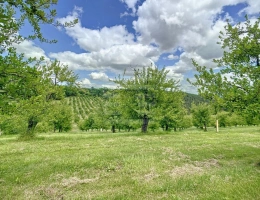
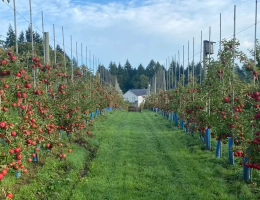
Looking for an orchard for sale in France? This page brings together the fruit-growing holdings currently offered by growers preparing their handover, rural estate agencies and notaries: apple and pear orchards, cherry, plum, apricot and peach plantings, walnut groves, kiwi plots, fruit farms selling direct and organically certified units. Each listing states the species and varieties planted, the age of the trees, the training system, the irrigated area, the protective netting in place and the harvest and packing buildings. It complements all the farms for sale in France on ma-propriete.fr.
Beyond the listings, you will find the benchmarks buyers usually lack when taking over a fruit farm: farmland prices region by region, the growing basins where supply is densest, what to check on the planting, the water supply and the equipment, and the steps of a takeover that goes through. Our white paper « Créer une exploitation agricole » (in French) covers the route from financing to the agricultural qualification.
On an orchard for sale in France, land tells only part of the price story, yet it remains its base: the value of the planting, of the trellising and of the irrigation sits on top of it, and depreciates as the trees age. Knowing the regional price of farmland lets you separate what belongs to the soil from what belongs to the orchard itself, and judge what the plot will be worth once replanting has been done. Two sources place an offer: our own statistics, computed from the sales recorded by the French tax administration (DVF, vineyards excluded), show the prices actually paid; the SAFER benchmark of land values gives the reference for vacant and tenanted land and pasture.
Across France, 14,328 sales of agricultural land were recorded in 2025, at a median price of €5,307/ha (average €6,059/ha; 80% of transactions between €2,500 and €10,537/ha). The SAFER benchmark of land values puts vacant land and pasture at €6,460/ha (+0.9% year on year) and tenanted land at €5,350/ha (+2.5%), an average discount of around 17% where a tenant farmer is in place.
| Region | Sales 2025 (DVF) | DVF median price (€/ha) | SAFER vacant land (€/ha) | 1-year change | SAFER tenanted land (€/ha) |
|---|---|---|---|---|---|
| Brittany | 1,297 | 5,500 | 6,540 | +0.3% | 5,180 |
| Pays de la Loire | 1,873 | 3,267 | 4,100 | +1.5% | 3,350 |
| Normandy | 1,442 | 8,305 | 9,610 | +2.9% | 8,410 |
| Hauts-de-France | 1,365 | 7,976 | 10,890 | -0.5% | 7,650 |
| Grand Est | 1,233 | 5,611 | 6,510 | -4.4% | 6,120 |
| Île-de-France | 214 | 7,465 | 8,190 | +5.7% | 7,000 |
| Centre-Val de Loire | 1,195 | 5,480 | 6,260 | -6.1% | 5,700 |
| Bourgogne-Franche-Comté | 1,303 | 2,773 | 2,740 | -6.2% | 2,750 |
| Nouvelle-Aquitaine | 2,103 | 4,538 | 5,770 | +5.5% | 3,900 |
| Occitanie | 995 | 7,015 | 7,260 | -0.3% | n/a |
| Auvergne-Rhône-Alpes | 1,230 | 3,887 | 5,100 | +4.9% | 4,140 |
| Provence-Alpes-Côte d'Azur* | 59 | 13,518 | 12,260 | +2.8% | n/a |
| Corsica* | 19 | 5,012 | — | — | n/a |
Fruit growing is concentrated in a few territories: the Rhône valley and Provence for stone fruit, the Val de Loire, the Limousin and the South-West for apples, plums and walnuts, Alsace for more specialised production. Differences in land prices between these regions matter less here than on an arable farm: in an orchard, value rests mainly on the condition of the planting, on secure access to water, on hail protection and on packing facilities. From one region to the next, the benchmark varies fourfold, from €2,740/ha in Bourgogne-Franche-Comté to €10,890/ha in Hauts-de-France. See the full analysis, department by department, on our agricultural land price observatory, estimate your plots with the land value tool, and work out notary fees and borrowing capacity with our financial calculators. * Fewer than 100 recorded sales: indicative value. n/a: no tenanted-land benchmark published for this region.
An orchard is bought first for its planting. The species and varieties in place, the rootstock, the planting density, the training system and above all the age of the trees set the cropping years still to come: a young, well-kept plot sells far above an orchard at the end of its cycle, which will have to be grubbed up and replanted before any harvest can be expected. The trellising, the drip irrigation, the hail netting and insect-proof netting, and the frost-protection equipment count as much as the hectares: they secure the crop and are expensive to rebuild from scratch.
Then comes everything downstream. An apple orchard or a stone-fruit unit usually includes a harvest shed, a packing station with grading lines, cold stores, sometimes under controlled atmosphere, along with bins and handling equipment. These facilities decide whether the crop can be sold over a long season or must leave the farm at the peak. Housing for the seasonal workforce, without which picking simply does not happen, is an item often overlooked and yet decisive at handover.
A fruit farm on the market usually sits in one of a few well-defined basins. The Rhône valley and Provence dominate stone fruit, peaches, apricots and cherries, with a dense packing and shipping industry and holdings of widely varying size. The Val de Loire and the Limousin remain apple country, backed by producer organisations and quality labels, including protected designations for some products. The South-West, from Lot-et-Garonne to Tarn-et-Garonne, combines plums, apples, walnuts and kiwis, mostly with irrigation and relatively young plantings.
Elsewhere, fruit growing is more scattered: Alsace and Lorraine for cherries, mirabelles and quetsches, Corsica and the Mediterranean rim for warm-climate crops, Normandy and Brittany for cider apples, grown as standard trees or in bush orchards. In those areas a fruit-growing holding is often part of a mixed farm rather than a specialised business, which changes what a takeover involves.
Water comes first. Many orchards only work because they are irrigated: check where the water comes from, borehole, canal or collective network, whether the abstraction is authorised or declared, what volume is granted and how reliable it is in a dry year, because a restriction threatens both the crop and the trees themselves. Then comes the health of the planting, which should be inspected before purchase: decline, virus diseases, established pests, root quality. The chemical store and the spray records must be compliant.
Legally, the sale remains subject to SAFER's pre-emption right and to the structures control, and rented land passes on through the rural lease with the landlord's agreement. Check too the membership of a producer organisation or cooperative, which does not automatically follow the property, what happens to marketing contracts, and, for an organic unit, the remaining conversion period with the certifying body. Employing seasonal workers finally carries precise obligations on accommodation and declaration.
Selling an orchard takes several forms. Where the grower owns the land, the sale covers the land, the planting, the buildings and the machinery, each valued separately; where the business is run as a company (EARL, SCEA, GAEC), the deal is a transfer of shares, which keeps leases, contracts and memberships in the company's name but also passes on its liabilities. Our article selling the assets or the shares of a farming company compares the two structures. Some sellers keep the land and let it to the buyer, which lightens the purchase but leaves the planting to finance.
For the buyer, taking over a fruit-growing holding follows a set order: define the project and its financing, obtain the agricultural qualification, study the accounts, the yields plot by plot and the orchard replanting plan, then secure the water and the land before signing. Our complete guide to buying a farm details each step. For the seller, the handover is prepared well in advance, with leases regularised and plantings documented: the complete guide to selling a farm helps set a consistent price and organise the transaction.
There is no useful average: everything depends on the species, the age of the planting, whether irrigation and netting are in place, and what the seller hands over with the land. The valuation is built item by item: land at the regional farmland price, the planting according to the cropping years still ahead, irrigation and protective structures at residual value, the packing station and cold stores according to condition, machinery at second-hand quotation.
Yes, and there is no nationality restriction either. Nothing stops a private buyer from acquiring a planted plot for family or leisure use, as our article buying farmland without being a farmer explains. The sale is still notified to SAFER, the rural land agency, which may prefer a farming candidate, especially on a plot useful to a neighbouring holding. Selling the fruit commercially, on the other hand, requires registering the activity, and public support stays reserved for qualifying farmers.
Every sale of agricultural land and buildings is notified to SAFER by the notary, a planted orchard included. It may exercise its pre-emption right to set up a new grower or consolidate a neighbouring holding, with exceptions such as a sale to the sitting tenant or to a close relative. It can also assist a handover by running a call for candidates. The structures control rules govern both setting up and enlarging a holding.
The planting is valued separately from the soil, on the cost of re-establishing an equivalent orchard less what has already been used up: species and variety, rootstock, density, health status and above all the cropping years left before grubbing up. An orchard in full production carries a high value, an ageing plot very little, and none at all where it has to be removed. Have each item priced by a rural surveyor before negotiations open.
Nothing follows the orchard automatically. Abstraction permits and allocated volumes have to be transferred or applied for again, depending on the regime and the type of resource. Membership of a producer organisation or cooperative, marketing contracts and organic certification are renegotiated with each body, which may or may not accept the buyer. Settle these points in writing before signing: an orchard without water and without an outlet loses most of its operating value.
The orchards and fruit farms for sale on ma-propriete.fr come from private growers, rural estate agencies and notaries' offices. Filter by region, area, price or type of production, and set up an e-mail alert to be told of every new fruit-growing holding put on the market. Selling your orchard? Post your listing so that buyers following this market can find it.