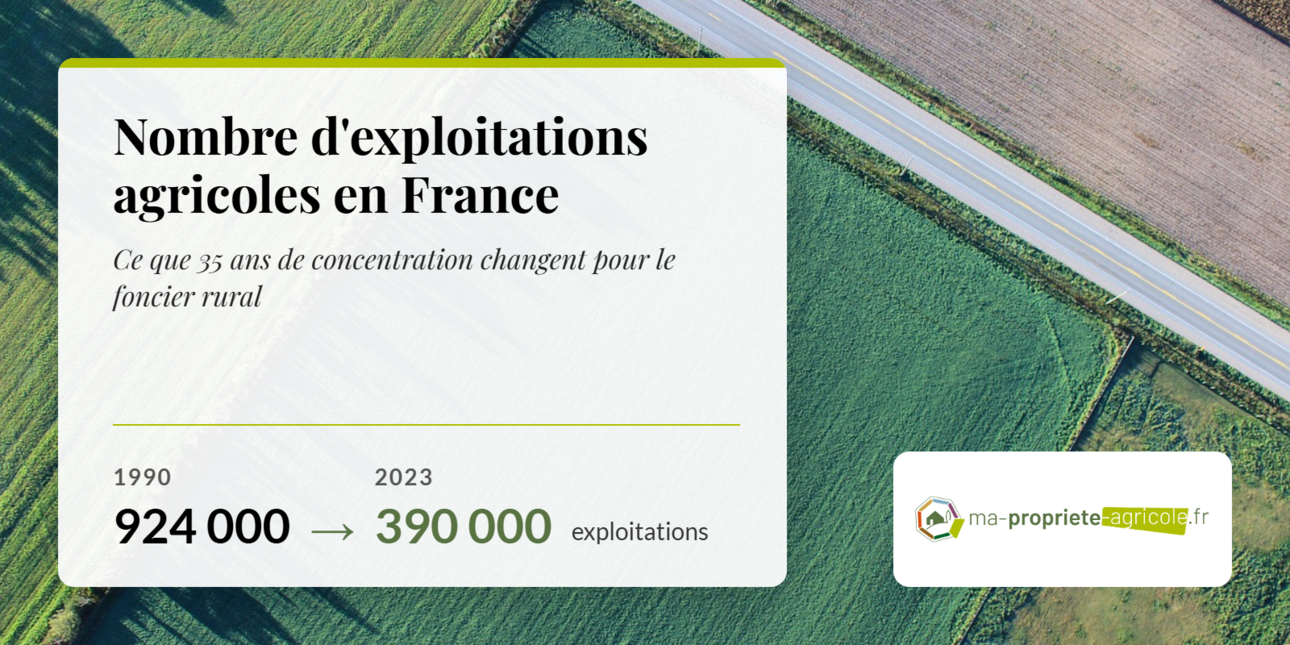
The number of farms in France has fallen by a factor of 2.6 in just over thirty years: 924,000 in 1990, 349,600 in 2023 in mainland France. Over the same period, the agricultural sector began investing far more than the rest of the economy, vineyards lost 181,000 hectares and the price of farm buildings rose by almost 82%.
These figures come from Insee Première No. 2133, published on 28 October 2026 by Vincent Hecquet, Félix Lucas and Alexandre Wukovits. The study traces agricultural investment from 1990 to 2024 using the agricultural accounts (provisional accounts for 2025). It describes a farming sector with fewer farms, more mechanised and more capital-intensive, and this underlying trend weighs directly on the market for farmland, vineyards and farmhouses. Here are the key takeaways for anyone buying or selling a rural property.
The decline in the number of farms is the common thread running through the whole study. Between 1990 and 2023, mainland France lost almost 575,000 farms, or 62% of the initial total. Employment followed: the agricultural sector accounted for 696,100 full-time equivalent (FTE) jobs in 2024, compared with around 1.42 million in 1990 (−51%).
The decline has not affected everyone equally. Non-salaried workers (farmers and family helpers) fell by 66%, while salaried employment dropped by only 9%. As a result, employees now account for 44% of agricultural jobs, compared with 20% in 1990. The family farm, run by a couple and their children, is giving way to larger structures that employ staff.
|
Indicator
|
Start of period
|
End of period
|
Change
|
|
Farms (1990 / 2023)
|
924,000
|
349,600
|
−62%
|
|
Agricultural employment in FTE (1990 / 2024)
|
1,418,600
|
696,100
|
−51%
|
|
Vineyard area (1990 / 2024)
|
956,000 ha
|
775,000 ha
|
−18.9%
|
|
Orchard area (1990 / 2024)
|
232,000 ha
|
196,000 ha
|
−15%
|
|
Cow herd (avg. 1990-1994 / 2020-2024)
|
8.6 million
|
7.0 million
|
−19%
|
|
Investment rate (avg. 1990-1994 / 2020-2024)
|
23.4%
|
37.5%
|
+14.1 points
|
Thirty-five years of agricultural change in figures — Source: Insee, agricultural accounts, Insee Première No. 2133 (October 2026)
What this means for land. Every farm that disappears frees up land, and that land is mostly taken over by neighbouring farmers who are expanding. For a buyer from outside the farming world, this means direct competition with farmers seeking to consolidate their holdings, whom the Safer (the regional land development agency) may favour as part of its remit. Before making any offer on farmland, it is worth finding out whether you can buy farmland without being a farmer and understanding the scope of Safer partial pre-emption since the 2026 law.
The investment rate compares purchases of durable goods (machinery, buildings, plantations, breeding livestock) with the value added produced. For the agricultural sector, it rose from 23.4% in 1990-1994 to 37.5% in 2020-2024. Over the same period, non-financial corporations went only from 19.0% to 21.7%. Agriculture therefore now invests almost 16 points more than the rest of the economy.
This increase is explained more by prices than by volumes. In volume terms, total agricultural investment grew by only 16.5% over thirty years; in price terms, it rose by 62.3%. Yet the price of agricultural output rose by only 39.4% over the same period. Equipment is becoming more expensive faster than what farmers sell: this scissor effect squeezes farms' ability to repay debt, and therefore what a farmer can afford to spend on buying or renting land.
|
Investment item
|
Share in 2020-2024
|
Change in volume
|
Change in price
|
|
Specialised machinery
|
41.0%
|
+49.8%
|
+51.5%
|
|
Tractors and other vehicles
|
23.5%
|
+20.1%
|
+61.4%
|
|
Farm buildings
|
20.8%
|
−6.1%
|
+81.9%
|
|
Plantations (vineyards, orchards)
|
5.8%
|
−27.8%
|
+105.8%
|
|
Ownership transfer costs (land)
|
4.3%
|
+30.8%
|
+128.5%
|
|
Breeding livestock and draught animals
|
2.7%
|
−48.8%
|
+92.4%
|
|
IT equipment
|
0.7%
|
+2,151.8%
|
−83.6%
|
|
Total agricultural investment
|
100%
|
+16.5%
|
+62.3%
|
Main items of agricultural investment, changes between 1990-1994 and 2020-2024 (minor items such as metal sheds, software and miscellaneous are not detailed) — Source: Insee, Insee Première No. 2133
Machinery alone accounts for 64.5% of agricultural investment. The largest item is no longer the tractor, already widespread in 1990, but specialised machinery: combine harvesters, harvesting, tillage and haymaking equipment, and refrigeration units. Their volume rose by 50%, compared with 20% for tractors, whose price accelerated sharply from 2021 onwards.
IT, starting from almost nothing, has spread massively: its volume has increased 22-fold while its price fell by 84%. Yet, together with software, it accounts for only 0.9% of investment. The transformation is therefore mechanical rather than digital: each farm worker now works with far more equipment. Agricultural investment per non-salaried worker has thus risen by 110% in real terms, and total investment per non-salaried worker by 222%.
What this means for land. Taking over a farm today requires far more capital than thirty years ago, even before buying a single plot. This is one of the reasons why many new farmers separate the farming business from land ownership: they rent the land under a rural lease (fermage) and leave its purchase to investors, either directly or through a groupement foncier agricole (GFA, agricultural land holding company). For investors, this trend supports demand for leased farmland, whose yield depends on rent levels, among the lowest in Europe.
Buildings are the second-largest investment item (20.8%). Their volume has fallen slightly (−6%), but their price has risen by 81.9%, much faster than that of machinery. Insee notes that the most labour-intensive items (buildings, plantations, transfer costs) are those whose prices have risen the most. Poultry houses, pig units and greenhouses are declining in volume (−10%), as are cattle sheds and stables (−3%).
Two factors specific to agriculture add to the general rise in construction costs. The Insee study does not quantify them, but they have weighed heavily over the period.
Fewer in number, farms are much larger: their average utilised agricultural area (UAA) rose from 42 hectares in 2000 to 69 hectares in 2020, according to the agricultural censuses (Agreste, cited by Insee). A larger farm stores more crops, fodder and equipment, and houses larger herds. It needs bigger, taller buildings designed for larger machinery.
The total volume invested in buildings fell by only 6%, while the number of farms was divided by 2.6. Per farm, investment in buildings has therefore increased roughly 2.5-fold. This order of magnitude is our own calculation: it is approximate, as the reference periods of the two series do not exactly coincide.
Since the early 1990s, livestock farms have had to absorb a series of environmental and health requirements: the programme for controlling agricultural pollution (PMPOA) from 1993, involving the construction of slurry pits and covered manure stores; increased effluent storage capacity in vulnerable zones under the Nitrates Directive; then animal welfare standards (enriched cages for laying hens from 1 January 2012, group housing for pregnant sows from 1 January 2013). This mandatory work has increased the cost of livestock buildings without increasing their production capacity.
Expert view: construction cost and market value are not the same thing
An 82% rise in the price of new buildings does not mean that existing buildings are worth 82% more. In valuation, a farm building is worth first and foremost what it is useful for to a farm. A tie-stall barn, a non-compliant poultry house or a barn too low for today's machinery loses most of its use value, whatever the cost of rebuilding it new. A livestock building that no longer meets standards also requires work that the buyer will deduct from the price.
Conversely, soaring construction costs increase the value of recent, functional and well-located buildings: for a new farmer, buying a shed or a livestock barn in good condition often costs far less than building one. Bernard Charlotin, SEEIF-certified real estate valuation expert, founder of ma-propriete.fr.
What this means for land. Farm consolidation increasingly separates land from buildings. When the plots go to expand a neighbouring farm, the original farmhouse and outbuildings lose their agricultural function and end up on the residential or tourism market. This is a major source of the supply of farmhouses, barns and mas to renovate. A point to watch before buying: in an agricultural or natural zone of a local urban development plan (PLU), converting a farm building into a dwelling requires the PLU to have designated it as eligible for a change of use, and the relevant commission (CDPENAF in agricultural zones, CDNPS in natural zones) to give a binding favourable opinion (Article L. 151-11 of the French Town Planning Code).
Metropolitan France had 956,000 hectares of vineyards in 1990 and 775,000 in 2024, a loss of 18.9%. Orchards followed the same downward trend, from 232,000 to 196,000 hectares. In volume terms, investment in plantations fell by 28%, but its price more than doubled (+105.8%), driven by the cost of vine stock and labour and by a shift towards appellations.
This last point is crucial: vineyards under a protected designation of origin (PDO/AOP) now account for 54.8% of investment in plantations, 5.4 points more than in the early 1990s. Planted volumes had increased from 2010 to the early 2020s (grubbing-up and replanting), before falling since 2022, and plantation prices have been falling since 2023. Less replanting is taking place, and it is mainly happening where vines retain their value.
The Insee index does not give an amount in euros. Technical benchmarks published by wine industry bodies make it possible to put a figure on it, excluding the price of the land:
|
Benchmark
|
Assumptions
|
Planting cost (€ excl. VAT/ha)
|
|
IFV Occitanie, Vin de France
|
4,000 vines/ha
|
20,820
|
|
Hérault Chamber of Agriculture, trellised vineyard (2022)
|
4,444 vines/ha, from soil preparation to the 3rd leaf
|
24,400 to 40,000
|
|
Vinipôle Sud Bourgogne, economic benchmark
|
Burgundy vineyard average, excluding grubbing-up
|
43,000
|
Cost of planting one hectare of vines, excluding land and overheads — Sources: IFV Occitanie, Hérault Chamber of Agriculture, Vinipôle Sud Bourgogne
The differences stem from planting density, the type of trellising and the number of years taken into account before the vines come into production. In all cases, young vines yield at best a partial harvest before their third leaf: during these first years, the plot costs money without generating income.
What this means for land. This twofold trend is consistent with what transactions show. According to the FNSAFER, AOP vineyards sold for an average of €171,400/ha in 2025, compared with €12,800/ha for non-AOP vineyards, and the DVF median for the Bordeaux region fell to €15,434/ha. In other words, in volume wine regions, one hectare of established vines now sells for less than the cost of planting it, land not included. Replanting there only makes economic sense if wine sales cover this investment over the lifetime of the vines, which encourages grubbing-up and changes in land use. Conversely, in renowned appellations, the value of the plot remains well above the cost of planting, and replanting continues. Details by wine region can be found in our vineyard price observatory for France and in our comparison of vineyard prices in France, Spain and Italy.
Investment in breeding livestock (cows, ewes, goats and sows kept for breeding) fell by 48.8% in volume, the steepest decline of all items. The cow herd fell from an average of 8.6 million in the early 1990s to 7.0 million in 2020-2024. Cattle account for 73.5% of this item, sheep and goats for 24.9%.
The study notes that ownership transfer costs, mainly related to land, saw their price rise by 128.5% and their share of agricultural investment increase from 2.8% to 4.3%. This figure is often misread.
Note: this is not the price of land
In national accounting, land is not a produced asset: its purchase price is not included in investment. Only the costs that accompany the transfer are included, namely the fees of surveyors, notaries and experts, and the taxes payable by the buyer. The +128.5% therefore measures the increase in these costs, not in the price per hectare. For land prices themselves, refer to Safer and DVF data, which we track in the agricultural land price observatory for France.
The figure remains informative: the increase in the volume of these costs (+31%) indicates that land changes hands more often or for higher amounts, which is consistent with the farm consolidation described above.
Mainland France had 349,600 farms in 2023, compared with 924,000 in 1990, according to figures cited by Insee. Their number has fallen by a factor of 2.6 in just over thirty years, due to farm consolidation: farms that disappear are taken over by expanding neighbours, and the average UAA reached 69 hectares in 2020.
Metropolitan France had 775,000 hectares of vineyards in 2024, compared with 956,000 in 1990, i.e. 181,000 fewer hectares (−18.9%). Replanting is now concentrated in appellation vineyards.
The price of new farm buildings rose by 81.9% between 1990-1994 and 2020-2024. Insee notes that the most labour-intensive investment items saw the fastest price increases. On top of this come the enlargement of farms, which requires larger buildings, and the environmental and animal welfare upgrades required for livestock farms. This increase concerns construction costs, not the resale value of existing buildings, which depends on their actual usefulness.
No. The +128.5% figure published by Insee relates to transfer costs (fees and taxes linked to land purchases), not to the price of land, which is not counted as investment.
Fewer farms, more machinery, fewer vineyards, buildings that cost more to build: the Insee study confirms that agriculture is consolidating and becoming more capital-intensive. For the rural property market, the consequences are concrete. Land is contested by expanding farmers, ownership is increasingly separated from farming, farmhouses without land are feeding the residential market, and the wine sector is narrowing down to the appellations that retain their value. Before buying or selling, the right question is therefore no longer just "what is a hectare worth?", but also "who will want to farm or rent this property tomorrow?". To accurately position a property, a land valuation study makes it possible to compare local market benchmarks.