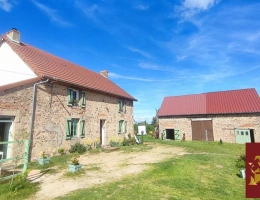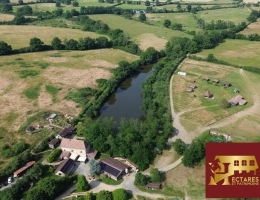
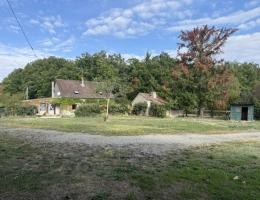
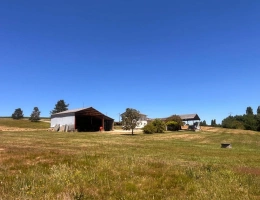
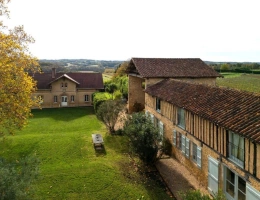
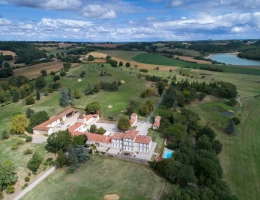
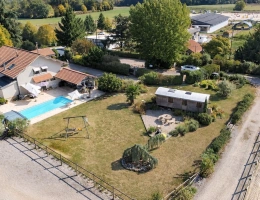
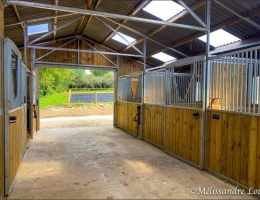
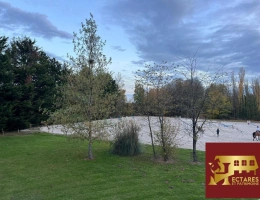
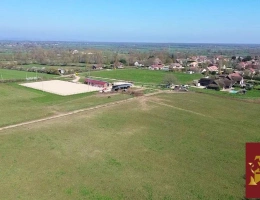
Looking for an equestrian property for sale in France? This page gathers the horse properties currently offered by private sellers, rural estate agents and notaires across the country: country homes with stables and paddocks, farmhouses surrounded by grazing, horse farms with an arena, and larger estates with an indoor school and staff accommodation. Most listings state the land area, the number of stables and the facilities, so you can shortlist before travelling to view. This page sits within our wider selection of equestrian properties, stud farms and stables on ma-propriete.fr, a French portal specialising in rural property.
Buying a horse property in France raises questions that a standard house purchase does not: what the land is really worth, which facilities add value, how French rules on farmland and planning apply to a private buyer, and what the purchase process looks like from offer to completion. The sections below answer them with our own price data. For a step-by-step approach, read our complete guide to buying an equestrian property.
The price of a French horse property breaks down into three parts that sellers rarely separate: the house, the land (paddocks, grazing and hay fields) and the equestrian facilities. The first two can be benchmarked against recorded sales; the third has to be judged on site.
For land, our statistics built on the official French sales register (DVF, vineyards excluded) show 14,328 farmland sales in 2025, at a median price of €5,307 per hectare and an average of €6,059/ha, with 80% of sales between €2,500 and €10,537/ha. According to the SAFER group's 2025 figures, land and pasture sold with vacant possession averages €6,460/ha. By international standards, French farmland remains remarkably affordable, which is one reason British and Northern European riders look here. The table combines land and country house prices for each region.
| Region | Farmland: DVF median price 2025 (€/ha) | SAFER land and pasture with vacant possession (€/ha) | Country house: median price 2025 | Country house: median price per m² |
|---|---|---|---|---|
| Auvergne-Rhône-Alpes | 3,887 | 5,100 | €230,000 | €2,200 |
| Bourgogne-Franche-Comté | 2,773 | 2,740 | €157,000 | €1,525 |
| Brittany | 5,500 | 6,540 | €210,000 | €2,026 |
| Centre-Val de Loire | 5,480 | 6,260 | €150,000 | €1,519 |
| Grand Est | 5,611 | 6,510 | €150,000 | €1,400 |
| Hauts-de-France | 7,976 | 10,890 | €175,000 | €1,686 |
| Île-de-France | 7,465 | 8,190 | €280,000 | €2,603 |
| Normandy | 8,305 | 9,610 | €189,000 | €1,871 |
| Nouvelle-Aquitaine | 4,538 | 5,770 | €170,000 | €1,656 |
| Occitanie | 7,015 | 7,260 | €210,000 | €1,987 |
| Pays de la Loire | 3,267 | 4,100 | €190,000 | €1,875 |
| Corsica* | 5,012 | — | €398,800 | €3,688 |
| Provence-Alpes-Côte d'Azur* | 13,518 | 12,260 | €360,000 | €3,465 |
Sources: ma-propriete.fr statistics from DVF 2025 (farmland excluding vineyards, country houses); SAFER 2025 figures. * Under 100 sales: indicative. —: not published.
On the house side, the median French country house sold for €189,200 in 2025 (up 4.0% on the year), or €1,830 per m² of living space, with most sales between €90,000 and €340,000. Large homes of over 300 m² form a separate market: 981 sales in 2025 at a median of €822,000. As for asking prices, on 24 September 2026 the 274 properties listed on this page showed a median of €650,000, half of them between €425,000 and €1,025,000, with a median land area of 5.3 hectares. A third are priced below €500,000 and a quarter above €1 million.
In practice, on a small property of three to five hectares the house drives the price, whereas on a large estate the land takes over, and a hectare in Normandy or Hauts-de-France costs about three times as much as in Bourgogne-Franche-Comté. Explore the detail on our farmland price observatory and country house price observatory, value land with our land value tool and work out notary fees and repayments with our financial calculators.
Start with the buildings. Loose boxes of at least 3 m × 3 m, or an open barn for horses kept together, a lockable tack room, a wash bay, a hay barn and a muck heap make up the working core. Then come the riding facilities: a well-drained sand arena, commonly 20 × 40 m for flatwork and larger for jumping, sometimes an indoor school, a lunge pen or a horse walker. A separate cottage or studio adds flexibility for a groom or for letting to visiting riders. Budget for condition: an old fibre-cement barn roof that may contain asbestos, a failed arena drainage system or tired timber stables can add significantly to the real cost. Our article on fitting out an equestrian property helps you estimate improvements.
The usual rule of thumb is one hectare of grazing per horse kept out all year, more if you want to make your own hay. Quality matters as much as area: free-draining soil, hedges and trees for shelter, water available all year round and field shelters. Land adjoining the house is worth more than scattered plots a few kilometres away. Check the fencing is horse-safe, whether post-and-rail, electric tape or wire; our guide to fencing options for grazing land compares them.
Many of our listings are in the south-west (Gironde, Lot-et-Garonne, Dordogne and the Landes), where land is affordable and the climate allows horses to live out for most of the year. Loire-Atlantique and the wider Pays de la Loire combine a strong breeding tradition with some of the cheapest grazing in the country. Normandy remains the heartland of French breeding, with excellent grassland but some of the highest land prices, while Brittany appeals for its mild climate and its direct ferry links from Plymouth and Portsmouth. Our overview of the best regions to buy an equestrian property compares them.
Most horse properties sit in agricultural or natural zones of the local plan, where building new stables, an arena or a second dwelling is only allowed under conditions, often linked to a farming activity. Check that existing buildings were properly authorised and what the rules will let you add. When farmland is included in a sale, the notaire must notify the SAFER, a regional body with a pre-emption right on agricultural land; where a tenant farmer is in place, he has first right of pre-emption on the land he farms. The notaire, a public official who remains neutral between buyer and seller, checks these points before the final deed. After signing the preliminary contract, the compromis de vente, a private buyer purchasing a property that includes a house has a ten-day cooling-off period, and completion usually follows about three months later. Allow roughly 7 to 8% of the price for notary fees and taxes on an older property.
Keeping your own horses is a leisure use; taking in other people's horses at livery, breaking or training them is a farming activity, which, depending on its scale, brings contributions to the MSA agricultural social security scheme and its own tax rules, covered in our article on the taxation of equestrian properties. Since Brexit, UK nationals need a long-stay visa to live in France for more than 90 days in any 180, and moving horses from the UK requires export health certificates. Read our advice on financing an equestrian property and on moving horses and equipment before you commit.
Properties listed on this page had a median asking price of €650,000 and a median land area of 5.3 hectares on 24 September 2026. Small homes with stables and a few hectares can still be found below €500,000 in central and south-western France, while estates with an indoor school often exceed €1 million.
Yes, particularly in regions where land or houses are cheapest, such as Bourgogne-Franche-Comté, Centre-Val de Loire, Grand Est and parts of Nouvelle-Aquitaine. Lower prices usually mean more work on the house or facilities, so factor renovation into your budget.
Around one hectare per horse for year-round grazing, adjusted to the quality of the grass and the time horses spend stabled. Add hay fields if you want to be self-sufficient in forage.
Yes. There is no nationality restriction on buying property in France. The sale of agricultural land remains subject to SAFER pre-emption, and if the land is then farmed, by you or a tenant, a permit to farm may be required under the structures control; the notaire checks these points before completion.
To see each new equestrian property for sale in France as soon as it is listed, set up an e-mail alert with your preferred regions, land area and budget, and join our Facebook group "Propriétés équestres à vendre - ma-propriete.fr", where new properties are regularly shared. Selling? List your property to reach riders across Europe. For a professional project, browse our stud farms, livery yards and equestrian gîtes.