

Looking for a racing yard for sale in France? This page gathers properties designed for the daily work of racehorses and sport horses, offered for sale by trainers, breeders, specialist agents and notaires: racing yards with their own gallops, training centres for trotters or Thoroughbreds, estates with a straight track and horse walkers, and dealing yards for competition horses. Most listings state the number of boxes, the tracks and the land area. You will find these properties alongside the other equestrian properties, stud farms and stables listed on ma-propriete.fr.
These properties serve a narrow and demanding market, in which proximity to racecourses, track quality and yard layout count more than anywhere else. Below you will find land prices by region, asking prices for the training centres currently listed, the facilities that give a racing yard its value and the conditions for training in France. For the steps shared with any purchase, see our guide to buying an equestrian property.
The price of a training centre depends first on the area needed for tracks and paddocks, then on its equipment: a well-maintained private gallop, a covered horse walker and modern stables are heavy investments that listings reflect. Land provides the most reliable basis for comparison.
Our statistics based on DVF sales (vineyards excluded) record 14,328 farmland sales in France in 2025 at a median of €5,307/ha; the average is €6,059/ha and 80% of sales fall between €2,500 and €10,537/ha. SAFER group figures for 2025 value land and pasture with vacant possession at €6,460/ha and tenanted land at €5,350/ha, a 17% discount where a tenant farmer is in place. The table lists regions starting with the main racing areas north of Paris.
| Region | Farmland sales 2025 (DVF) | DVF median price (€/ha) | SAFER land and pasture with vacant possession (€/ha) | SAFER 1-year change | SAFER tenanted land (€/ha) | Country house: median price 2025 |
|---|---|---|---|---|---|---|
| Hauts-de-France | 1,365 | 7,976 | 10,890 | -0.5% | 7,650 | €175,000 |
| Île-de-France | 214 | 7,465 | 8,190 | +5.7% | 7,000 | €280,000 |
| Normandy | 1,442 | 8,305 | 9,610 | +2.9% | 8,410 | €189,000 |
| Nouvelle-Aquitaine | 2,103 | 4,538 | 5,770 | +5.5% | 3,900 | €170,000 |
| Pays de la Loire | 1,873 | 3,267 | 4,100 | +1.5% | 3,350 | €190,000 |
| Occitanie | 995 | 7,015 | 7,260 | -0.3% | n/a | €210,000 |
| Centre-Val de Loire | 1,195 | 5,480 | 6,260 | -6.1% | 5,700 | €150,000 |
| Auvergne-Rhône-Alpes | 1,230 | 3,887 | 5,100 | +4.9% | 4,140 | €230,000 |
| Bourgogne-Franche-Comté | 1,303 | 2,773 | 2,740 | -6.2% | 2,750 | €157,000 |
| Brittany | 1,297 | 5,500 | 6,540 | +0.3% | 5,180 | €210,000 |
| Grand Est | 1,233 | 5,611 | 6,510 | -4.4% | 6,120 | €150,000 |
| Provence-Alpes-Côte d'Azur* | 59 | 13,518 | 12,260 | +2.8% | n/a | €360,000 |
| Corsica* | 19 | 5,012 | — | — | n/a | €398,800 |
ma-propriete.fr calculations on DVF 2025; SAFER 2025 figures. * Sample below 100 sales, read with caution. n/a: tenanted value not published.
Supply is scarce. On 24 September 2026, the 8 training centres listed on this page showed a median asking price of €965,000, half of them between €650,000 and €1,220,000, with a median area of 14 hectares. On such a small sample these figures give an order of magnitude rather than a market value: with eight listings, one or two estates can shift the median. As for living accommodation, country houses sold at a median of €189,200 in 2025, while homes of over 300 m², common on large racing estates, fetched a median of €822,000.
Land is among the most expensive precisely in the racing regions: Hauts-de-France around Chantilly, the Paris region and Normandy. By contrast, Nouvelle-Aquitaine and the Pays de la Loire offer more affordable acreage on which to build a private track. See department-level data on our farmland price observatory, value plots with our land value tool and model the finance with our financial calculators.
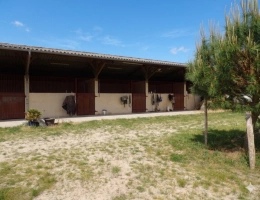
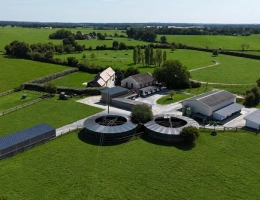
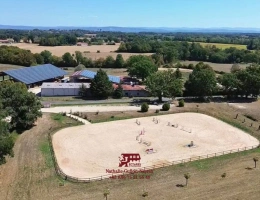
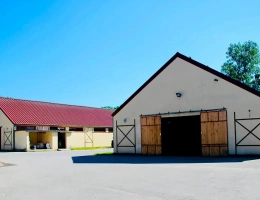
The heart of a training centre is its track: round or straight, on fibre sand, turf or a surface suited to trotters, it must be drained, maintained and long enough for fitness work. Add a horse walker, often covered, a lunge pen and turnout paddocks. Stables need roomy boxes, a tack room, a wash bay, a treatment area and an isolation box; staff housing on site is highly valued, as work starts at dawn. A yard with its own gallop gains precious independence, but carries the full cost of maintaining it.
Much French training is concentrated around shared centres where trainers rent or own yards and use communal tracks: Chantilly and Maisons-Laffitte for Thoroughbred racing (flat and jumps), Grosbois for trotting, plus regional centres in the west and south-west. A yard within reasonable reach of these tracks and of racecourses cuts transport and widens the pool of owners. Away from these hubs, a centre needs good private gallops to attract horses. Normandy, where both trotters and Thoroughbreds are bred, offers studs, tracks and many racecourses in the same area.
Training racehorses for other owners requires a licence issued by France Galop for flat and jump racing, or by LeTrot, which runs trotting. Because French law treats horse training as an agricultural activity, the new operator generally comes under the MSA scheme, and the training premises are declared to France Galop or LeTrot depending on the discipline. Before buying, check that tracks and buildings comply with planning rules, and check the soil and drainage, water abstraction rights for irrigation and any rights of way, using our article on checking easements before buying.
The sale usually covers more than the buildings: land and tracks, stables and housing, maintenance machinery and sometimes a base of owners whose horses are in training. When a trainer hands over the business, the clientele cannot simply be transferred; the handover has to be prepared, ideally through a period of working together. Have land, buildings and business valued separately, and estimate the annual cost of maintaining the gallops before setting your budget. Our article on valuing farm buildings offers useful benchmarks for stables.
To build the project, read how to finance an equestrian purchase and what to know about tax on equestrian properties. For sellers, well-presented tracks and records of their upkeep reassure highly technical buyers.
Training centres listed on ma-propriete.fr had a median asking price of €965,000 and a median area of 14 hectares on 24 September 2026, based on a small number of listings. A private track, the condition of the stables and the region make the biggest difference.
Yes. Trainers licensed abroad can run horses in France, but setting up a yard here to train for owners requires a French licence from France Galop or LeTrot, granted on the basis of experience and qualifications. Contact the relevant body early in your project.
A racing yard is the trainer's establishment, with its boxes and team; a training centre is where the horses work, whether private or shared. A property with its own gallop combines both.
Yes. Tracks, walkers and paddocks also suit the preparation of eventers, endurance horses and show jumpers, or a dealing yard, which widens the circle of buyers when you sell.
Racing yards are rarely listed: to catch every racing yard for sale in France, an e-mail alert tells you as soon as one appears, and our Facebook group "Propriétés équestres à vendre - ma-propriete.fr" keeps professionals informed. Trainers and owners can list their property to reach a professional audience. See also our stud farms for sale, often complementary to a racing business, and our livery yards.