

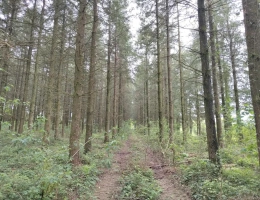
For a hunting property for sale in Côtes-d’Armor, you have two landscapes to choose from: the wooded Argoat inland and the hedged plateau along the coast. Between Callac, Bourbriac, Quintin and Saint-Nicolas-du-Pélem, then towards Loudéac and the Mené hills, woods, heathland and steep valleys hold wild boar, roe deer and red deer; no other department in Brittany takes as many red deer. In the Trégor, the Goëlo and the Penthièvre, bocage and small woods are mainly home to roe deer, woodcock and small game, while coves and estuaries draw wildfowlers. Here you will find the hunting woods and estates for sale across Côtes-d’Armor, whether offered by private owners, agents or notaires.
The data block below this introduction gives the prices of forests and ponds sold in the department, compared with Brittany as a whole, and the big game bag figures. The text then presents inland and coastal grounds, followed by the checks specific to a property in Côtes-d’Armor: how hunting is organised in the commune, cull plans, night flighting hides and fencing.
A hunting estate is rarely valued with a single figure: its price adds up the value of the woodland, the ponds, the buildings and the shooting facilities. The statistics below give benchmarks for wooded land and ponds, based on sales actually recorded.
According to the ma-propriete.fr forest price observatory, built from sales recorded in the French DVF land registry database, the median price of a hectare of forest in Côtes-d’Armor was €5,096/ha in 2025*, across 56 sales, with an average of €6,120/ha. That puts the department below the Brittany median (€5,208/ha) and above the national median (€4,936/ha). Compared with 2024, the median changed by +27.2%, a movement to interpret with care given the number of sales. Over the more robust 2020-2025 period, 299 sales give a median of €4,743/ha for a median plot size of 2.2 ha.
| Indicator | Côtes-d’Armor (22) | Brittany | France |
|---|---|---|---|
| Median price 2025 | €5,096/ha* | €5,208/ha | €4,936/ha |
| Average price 2025 | €6,120/ha* | €6,119/ha | €6,214/ha |
| Number of sales 2025 | 56 | 222 | 6,329 |
| Change in median 2024 → 2025 | +27.2%* | +11.8% | +1.9% |
| Median price 2020-2025 | €4,743/ha | €4,822/ha | €4,778/ha |
| Number of sales 2020-2025 | 299 | 1,298 | 35,100 |
Nationally, the price per hectare rises with size: the large properties that appeal to hunters sell for more per hectare than medium-sized woods.
| Size of forest sold (France, 2020-2025) | Median price | Number of sales |
|---|---|---|
| 10 to 20 ha | €4,010/ha | 3,161 |
| 20 to 50 ha | €5,330/ha | 1,850 |
| 50 to 100 ha | €6,810/ha | 581 |
| Over 100 ha | €7,361/ha | 320 |
Ponds trade at a very different level: a median of €50,935/ha for the 17 ponds sold without buildings in Côtes-d’Armor between 2020 and 2025†, a sample too small to be representative; regionally, the median reaches €32,902/ha.
On the listings side, 18 hunting properties are offered on ma-propriete.fr across France as of 2 October 2026, none in Brittany at that date. Their median asking price is €888,000 for a median size of about 68 ha. These are advertised prices for whole properties, sometimes with a house or a pond, not recorded sale prices per hectare like those in the DVF database.
* 30 to 99 sales: indicative value. † 10 to 29 sales: sample too small to be representative of the local market. Source: DVF (French tax authority), processed by ma-propriete.fr; forests of 1 ha or more, cadastral type woodland; ponds without buildings of at least 2,000 m²; July 2020 to December 2025; Moselle, Bas-Rhin and Haut-Rhin are not covered by DVF. Listings recorded on ma-propriete.fr on 2 October 2026.
The game bag records published by the French Biodiversity Agency (OFB) measure hunting pressure and, indirectly, the presence of big game. In Côtes-d’Armor, 379 red deer were taken in the 2024-2025 season, about 0.4% of the national total, alongside 6,972 roe deer and 5,800 wild boar.
| Species | 2021-2022 season | 2024-2025 season | Change |
|---|---|---|---|
| Red deer | 288 | 379 | +32% |
| Roe deer | 6,834 | 6,972 | +2% |
| Wild boar | 3,099 | 5,800 | +87% |
Source: OFB, wild ungulates network, departmental big game bags (total culls, data published on data.gouv.fr).
The centre of the department has forests of real weight for Brittany. South of Saint-Brieuc, the forest of Lorge, at Plœuc-L’Hermitage, is a beech wood dotted with dry heath and peat bogs; further south, the forest of Loudéac combines a state-owned southern half with private woods; on the Morbihan border, the forest of Quénécan runs along the south shore of Lac de Guerlédan with oak, beech, pine and Douglas fir. Big game culls have risen sharply over some twenty years, and red deer, subject to a cull plan, use these forests and the wooded valleys between them.
Away from the large forests, a typical Argoat hunting wood covers a few dozen hectares of oak and chestnut coppice, conifer plantations and heath, often on slopes that only rides make passable. Driven boar shoots are the norm; high-seat watching and stalking suit roe deer in the more open stands. Buyers are Breton hunters who want a shooting ground of their own and families combining a country house, a wood and some water: the ponds for sale in Côtes-d’Armor often come with a few wooded hectares.
On the coastal plateau the bocage is still dense, cut by the wooded valleys of the Léguer, the Trieux and the Arguenon. Woodcock find hedges and damp hollows to their liking in winter, and shooting them over pointers is a Breton tradition; partridge, pheasant and rabbit depend more on how each ground is managed. Côtes-d’Armor is also one of the departments where night wildfowling from a declared fixed hide is permitted, so a flighting pond behind a cove or estuary can carry value of its own. The inner Bay of Saint-Brieuc, by contrast, is a national nature reserve, as is the Sept-Îles archipelago: these protected areas are outside the market.
Start with how hunting is organised in the commune. Depending on the case, the hunting right is used by the owner, let to a local club or pooled in an ACCA (an approved municipal hunting association); where an ACCA exists, land only leaves it if it reaches the minimum single-block area set for the department, under a regulated procedure. The town hall and the departmental hunters’ federation can tell you more. Then ask for cull plan allocations for red and roe deer, the wild boar management rules and the history of damage to neighbouring crops.
For a wood under 4 ha, adjoining woodland owners have a right of first refusal that must be notified before the sale. As for fencing, the act of 2 February 2023 requires fences built in natural areas since 1993 to leave a 30 cm gap under the mesh and stay below 1.20 m, by 1 January 2027 at the latest; an old fenced game park will need adapting. Details are in our article on fences and the 2023 act.
Hunting woods and grounds in Côtes-d’Armor on ma-propriete.fr are listed by private sellers, estate agents and notaires; sort them by size or price and create an alert to hear about new listings, or publish your own if you are selling. If the property is mainly about woodland, see our forests for sale in Côtes-d’Armor; to compare with the rest of Brittany, look at hunting properties for sale in Brittany, including hunting estates in Morbihan.