
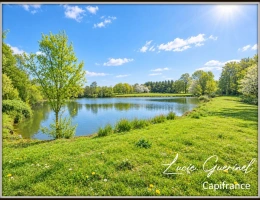
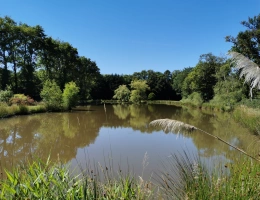
A hunting property for sale in Ille-et-Vilaine rarely exceeds a few dozen hectares, with one exception: the Paimpont massif in the west, which large private owners manage for timber and hunting. Elsewhere, the forests of Rennes, Liffré and Fougères are state-owned, and what comes on the market is bocage woods, flighting ponds and farmland shoots around Vitré, Fougères or Redon. In the north, the Dol marshes and the salt meadows of the Bay of Mont-Saint-Michel belong to the world of wildfowling. This page gathers the hunting properties for sale in the department, listed by private sellers, estate agents and notaires.
Further down you will find the prices of forests and ponds sold in the department and across Brittany, along with the big game bags published by the French Biodiversity Agency (OFB): wild boar and roe deer make up most of the cull, while red deer remain scarce. The rest of the page describes the department’s grounds and the checks to make, from a possible ACCA in the commune to the status of ponds and night flighting hides.
A hunting estate is rarely valued with a single figure: its price adds up the value of the woodland, the ponds, the buildings and the shooting facilities. The statistics below give benchmarks for wooded land and ponds, based on sales actually recorded.
According to the ma-propriete.fr forest price observatory, built from sales recorded in the French DVF land registry database, the median price of a hectare of forest in Ille-et-Vilaine was €6,664/ha in 2025*, across 33 sales, with an average of €8,358/ha. That puts the department above the Brittany median (€5,208/ha) and above the national median (€4,936/ha). Year on year, the departmental median moved by +14.0%: a change to read with caution on fewer than a hundred sales, where a few large estates can shift the median. Over the more robust 2020-2025 period, 178 sales give a median of €5,534/ha for a median plot size of 2.4 ha.
| Indicator | Ille-et-Vilaine (35) | Brittany | France |
|---|---|---|---|
| Median price 2025 | €6,664/ha* | €5,208/ha | €4,936/ha |
| Average price 2025 | €8,358/ha* | €6,119/ha | €6,214/ha |
| Number of sales 2025 | 33 | 222 | 6,329 |
| Change in median 2024 → 2025 | +14.0%* | +11.8% | +1.9% |
| Median price 2020-2025 | €5,534/ha | €4,822/ha | €4,778/ha |
| Number of sales 2020-2025 | 178 | 1,298 | 35,100 |
Nationally, the price per hectare rises with size: the large properties that appeal to hunters sell for more per hectare than medium-sized woods.
| Size of forest sold (France, 2020-2025) | Median price | Number of sales |
|---|---|---|
| 10 to 20 ha | €4,010/ha | 3,161 |
| 20 to 50 ha | €5,330/ha | 1,850 |
| 50 to 100 ha | €6,810/ha | 581 |
| Over 100 ha | €7,361/ha | 320 |
Ponds, which often make much of a shoot’s value, trade at a very different level: a median of €30,864/ha for the 87 ponds sold without buildings in Ille-et-Vilaine between 2020 and 2025*.
On the listings side, 18 hunting properties are offered on ma-propriete.fr across France as of 2 October 2026, none in Brittany at that date. Their median asking price is €888,000 for a median size of about 68 ha. These are asking prices for complete properties: they describe the supply on offer more than the average price of a wooded hectare.
* 30 to 99 sales: indicative value. Source: DVF (French tax authority), processed by ma-propriete.fr; forests of 1 ha or more, cadastral type woodland; ponds without buildings of at least 2,000 m²; July 2020 to December 2025; Moselle, Bas-Rhin and Haut-Rhin are not covered by DVF. Listings recorded on ma-propriete.fr on 2 October 2026.
The game bag records published by the French Biodiversity Agency (OFB) measure hunting pressure and, indirectly, the presence of big game. In Ille-et-Vilaine, 7,490 wild boar and 7,363 roe deer were taken in the 2024-2025 season, along with 75 red deer.
| Species | 2021-2022 season | 2024-2025 season | Change |
|---|---|---|---|
| Red deer | 155 | 75 | −52% |
| Roe deer | 6,408 | 7,363 | +15% |
| Wild boar | 4,517 | 7,490 | +66% |
Source: OFB, wild ungulates network, departmental big game bags (total culls, data published on data.gouv.fr).
The forest of Paimpont, often identified with the Brocéliande of Arthurian romance, is mostly private; the State owns only a small part of it, in the north-east. Red deer, roe deer and wild boar live there on poor sandstone and schist soils, among oak and beech woods, pine stands and heath of purple moor grass and bracken. A hunting estate in the massif seldom changes hands, and when one does come up it often combines woodland, ponds and buildings. The forest burned in September 1990 and again in summer 2022, so ask the seller which plots were affected, how the stands are being restored and what access exists for fire crews. The massif continues into Morbihan, where hunting properties in Morbihan add to the Brocéliande supply.
East and south of Rennes, from the Fougères and Vitré areas to the Vilaine valleys, the bocage alternates meadows, maize and medium-sized woods. A shooting ground here often takes the form of a farm with its hedges and one or two woods, or an oak and chestnut wood of a few dozen hectares bordering farmland. The department also has many ponds, shot for duck at morning and evening flight: a well-placed pond adds value to a shoot, provided you know its legal status, and our ponds for sale in Ille-et-Vilaine widen the search. Around the state forests, private woods benefit from the quiet of the public massifs, where hunting is run by the national forestry office (ONF).
In the north, the Dol marshes, reclaimed from the sea and protected by a dyke, spread their meadows and channels between Dol-de-Bretagne and the bay. Ille-et-Vilaine is one of the departments where night wildfowling from existing, declared fixed hides is permitted, so a marsh plot with its pond and hide can be traded as a property in its own right. The salt meadows and sands of the bay, by contrast, belong to the maritime public domain: they are shot under their own rules and cannot be owned.
ACCA (approved municipal hunting associations) are widespread in Ille-et-Vilaine, where they cover a large part of the land. Where one has been set up, hunting rights are pooled, and an owner can only withdraw land that forms a single block of at least 20 ha; check this at the town hall before assuming you are buying exclusive sporting rights. Elsewhere, the right goes with the land and current leases need close reading. Ask also for the roe deer cull plan allocations, the record of wild boar damage in neighbouring maize fields and, for a wooded plot under 4 ha, confirmation that the neighbours’ right of first refusal has been cleared.
If the ground is fenced, check when the mesh was put up. Since the act of 2 February 2023, a fence in a natural area must leave 30 cm under the mesh and stay below 1.20 m; those installed since 1993 have until 1 January 2027 to comply. Our guide to the fencing act and its exceptions will help you cost the work.
Ille-et-Vilaine hunting listings on ma-propriete.fr come from private sellers, estate agents and notaires; narrow them down by size or price and set an alert to follow new listings, or post your own. The ferry port of Saint-Malo puts the department within easy reach of British buyers. For a mainly woodland project, see our woods and forests for sale in Ille-et-Vilaine; to widen the search across the region, browse shooting grounds for sale in Brittany.