

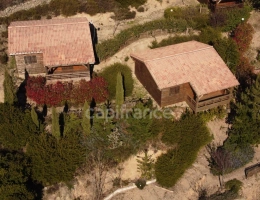

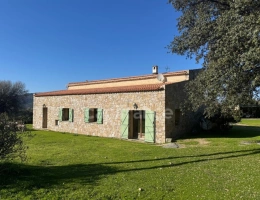
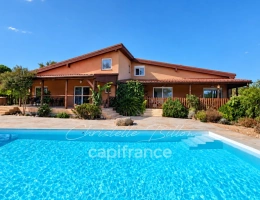
A hunting property for sale in Corsica bears little resemblance to the large enclosed shoots of mainland France. On the island, hunting means wild boar first and foremost, driven by village teams from mid-August through maquis scrub, holm oak woods and chestnut groves; winter belongs to woodcock, thrushes and blackbirds, and the lagoons of the eastern plain draw ducks and coots. There are no roe deer, while red deer and mouflon, the signature species of the Corsican mountains, may not be hunted. Properties on offer are mainly maquis land, chestnut groves or rural holdings of a few dozen hectares; this page lists them alongside the other hunting properties for sale in France, entrusted to the site by private owners, agencies and notaires.
The figures further down give the price of forests sold on the island and the number of wild boar taken in each of its two departments. It is followed by the island’s main hunting areas, from Cap Corse to the far south, then the checks that Corsican land ownership calls for: title deeds, undivided ownership, building rights and fire risk.
The price of a hunting property adds up the value of the woodland, ponds, buildings and facilities. For wooded land, the ma-propriete.fr forest price observatory, built from DVF data, gives a median of €4,532/ha for forests sold in Corsica in 2025* (63 sales), against €4,936/ha nationally, and €4,866/ha over 2020-2025 (371 sales). Nationally, the price per hectare rises with size: the large blocks sought by hunters sell for more per hectare than medium-sized woods.
| Size of forest sold (France, 2020-2025) | Median price | Number of sales |
|---|---|---|
| 10 to 20 ha | €4,010/ha | 3,161 |
| 20 to 50 ha | €5,330/ha | 1,850 |
| 50 to 100 ha | €6,810/ha | 581 |
| Over 100 ha | €7,361/ha | 320 |
On the listings side, 18 hunting properties are offered on ma-propriete.fr across France as of 2 October 2026, none in Corsica at that date. Their median asking price is €888,000 for a median size of about 68 ha. These are advertised prices for whole properties, sometimes with a house or a pond, not recorded sale prices per hectare like those in the DVF database.
* 30 to 99 sales: indicative value. Source: DVF (French tax authority), processed by ma-propriete.fr; forests of 1 ha or more, cadastral type woodland; ponds without buildings of at least 2,000 m²; July 2020 to December 2025; Moselle, Bas-Rhin and Haut-Rhin are not covered by DVF. Listings recorded on ma-propriete.fr on 2 October 2026.
According to the game bag records of the French Biodiversity Agency (OFB), 30,941 wild boar were taken in Corsica in the 2024-2025 season. Compared with 2021-2022, culls changed by −11% for wild boar.
| Department | Red deer | Roe deer | Wild boar |
|---|---|---|---|
| Corse-du-Sud (2A) | — | — | 14,111 |
| Haute-Corse (2B) | — | — | 16,830 |
| Corsica | — | — | 30,941 |
2024-2025 season. Source: OFB, wild ungulates network, departmental big game bags (total culls, data.gouv.fr).
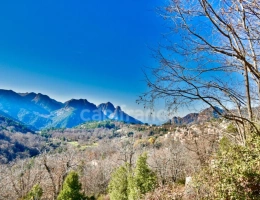
In the north of the island, Haute-Corse alternates coastal maquis and wooded valleys. On the slopes of the Balagne, the Nebbio or Cap Corse, boar are hunted through thickets of holm oak and strawberry tree that have reclaimed old olive groves and terraced fields; red-legged partridge and hare use the more open ground. East of Corte, under the chestnut trees of the Castagniccia, nuts falling in autumn draw wild boar, and also the free-ranging pigs with which they sometimes interbreed. Properties sold there are terraced chestnut groves, plots of maquis around a village or a former farm, rarely more. Listings are grouped on our page of shooting grounds in Haute-Corse.
From Bastia to Ghisonaccia, the eastern plain looks quite different: farmland, citrus orchards and vineyards alternate with coastal lagoons. The Biguglia lagoon, south of Bastia, has been a nature reserve since 1994, and hunting there is strictly controlled; further south, the Diana lagoon near Aléria is used for oyster and mussel farming, while the Urbino lagoon near Ghisonaccia belongs to the Conservatoire du littoral. Its marshes and low-lying land lend themselves to wildfowling. Wild boar damage to crops is frequent, and a ground bordering farms needs to be hunted regularly to stay on good terms with the neighbours.
In Corse-du-Sud, the Prunelli, Taravo and Rizzanese valleys mix holm oak, downy oak and chestnut around mid-mountain villages, where local hunting societies organise the drives. The Sartenais and the Valinco combine dense maquis, holm oak woods and old grazing land where woodcock settle in winter. In the far south, around Porto-Vecchio and Figari, cork oak woods and low maquis hold boar and partridge, but pressure on coastal land makes large plots scarce; hunting properties are more often found further inland, towards the Alta Rocca. They are listed on our Corse-du-Sud hunting estates for sale page.
Higher up, the laricio pine and beech forests, from Aïtone to Vizzavona and Bavella, are largely owned by the communes or by the Collectivité de Corse, which governs the island, and much of the interior lies within the Corsica regional nature park. The mouflon, found in the Cinto and Bavella massifs, is a protected species; the Corsican red deer, reintroduced from 1998 through successive releases of animals of Sardinian origin, is listed in the annexes of the EU Habitats Directive and is not among the island’s huntable species. Its population now extends across several valleys of the island. For a buyer, the mountains therefore mainly offer driven boar and woodcock, on land often grazed by herds.
The first check concerns ownership. A large share of Corsican plots is still held in undivided inheritance, sometimes without a title enforceable against third parties, and the island’s land register contains many undelimited holdings: before any preliminary contract, the notaire must make sure every co-owner consents and that the plot’s limits have been surveyed. The GIRTEC, a public body set up to reconstitute property titles in Corsica, supports this work. Also check who hunts the land: unfenced property is often hunted by the village hunting society, and a written agreement is better than a tacit custom.
The second check concerns use. The coastal and mountain laws (loi Littoral, loi Montagne) and the PADDUC, the island’s planning framework, strictly limit building in natural areas: a hunting lodge cannot go up on maquis land without permission, as our article on building in a forest or on wooded land explains. Fire risk also means regular brush clearance around buildings, and fences, put up mainly for livestock, fall under the 2 February 2023 law in natural surroundings unless exempt; the details are in our fencing rules guide.
On ma-propriete.fr, Corsican hunting properties are put up for sale by private owners, island agencies and notaires; as they are few, following them is easiest with an email alert. Size and price filters separate maquis land from farm holdings, and any owner can post a listing. For chestnut groves and woods with no shooting purpose, see our forests and wooded land for sale in Corsica.