

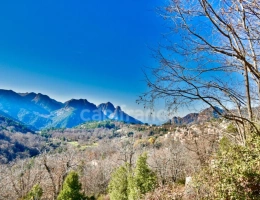
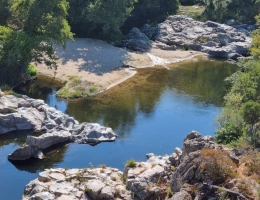
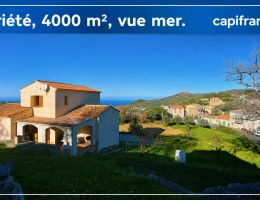
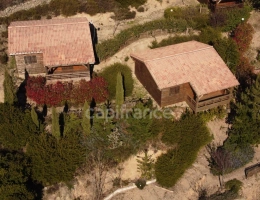

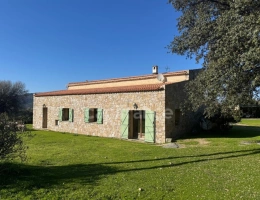
When you look at hunting property for sale in Corse-du-Sud, the first question is the wild boar. Corsican red deer and mouflon are protected and may not be hunted, and there are no roe deer on the island, so the sporting value of a piece of land rests on the boar drives held there, from mid-August until the season closes in winter, in the maquis, the holm oak woods and the chestnut groves, and then on the passage of woodcock, thrushes and blackbirds. What comes up is mostly maquis land around the villages of the Taravo valley, the Sartenais or the Cinarca, cork oak woods in the far south and mountain plots in the Alta Rocca, sometimes with an old shepherd’s hut (bergerie). These properties, listed by private sellers, estate agents and notaires, appear here next to the shoots for sale elsewhere in France.
The data panel that follows gives the prices of forests sold in the department and across the island, together with the game bags recorded by the French Biodiversity Agency (OFB), in which Corsican big game comes down to wild boar alone.
A hunting estate is rarely valued with a single figure: its price adds up the value of the woodland, the ponds, the buildings and the shooting facilities. The statistics below give benchmarks for wooded land and ponds, based on sales actually recorded.
According to the ma-propriete.fr forest price observatory, built from sales recorded in the French DVF land registry database, the median price of a hectare of forest in Corse-du-Sud was €6,160/ha in 2025*, across 34 sales, with an average of €7,366/ha. That puts the department above the Corsica median (€4,532/ha) and above the national median (€4,936/ha). Year on year, the departmental median moved by +26.8%: a change to read with caution on fewer than a hundred sales, where a few large estates can shift the median. Over the more robust 2020-2025 period, 184 sales give a median of €5,340/ha for a median plot size of 3.8 ha.
| Indicator | Corse-du-Sud (2A) | Corsica | France |
|---|---|---|---|
| Median price 2025 | €6,160/ha* | €4,532/ha | €4,936/ha |
| Average price 2025 | €7,366/ha* | €6,418/ha | €6,214/ha |
| Number of sales 2025 | 34 | 63 | 6,329 |
| Change in median 2024 → 2025 | +26.8%* | −3.2% | +1.9% |
| Median price 2020-2025 | €5,340/ha | €4,866/ha | €4,778/ha |
| Number of sales 2020-2025 | 184 | 371 | 35,100 |
Nationally, the price per hectare rises with size: the large properties that appeal to hunters sell for more per hectare than medium-sized woods.
| Size of forest sold (France, 2020-2025) | Median price | Number of sales |
|---|---|---|
| 10 to 20 ha | €4,010/ha | 3,161 |
| 20 to 50 ha | €5,330/ha | 1,850 |
| 50 to 100 ha | €6,810/ha | 581 |
| Over 100 ha | €7,361/ha | 320 |
On the listings side, 18 hunting properties are offered on ma-propriete.fr across France as of 2 October 2026, none in Corsica at that date. Their median asking price is €888,000 for a median size of about 68 ha. These asking prices apply to complete properties, often with buildings, a pond or hunting rights: they cannot be compared directly with DVF medians per hectare.
* 30 to 99 sales: indicative value. Source: DVF (French tax authority), processed by ma-propriete.fr; forests of 1 ha or more, cadastral type woodland; ponds without buildings of at least 2,000 m²; July 2020 to December 2025; Moselle, Bas-Rhin and Haut-Rhin are not covered by DVF. Listings recorded on ma-propriete.fr on 2 October 2026.
The game bag records published by the French Biodiversity Agency (OFB) measure hunting pressure and, indirectly, the presence of big game. In Corse-du-Sud, 14,111 wild boar were taken in the 2024-2025 season.
| Species | 2021-2022 season | 2024-2025 season | Change |
|---|---|---|---|
| Wild boar | 11,000 | 14,111 | +28% |
Source: OFB, wild ungulates network, departmental big game bags (total culls, data published on data.gouv.fr).
In the Taravo, Prunelli and Gravona valleys, in the Cinarca and the Sartenais, drive teams, often linked to the village hunting society, send their dogs into the thickets to push boar, through tall maquis and holm oak, towards a line of posted guns. Every drive is entered in a logbook that the team returns to the departmental hunters’ federation at the end of the season. In the far south, the cork oak woods of Porto-Vecchio, Sotta and Figari carry the same landscape down to the coast.
Winter brings other quarry. Woodcock move into the oak woods and cool valley bottoms, while thrushes and blackbirds feed on myrtle and lentisk berries and on the strawberry-tree fruit of the maquis; shooting them, within daily bag limits, remains a very live island tradition. Red-legged partridge and hare, both scarcer, are subject to restrictions set each season by order. A hunting ground of maquis and oak, facing the winter sun and with a water point, can therefore appeal as much to a woodcock shooter as to a boar team.
Higher up, the laricio pine forests of Bavella and the Ospédale, like many communal forests of the interior, belong to the Collectivité de Corse or to the communes and never come onto the market. The Bavella massif holds one of the two core populations of the Corsican mouflon, taken off the list of huntable species and protected by a ministerial order of 1 March 2019; the other lives in the Cintu massif, in Haute-Corse. The Corsican red deer, which had vanished from the island by the end of the 1960s, was reintroduced from Sardinian stock, released at Quenza in 1998 and later in other valleys; it may not be hunted in Corsica, and shooting instructions for drives have to allow for it.
The two Corsican departments are not among those where the Verdeille Act imposed communal hunting associations (ACCA). Hunting rights therefore belong to the landowner, who may use them, let them or leave them to the local hunting society; in practice, drives often cross unfenced land whose boundaries are poorly known. Ask the seller which team hunts the land and on what basis, written agreement or simple tolerance, whether neighbours have reported boar damage, and have the notaire check the title: old undivided ownership (indivision) and plots never formally delimited are still common inland.
A hunting lodge cannot simply be built: the Littoral and Montagne laws and Corsica’s regional development plan (PADDUC) tightly restrict any building in natural areas, so read our article on building on wooded land before paying for hoped-for planning rights. Fire also shapes how the property is used: the boar season opens in high summer, and clearing scrub around buildings is a legal duty. Finally, the act of 2 February 2023 exempts fences around farmed plots and allows a closed fence within 150 m of a house; a game enclosure, on the other hand, must leave 30 cm clear above the ground, stay below 1.20 m and, if put up in the thirty years before the act, be brought into line by 1 January 2027. Our page on fencing rules for natural land sets out these cases.
On ma-propriete.fr, hunting land and hunting woods in Corse-du-Sud are put up for sale by owners, estate agents and notaires. Listings are scarce: save an email alert, sort them by price or size, and post your own listing if you are selling. If woodland interests you as much as hunting, browse our wooded land and forests in Corse-du-Sud; to widen your search to the north of the island, see the shoots in Haute-Corse or all hunting properties for sale in Corsica.