Two geographies share the supply of hunting property for sale in Pays de la Loire. In the east, Sarthe and the Baugeois in Anjou form one of the main red deer strongholds of western France, with well-known state forests and private woods hunted by driven shoots and stalking. In the west, from the Brière to the Marais poitevin, the Atlantic wetlands make the region wildfowling country, while the hedgerow landscapes of Mayenne, the Mauges and Vendée are hunted for roe deer, wild boar and woodcock. Here you will find the shooting grounds and hunting estates for sale across the region, from woods with a lodge and forest blocks to marshland or hedgerow ground, offered by private vendors, estate agencies and notaries’ offices.
Just below, a figures panel shows sale prices for woodland and ponds in the region and the number of red deer, roe deer and wild boar taken in each department, with Sarthe well ahead for red deer. Each area is then described in turn, followed by what to verify here: who holds the shooting rights, deer allocations, crop damage, marsh status and wire fencing.
The price of a hunting property adds up the value of the woodland, ponds, buildings and facilities. For wooded land, the ma-propriete.fr forest price observatory, built from DVF data, gives a median of €5,000/ha for forests sold in Pays de la Loire in 2025 (254 sales), against €4,936/ha nationally, and €4,896/ha over 2020-2025 (1,435 sales). Nationally, the price per hectare rises with size: the large blocks sought by hunters sell for more per hectare than medium-sized woods.
| Size of forest sold (France, 2020-2025) | Median price | Number of sales |
|---|---|---|
| 10 to 20 ha | €4,010/ha | 3,161 |
| 20 to 50 ha | €5,330/ha | 1,850 |
| 50 to 100 ha | €6,810/ha | 581 |
| Over 100 ha | €7,361/ha | 320 |
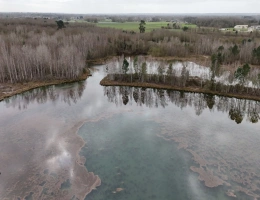
Ponds, which make the value of many shoots, trade at a very different level: a median of €25,243/ha for the 342 ponds sold without buildings in Pays de la Loire between 2020 and 2025.
On the listings side, 18 hunting properties are offered on ma-propriete.fr across France as of 2 October 2026, 1 of them in Pays de la Loire. Their median asking price is €888,000 for a median size of about 68 ha. These asking prices apply to complete properties, often with buildings, a pond or hunting rights: they cannot be compared directly with DVF medians per hectare.
Source: DVF (French tax authority), processed by ma-propriete.fr; forests of 1 ha or more, cadastral type woodland; ponds without buildings of at least 2,000 m²; July 2020 to December 2025; Moselle, Bas-Rhin and Haut-Rhin are not covered by DVF. Listings recorded on ma-propriete.fr on 2 October 2026.
According to the game bag records of the French Biodiversity Agency (OFB), 2,123 red deer, 37,227 roe deer and 34,545 wild boar were taken in Pays de la Loire in the 2024-2025 season. Compared with 2021-2022, culls changed by +18% for red deer, +7% for roe deer, +24% for wild boar.
| Department | Red deer | Roe deer | Wild boar |
|---|---|---|---|
| Sarthe (72) | 1,210 | 9,398 | 8,083 |
| Maine-et-Loire (49) | 535 | 9,653 | 8,822 |
| Mayenne (53) | 204 | 7,795 | 5,377 |
| Loire-Atlantique (44) | 101 | 5,352 | 7,736 |
| Vendée (85) | 73 | 5,029 | 4,527 |
| Pays de la Loire | 2,123 | 37,227 | 34,545 |
2024-2025 season. Source: OFB, wild ungulates network, departmental big game bags (total culls, data.gouv.fr).
No department in the region culls more red deer than Sarthe. Its state forests show why: Bercé, south-east of Le Mans, famous for its high-forest oaks, Perseigne in the Saosnois and Sillé on the rocky heights to the north-west, on the border with Mayenne. Around these public forests, private woods of several dozen or several hundred hectares are sought after for their big game shooting rights. With TGV services to Le Mans, these grounds are within easy reach of Paris-based guns. Neighbouring Mayenne, more given over to hedgerows, has its main wooded area in the north, with the Mayenne forest on the Chailland hills and, towards Orne, the Multonne forest, which lies within the Normandie-Maine regional nature park; red deer are present in Mayenne, but roe deer, wild boar and small game remain the everyday quarry. For listings, turn to our page of Sarthe hunting estates.
In Anjou, big game is concentrated east of Angers in the Baugeois, a plateau of sand and limestone covered with oak, pine and chestnut woods; the state forest of Chandelais and the Monnaie forest sit alongside large private woods that run on into southern Sarthe. To the north-west, the Segréen, and south of the Loire, the Mauges offer more fragmented hedgerow shoots. Upstream of Angers, around the confluence of the Mayenne, Sarthe and Loir rivers, the flood meadows of the Basses vallées angevines draw ducks and waders in winter. On the Loire itself, shooting on the state-owned river domain is let by the State in lots: it does not come with a riverside purchase. See our hunting properties in Maine-et-Loire.
Loire-Atlantique is above all wetland country. North of the estuary, the Grande Brière Mottière, a peat marsh held jointly by the surrounding communes since the 15th century, is run by a syndical commission and is not for sale; the other marshes of the Brière regional nature park, private or communal, include wildfowling plots that rarely come on the market. South-west of Nantes, Lake Grand-Lieu is a nature reserve, while the Goulaine marshes south-east of the city and the Marais breton around Bourgneuf bay offer other flight-shooting areas. For big game, the benchmark is the state forest of Le Gâvre, where stags roar every autumn and hunting with hounds is still practised. Listings for the department appear among our shooting grounds in Loire-Atlantique.
In Vendée, the Mervent-Vouvant forest, partly state-owned, is the largest wooded area in the department, on the edge of the Marais poitevin north of Fontenay-le-Comte; red deer live there but are scarce elsewhere in the department. The hedgerow country of the bocage vendéen, with its small woods, is mainly hunted for roe deer, wild boar, hare and woodcock. To the south, the Marais poitevin, shared with Deux-Sèvres and Charente-Maritime, and the Aiguillon bay nature reserve form a large wildfowl area; to the north-west, the Marais breton, between Beauvoir-sur-Mer and Saint-Jean-de-Monts, continues the marshes of Loire-Atlantique. A purchase there usually means wet meadows criss-crossed by ditches and channels, sometimes with a hunting shelter whose lawful status needs checking.
In the region, hunting is mostly organised through communal hunting societies, landowner groups and private shoots. Before signing, check with the mairie that no communal hunting association (ACCA) covers the commune: a holding below 20 ha in a single block would be absorbed into it automatically, unless a higher local threshold applies. For big game, ask for the cull plan allocations over recent seasons and the current leases; where red deer are plentiful, the balance between game and oak regeneration weighs on the level of allocations. In maize and cereal areas, ask the seller about wild boar damage compensated by the departmental hunting federation.
In the marshes, check the status of each plot: Natura 2000 site, game reserve, compulsory membership of a marsh drainage association, water level rules. Finally, since the law of 2 February 2023, wire fencing in natural areas has to let wildlife pass: raised 30 cm off the ground, it may not exceed 1.20 m, with 1 January 2027 as the deadline for any wire erected from 1993 onwards. Our article on the fencing act details the special cases.
On ma-propriete.fr, hunting properties in the region come from private owners, rural agencies and notaires: narrow the choice by price or area, let an alert flag new grounds, and add your own listing when selling. When timber comes first, look at the forests and woods for sale in Pays de la Loire; for a marsh or a sheet of water, turn to the region’s lakes and ponds for sale.