Few regions read as clearly: a dairy farm for sale in Bourgogne-Franche-Comté usually means a Montbéliarde herd, plateau grassland and milk delivered to the village fruitière, within the wide Comté designation area that shapes the eastern side of the region; further west, in Burgundy, dairying is scarcer, squeezed by Charolais beef and arable crops. Farmers approaching retirement, specialist rural agencies and notaries place their files here, setting out the milking system, the buildings, the forage area and the collector. Each one joins our national selection of dairy farms for sale.
Alongside the listings, this page supplies the bearings that matter when you decide: land and grassland prices across the eight departments, the areas where handovers are most frequent, what to look for in older loose housing, and the formalities of a French farm takeover. For a first setting-up project, our white paper « Créer une exploitation agricole » (in French) works through each stage, from the funding package to the agricultural qualification.
Pricing the land comes first in any plan to buy a dairy farm. On the basis of 2025 DVF sales (vineyards excluded), the median in Bourgogne-Franche-Comté works out at €2,773/ha and the average at €2,907/ha, across 1,303 transactions. The central range covering 80% of sales runs from €1,813 to €4,185/ha; nationally the median is €5,307/ha.
The SAFER benchmark, the market's second yardstick, gives €2,740/ha in 2025 for vacant land and pasture (-6.2% over twelve months, -8.1% over ten years), beside a national €6,460/ha; tenanted land is worth about 17% less.
The value of a dairy unit is decided beside the hectares. It rests on the housing and the bedding system, the type of milking installation and its age, the bulk tank, slurry and manure storage, the clamps and the hay barn. To that add the herd and its records, the stock of in-calf heifers, how well the fields sit around the buildings and, in the designation area, the right to produce attached to the fruitière. Measure the asking price against our land price observatory, then run your project through our financial calculators.
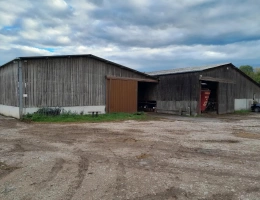
On the Franc-Comtois plateaux, buildings have usually grown in stages: an old tie-stall barn turned into a straw-bedded yard, then a cubicle house added alongside, with a feed passage and a scraper. Milking is done in a herringbone or rapid-exit parlour, and the milking robot is gaining ground on herds that have grown. Look at the age of the installation, the bulk tank, the plant room, the calf accommodation, whether the slurry store is sound, the manure pad and the space available for hay and second-cut forage, since dry forage is the rule in the designation area.
The herd counts in the deal. Montbéliarde dominates, Prim'Holstein remains where the milk goes to a standard dairy, and Simmental appears here and there. Ask for the milk recording results, the composition of the milk, the health record and the share of heifers close to calving. When a listing covers a house, buildings, machinery and land together, have each item priced separately: lending, taxation and future resale do not treat a dwelling and a working tool in the same way.
Doubs (25) is the dairy department par excellence: the Levier, Amancey and Haut-Doubs plateaux, herds supplying a dense network of fruitières for Comté, Morbier and Mont d'Or, well-kept buildings and, inside the designation area, some of the dearest farmland in France. Jura (39) continues the same model from the Revermont up to the plateaux and the high ridge, with Comté, Morbier and Bleu de Gex, and competition from the vineyard on the best slopes. Haute-Saône (70) is more mixed: arable plains towards Gray, livestock in the Vosges Saônoises, and part of the department inside the Comté area, which widens price gaps from one sector to the next.
Territoire de Belfort (90), the smallest of the eight, has few holdings but keeps foothill farms geared to milk, with local outlets towards the urban area. Saône-et-Loire (71) is first of all Charolais country: dairy units are scattered, more common in the Bresse and the north of the department, a fringe of which falls within the Comté area. Côte-d'Or (21) retains dairying in the Auxois and the Châtillonnais, with Époisses as its emblematic cheese; as you approach Dijon and the vineyard, land becomes markedly more expensive.
Yonne (89) mixes large-scale arable farming in the north with livestock towards the Puisaye and the Tonnerrois, keeping a few dairy units and local cheeses such as Soumaintrain; supply is irregular and lowland prices are held up by cereals. Nièvre (58), dominated by Charolais cattle, the Morvan and woodland, offers spacious livestock holdings and the gentlest entry prices in the region, but few working dairy units: taking one on often means rebuilding the milking facilities. Overall, a milking parlour and a working dairy herd are found mainly in the east, where prices reflect the designation, while western Burgundy offers space for less money without the same outlet.
The outlet outweighs almost everything else. Within the Comté area, milk is delivered to a cooperative cheese dairy, the fruitière, whose rules set volumes, farming practices, a ban on silage in the ration and stocking density per hectare; cooperative shares and the right to produce pass on under rules specific to each dairy, and they should be read before any offer. Outside the designation, a dairy holding supplies a private dairy or an ordinary cooperative, and the terms for taking over the milk contract are settled collector by collector.
Since the end of milk quotas, that difference in value explains much of the price gap between the east and the west of the region. Ask the seller for the record of volumes delivered, the payment grid applied and the commitment still to run. Where the farm processes its own milk, with a ripening cellar, an approved workshop and direct sales, that activity is valued separately, customer base included. Organic conversion likewise transfers with the period still to run, provided the collector takes the volume on organic terms.
Begin with the land. Grassland here is often rented and sometimes well away from the buildings; the rural lease continues with the new farmer subject to the landlord's agreement, and the transaction falls under the structures control, the French authorisation regime for taking over farmland, as well as SAFER's pre-emption right. Then check how the buildings are classified under the French classified installations regime according to herd size, the manure spreading plan, effluent storage volumes and whether the area is a nitrate vulnerable zone, common in the Saône and Yonne lowlands. On limestone country, water catchment protection adds its own constraints.
On structure, separate buying assets from buying shares: many holdings are run as a GAEC or an EARL, and joining the capital means agreeing terms with the remaining partners. Have the herd, the machinery and the stocks inventoried with the seller, and clarify what happens to the basic payment entitlements. If you are applying for setting-up support, the agricultural qualification and the application must come before signature, which means fixing the timetable with the seller well ahead.
What you see here comes from three sources: farmers selling directly, rural property firms holding a mandate, and notaries dealing with an estate or a division. Narrow by department, by area or by budget, then set up an e-mail alert to follow new listings without watching the page. Your search can also extend to every farm for sale in Bourgogne-Franche-Comté.