

Buying a dairy farm for sale in Doubs almost always means taking over a holding tied to a fruitière, one of the village cheese cooperatives that turn plateau milk into Comté. The department lives by that model: Montbéliarde herds, grass and barn-dried hay, no silage, permanent pasture managed extensively. Rural notaries, specialist agencies and retiring farmers feed a quiet market whose particulars state the forage area, the milking equipment and the volume delivered under the designation. These holdings are part of the dairy farms for sale listed across France.
What the listings leave out is gathered here: the level of farmland values in the department, the plateaux where handovers actually come up, how to examine a building and its hay drier, the formalities to start early, and the way handovers are usually organised between generations. Our white paper « Créer une exploitation agricole » (in French) deals with building a setting-up project.
Pricing the land comes first in any plan to buy a dairy farm. On the basis of 2025 DVF sales (vineyards excluded), the median in Doubs (25) works out at €3,314/ha and the average at €3,569/ha, across 132 transactions. The central range covering 80% of sales runs from €2,485 to €5,000/ha; nationally the median is €5,307/ha.
The SAFER benchmark, the market's second yardstick, gives €3,280/ha in 2025 for vacant land and pasture (+7.9% over twelve months, +27.6% over ten years), beside a national €6,460/ha; tenanted land is worth about 17% less.
Beyond area, what is paid for in Doubs is measured differently: housing capacity, robot or parlour, bulk tank, hay drier, a compliant slurry store and muck pad, the quality of the herd and its heifers, forage self-sufficiency on the block around the buildings, and above all the place held in the cooperative's collection scheme. To compare those items, open our land price observatory and project your funding with the financial calculators.
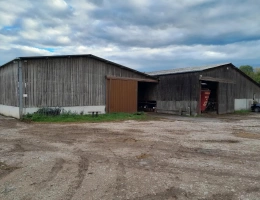
The rule banning silage has shaped local buildings: you find cubicle housing with a barn hay drier, sometimes solar, older barns converted for cattle, and straw yards on the smaller farms. Buyers inspect ventilation, lying comfort, the state of the slats or scraper, slurry capacity set against the length of housing, then the whole haymaking chain for first and second cuts. A milking robot, now common on the plateaux, changes the value of the whole unit but calls for checks on its age, its servicing record and the cost of wearing parts to come.
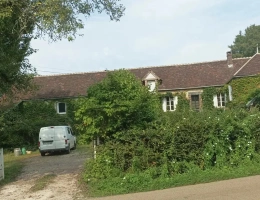
The Montbéliarde herd is a meaningful share of the deal, with its cell count, its compliance with the designation rules and its replacement heifers. Farms that include the dwelling, usual in villages here, are best broken down item by item: house, farm buildings, machinery, livestock, land. Where the sale concerns shares in a GAEC partnership, study the accounts, the loans outstanding and the commitments given to the cooperative rather than the price per hectare alone.
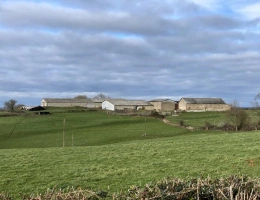
The Haut-Doubs, around Pontarlier, Levier and the val de Morteau, holds the most distinctive holdings, at the altitude where Mont d'Or and Morbier sit alongside Comté. The plateau de Maîche continues that landscape to the north-east, with pasture bounded by dry-stone walls and copses. The Ornans plateau and the Loue valley, the Sancey area and the surroundings of Baume-les-Dames offer somewhat larger units. Going down towards the Doubs valley and the plain near Besançon, dairying gradually gives way to arable cropping.
Land here ranks among the most sought after in France for grass, precisely because milk is well and durably paid. Pasture rarely comes free, neighbours usually bid, and complete units are agreed before any wide circulation. A buyer from outside the area does well to make themselves known early to the cooperative, to SAFER and to local councillors, since a handover here is as much a matter of local acceptance as of price. Visiting several fruitières before committing gives a far clearer view of how milk is paid from one village to the next.
The decisive point is the right to supply under the designation. Comté volumes are capped by the trade body and shared between units: their transfer on a sale is in no way automatic and must be prepared with the cooperative and the managing body. Check the holding's approval, the building's compliance with designation rules, stocking density against area, and the maximum distance allowed between the fields and the cheese dairy. These constraints never appear in a listing, yet they decide whether the takeover pays.
On land, the deal falls under the structures control, the prefectural authorisation required to take over farmland, and under SAFER's pre-emption right; rented parcels stay under a rural lease. Read the spreading plan against nitrate vulnerable zones and water catchment perimeters, which are numerous on limestone where water travels fast. The herd's status under the classified installations regime, mountain area payments and basic payment entitlements complete the list.
The offers shown here come from farmers handing over, from rural estate agencies and from notarial practices in the department. Sort by area, milking equipment or budget, then ask to receive new entries by e-mail: in Doubs, the gap between listing and agreement is sometimes a matter of days. Your search can equally cover all dairy farms for sale in Bourgogne-Franche-Comté.