

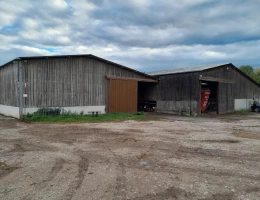
On the market for farms for sale in Doubs, land is not the deciding variable: the right to supply a village cheese dairy is. Milk turned into Comté is worth appreciably more than standard milk, and that gap passes straight into the value of the property, pastures included. Reading a listing here therefore starts with knowing which cooperative the steading belongs to and on what terms. The properties offered come from stock farmers standing down, from outgoing partners in farming companies, from rural agencies in Besançon, Pontarlier and the Montbéliard country, from notarial offices and from handover specialists; they state the grassland base, the stocking rate, the buildings and the milking equipment. They also appear in our running record of farms for sale in France.
What follows delivers what a listing keeps quiet: the value gap between pastures on the lower plateau and those of the high chain, the districts where handovers occur, the productions that keep the department alive and the checks to run before the preliminary contract. To prepare a start-up still on paper, our white paper « Créer une exploitation agricole » (in French) details company forms, the buy-out of capital and the grants available.
Land forms the base of a farm's value. DVF, the property sales database published by the French tax administration (vineyards excluded), records a 2025 median of €3,314 per hectare in Doubs (25), an average of €3,569 and 132 sales; four transactions in five fall between €2,485 and €5,000, against a national median of €5,307.
The SAFER land value benchmark sets €3,280 per hectare for vacant land and pasture offered for sale in the same year, +7.9% over one year and +27.6% over ten, against €6,460 nationally. Land sold with a tenancy in place is valued at €3,300, effectively the same level as vacant land, where the national discount runs close to 17%. That near-parity most likely reflects the fact that a sale of let land escapes SAFER's pre-emption right, and that the stated price of vacant land is held down by side arrangements, key money or the separate sale of payment entitlements. The gap is too small to read as anything other than parity.
Against the Bourgogne-Franche-Comté region, whose median is €2,773 per hectare, this department sits 20% higher. For commune-level detail and comparisons with neighbouring areas, see our land price observatory, then cost your purchase with our financial calculators.
The department lives off the Montbéliarde cow and off grass. Dairy holdings graze their herds at length, with dried hay and silage banned inside the appellation area, a capped stocking density per hectare and a large share of permanent pasture. The buyer inherits a system hungry for area but little dependent on bought-in feed, which cushions price swings. On the margins remain beef units making use of the steepest parcels, Comtois draught horse studs tied to the valleys, and arable holdings in the lower ground near the Saône and the Doubs valley.
Organic conversion is long established and well represented on the plateaux: an agricultural property already certified spares the buyer the transition period, and the price reflects it. What must be settled when the offer is made is the form the takeover takes: buying buildings and land outright, or buying shares in a farming company. The second case is common in Doubs and carries neither the same tax treatment nor the same guarantees.
The Haut-Doubs, from Mouthe to the Morteau valley, sits highest in altitude and in reputation: long winters, late pastures, dairies in heavy demand and handovers that almost never reach the open market, usually settled within families beforehand. The second plateau, around Levier, Vercel and Amancey, is the heart of cheese production, with larger structures and newer buildings. The first plateau, from Ornans to Baume-les-Dames, combines deep valleys with karst tableland; grass starts earlier and access is easier. The lower Doubs valley and the Montbéliard country, finally, open onto ploughable land where crops and livestock coexist.
Land pressure follows that gradation in reverse of what geography might suggest: it peaks where the milk is worth most, that is high up, and eases as you drop westwards. The rings around Besançon and Montbéliard form a case apart, where urban spread and speculative holding blur genuinely agricultural values.
The crucial point is access to processing. The appellation governs collection and the volume that may be delivered, and entitlement does not automatically follow a newcomer: meet the cooperative before fixing your offer and have what will be allocated to you confirmed in writing. The limestone subsoil then imposes its own discipline, with wide protection perimeters around springs and rivers: the spreading plan, effluent storage and compliance of classified buildings should all be checked on paper.
The rules that apply everywhere remain. The notary informs SAFER, which may pre-empt. Structural control decides the right to farm, on thresholds adopted in the Bourgogne-Franche-Comté plan, which watches enlargement closely. Let parcels, lastly, stay their tenant's, with a priority right to buy: have the schedule of current tenancies drawn up before any serious negotiation.
Few properties, many candidates: in this department, speed decides. Register an e-mail alert as soon as your project is defined, stating the altitude you can accept, the volume you are after and the maximum distance to a dairy; you will hear on the day of posting. Filtering by production, by area and by budget then narrows the list. Sellers and their advisers file a dossier in little time. Then widen the horizon with farms for sale in Bourgogne-Franche-Comté.


