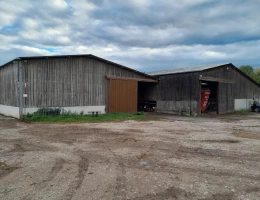
Buying one of the farms for sale in the Haute-Saône means buying into a hinge department, where three farming worlds meet without merging: plateau dairying tied to the Franche-Comté cheese specifications in the east, arable ground on the alluvial plains in the west, grassland on the first uplands to the north. Instructions reach us from stockmen winding down before retirement, from landlords closing an estate, from notaries in Vesoul, Gray and Lure, and from agents used to rural business. Each listing sets out the system, the area, the entitlements attached, the buildings and how the fields are held. They feed our wider picture of farms for sale in France.
Reading this market properly takes three bearings that listings leave out: how far the cheese designation area reaches, which fields the valley floods in winter, and how supply divides between plain and upland. What follows supplies them, together with the checks to run before committing. Where the project still needs structuring — legal form, funding, timetable — our white paper « Créer une exploitation agricole » (in French) lays out the stages.
Land forms the base of a farm's value. DVF, the property sales database published by the French tax administration (vineyards excluded), records a 2025 median of €2,615 per hectare in Haute-Saône (70), an average of €2,727 and 156 sales; four transactions in five fall between €1,999 and €3,577, against a national median of €5,307.
The SAFER land value benchmark sets €2,660 per hectare for vacant land and pasture offered for sale in the same year, -1.5% over one year and +0.8% over ten, against €6,460 nationally. Land sold with a tenancy in place is valued at €2,700, effectively the same level as vacant land, where the national discount runs close to 17%. That near-parity most likely reflects the fact that a sale of let land escapes SAFER's pre-emption right, and that the stated price of vacant land is held down by side arrangements, key money or the separate sale of payment entitlements. The gap is too small to read as anything other than parity.
Against the Bourgogne-Franche-Comté region, whose median is €2,773 per hectare, this department sits 6% lower. For commune-level detail and comparisons with neighbouring areas, see our land price observatory, then cost your purchase with our financial calculators.
Along the eastern edge, dairy holdings running Montbéliarde cows feed on hay and grazing, part of the territory falling inside a Franche-Comté cheese designation area: the right to supply under those specifications transforms the economics of a purchase. Towards Gray and the Saône valley, arable businesses work deep silt soils under cereals, oilseed rape and pulses, sometimes with supplementary irrigation. Between the two, mixed farming prevails, the department's commonest pattern: pasture, home-grown cereals, a dairy or suckler herd and often a direct-selling enterprise.
That spread governs the entry ticket far more than the headline acreage. An approved dairy unit is priced on its ability to supply, its parlour and its forage self-sufficiency; a lowland business is judged on soil quality, rotation and machinery. Before comparing two files, ask what share of turnover comes from milk, from cash crops and from side activities: the three blocks call for different funding and different labour. A mixed working farm rarely transfers in a single transaction.
The plain around Gray, Champlitte and Dampierre-sur-Salon holds the best arable soils and the most capital-intensive businesses; several neighbours bid the moment a field is released. The limestone plateaux of the centre, between Vesoul, Combeaufontaine and Jussey, mix tillage and pasture on shallower ground, with medium-sized units that make up most of what is actually available. To the north, the Vôge and the Vosges foothills, towards Luxeuil-les-Bains, Saint-Loup and Mélisey, belong to grass, acid soils and extensive systems, at markedly lower entry levels.
Eastwards, the Héricourt country and the approaches to the Belfort gap face residential and industrial competition: fragmented parcels, development boundaries, prices pulled upward. The south-east, around Rioz and the Montbozon country, benefits from sitting between Besançon and Vesoul and trades more quickly. For a buyer from elsewhere, the central triangle remains the zone where a whole holding, farmstead included, stays within reach.
Where a holding lies inside a cheese designation area, approval outranks everything else: the breed kept, a diet free of fermented forage, a minimum area per cow, attachment to a collective processing unit. Have it confirmed in writing, before any offer, that the supply entitlement genuinely follows the sale, because the whole forecast rests on it. Outside the designation, nitrate-vulnerable classification, compulsory cover crops and water-catchment perimeters frame cropping practice and the manure plan.
The Saône and Ognon valleys add their own constraint: flood meadows, late trafficability in spring, delayed cutting where conservation stakes exist. Those areas keep real forage value but do not count as arable ground. Legally, the regional SAFER receives notice of each transfer and can substitute itself for the buyer, structural control governs the right to farm, and a sitting tenant has first claim to buy. The tenancy position shapes the project timetable as much as the price: let farmland follows a logic of its own.
Sellers here are mostly stockmen nearing the end of their careers with no family successor, which is why complete holdings reach the market in one go, farmstead, herd and machinery together. Set your filter first on the system wanted, then on area, and only then on district. An e-mail watch flags every relevant listing, and local professionals lodge an instruction in minutes. Regional overview: farms for sale in Bourgogne-Franche-Comté.