
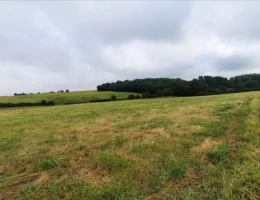

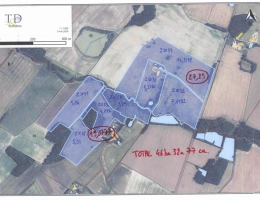
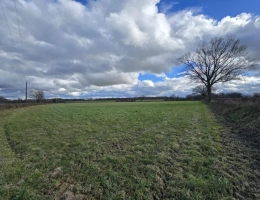
Finding a dairy farm for sale in Centre-Val de Loire calls for patience: milk holds a modest place here, confined to the bocage country and the valleys, while the great arable plateaux turned away from livestock long ago. Working units are therefore sought after, often well sized, sometimes run alongside cash crops. The holdings shown come from farmers preparing to step down, from rural agencies covering several departments and from notarial offices, with listings that set out the dairy herd, the milking equipment and the area under grass. All sit within the national selection of dairy farms for sale.
Beyond the listings themselves, this page supplies the bearings that are missing when the decision comes: what regional land and grassland are worth, where working units still remain, the condition of the milking equipment and the housing, and the points the sector requires you to verify. For a setting-up project, our white paper « Créer une exploitation agricole » (in French) walks through the administrative and financial steps.
Pricing the land comes first in any plan to buy a dairy farm. On the basis of 2025 DVF sales (vineyards excluded), the median in Centre-Val de Loire works out at €5,480/ha and the average at €5,892/ha, across 1,195 transactions. The central range covering 80% of sales runs from €3,003 to €9,349/ha; nationally the median is €5,307/ha.
The SAFER benchmark, the market's second yardstick, gives €6,260/ha in 2025 for vacant land and pasture (-6.1% over twelve months, +8.3% over ten years), beside a national €6,460/ha; tenanted land is worth about 17% less.
The price of a regional dairy unit is settled well away from the acreage figure. What counts first is the quality of the milking set-up and its ability to handle the herd without stretching the working day, the state of the housing and the youngstock buildings, effluent storage volumes, the balance between permanent grass and forage crops, and the feed self-sufficiency that follows from it. Add the harvesting machinery, the livestock themselves and the security of the outlet. Our land price observatory, then our financial calculators, will help you turn each of those items into a costed plan.
Many units in the region grew step by step, and the buildings show it: an older barn extended at a later date, a feed passage widened, cubicles added season after season. Look at how the whole thing works before worrying about its looks: lying space per cow, animal flow, summer airflow, access to the silos in wet weather. The milking equipment deserves a full inspection, whether it is a conventional milking parlour whose pulsation and servicing you check, or a milking robot whose age, daily milkings and remaining maintenance cost you need to know. The bulk tank and its cooling gear follow straight after.
Then the herd: numbers, breeds, mostly Prim'Holstein with some Montbéliarde and Normande units, milk recording results, butterfat and protein, cell counts, fertility and health status. Enough heifers coming through to cover replacement spares the buyer an expensive rebuilding job in the first year. Muck pad, slurry store, silos and forage harvesting machinery are costed line by line, as is the farmhouse where it is included in the sale. Insist on that breakdown: it shapes the funding plan as much as it shapes the negotiation.
Eure-et-Loir (28) shows the contrast plainly: arable Beauce leaves little room for livestock, while the west of the department, towards the Perche and the Thymerais, keeps its hedged fields, its grassland and dairy holdings that still change hands. Loir-et-Cher (41) follows the same logic through the Perche vendômois in the north-west, where most of the dairy units are found; the Sologne, sandier and wooded, belongs to a quite different market, and the Beauce around Blois stays given over to crops. In both departments, grassland thins out as soon as you approach the open fields.
Cher (18) and Indre (36) offer more grass, but it mainly feeds suckler herds and goat units: the pastures of the Pays-Fort, the Sancerrois, the Boischaut and the edges of the Brenne carry more scattered dairy holdings, on land markedly cheaper than in the north of the region. Indre-et-Loire (37) sits in between, with a few units in the Gâtine tourangelle and the north of the department, on land that vineyards and suburban pressure make dearer in places. Loiret (45) remains largely arable, milk surviving only on the hedged margins of the Gâtinais and towards the Berry.
In practice this changes the plan. A farm takeover in the Perche, straddling Eure-et-Loir (28) and Loir-et-Cher (41), puts you inside a still-dense livestock fabric, with neighbours who farm the same way and contractors used to silage work; the same search in Cher (18), Indre (36) or Loiret (45) opens up larger, cheaper areas, at the cost of greater isolation and longer collection rounds. Indre-et-Loire (37) appeals to anyone aiming at direct sales, thanks to its urban customer base. Settle on your farming model, then choose the department.
Forage governs everything else. Dry summers weigh on grass and maize yields, and steady stocks depend on the water-holding capacity of soils that are thin in places, on any access to irrigation, and on the room left for grassland in the rotation. A buyer works out the forage area per cow, judges the quality of the swards and checks whether the fields reachable from the buildings genuinely allow the herd to graze. A unit that buys in most of its forage stays exposed whenever commodity prices rise, and that should be reflected in the asking price.
Collection is more stretched than in Brittany or Normandy: fewer units, longer rounds, and therefore close attention to the milk contract, its volume, its remaining term and how it transfers on a change of operator. Since the region's protected cheese designations cover goat's milk, a cow dairy adds value here through milk quality, through organic conversion, or through on-farm processing and direct sales, which find a ready market near Tours, Orléans and the tourist routes of the Loire. A farm shop is then valued separately, with its health approval and its customers.
Depending on the number of dairy cows, the unit falls under the declaration or registration regime for French classified installations, and a change of operator must be notified to the authorities. Large parts of the region are designated nitrate vulnerable zones: storage capacity, spreading periods and soil cover are regulated there, and the spreading plan must match the land actually taken over. Check the distances to neighbouring dwellings too, since they will decide whether any future extension is feasible, along with any easements or water catchment areas that would restrict spreading on certain fields.
On the land side, a large share is rented and the rural lease continues with the buyer, subject to the landlord's agreement; the transaction remains subject to the structures control, the French authorisation regime governing the takeover of farmland, and to SAFER's pre-emption right. Basic payment entitlements follow the hectares through formalities that must not be missed. Where the farm is held by a GAEC or an EARL, what changes hands is shares rather than assets: have the accounts, the loans and the standing commitments examined before you make a move.
These holdings reach the market through the farmer directly, through rural estate agencies covering the Berry, Touraine or the Perche, or through notarial offices. Select by area, budget or milking set-up, set an alert so no new listing slips past you, and extend your search to all farms for sale in Centre-Val de Loire.