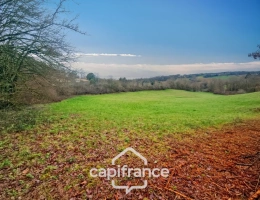
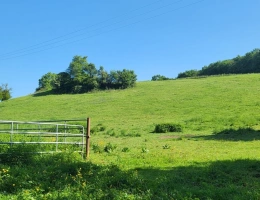
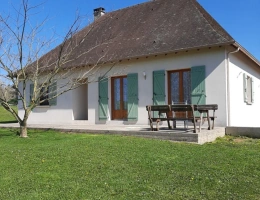
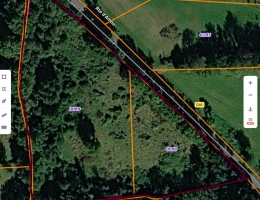
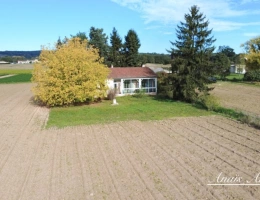
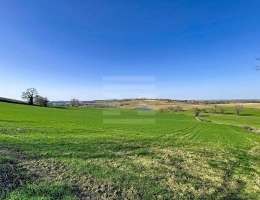
Buying a dairy farm for sale in Nouvelle-Aquitaine means stepping into a region where cow's milk carries very different weight from one area to the next: dense in the north, between Poitou and the Charentes, scattered across the Limousin plateaux, marginal along the Atlantic coast and still solid at the foot of the Pyrenees. The holdings shown here are placed by farmers preparing to step back, by specialist rural property firms and by notaries; each entry states the forage area, how the herd is housed and the milking equipment in place. The national picture of dairy farms for sale lets you widen the search afterwards.
Beyond the listings, this page gathers the benchmarks that are missing when a decision has to be made: regional farmland prices, the areas where handovers are most frequent, how to judge a livestock building, and the checks specific to milk production. Our white paper « Créer une exploitation agricole » (in French) guides anyone preparing to set up, from the funding plan to the agricultural qualification.
Pricing the land comes first in any plan to buy a dairy farm. On the basis of 2025 DVF sales (vineyards excluded), the median in Nouvelle-Aquitaine works out at €4,538/ha and the average at €5,135/ha, across 2,103 transactions. The central range covering 80% of sales runs from €2,500 to €8,190/ha; nationally the median is €5,307/ha.
The SAFER benchmark, the market's second yardstick, gives €5,770/ha in 2025 for vacant land and pasture (+5.5% over twelve months, +7.1% over ten years), beside a national €6,460/ha; tenanted land is worth about 17% less.
The value of a dairy holding is never read from hectares alone. The age of the milking equipment counts just as much, together with the bulk tank, the effluent storage capacity, the genetic quality of the herd and the batch of in-calf heifers due to renew it, not to mention the milk contract and the dairy or cooperative that collects. To place each item, use our land price observatory and our financial calculators.
The first thing examined during a visit is the milking equipment. Between a herringbone or rear-exit milking parlour and a recently installed milking robot, the gap in asking price is wide, and the question goes well beyond working comfort: an automated system implies a particular building layout, suitable tracks out to grazing, and maintenance that the buyer should cost with an adviser before making any offer. Next come the bulk tank and its cooling, cubicle housing or a straw-bedded area, ventilation, the condition of the scraper alleys, the slurry pit and the manure pad, then the clamps and forage storage that govern how the winter is managed on a dairy holding.
The herd deserves the same scrutiny: the breeds present, Prim'Holstein on most units in the north of the region, Montbéliarde or Normande where on-farm processing exists, somatic cell levels, the average age of the dairy herd and the number of heifers close to calving, which shapes the trajectory of the first few seasons. Where the holding comes with a dwelling house and land, ask for an item-by-item breakdown: the house, the production tool, the livestock and the land are not valued on the same logic, and they are not financed in the same way either.
The historic milk basin lies in the north. Deux-Sèvres (79) holds the largest number of units, with a dense cooperative network and company structures often handed on between partners; Vienne (86) combines milk with arable cropping on large holdings where the forage area reachable from the buildings is sometimes limited. Charente (16) and Charente-Maritime (17) keep dairy units set among cereals and vines, geared both to industrial collection and to Charentes-Poitou butter and cream, whose protected designation covers these departments. Supply appears regularly but is keenly contested, since arable farmers compete hard for the same land.
On the Limousin plateaux, milk sits alongside a dominant suckler beef sector. Haute-Vienne (87) retains a core of medium-sized grass-based holdings, with plentiful permanent pasture and land cheaper than in the north of the region. Creuse (23), equally grassy, offers complete farmsteads with older buildings and blocked fields, in an area where collection rounds are more stretched. Corrèze (19), hilly and fragmented, has few dairy units left; those that come on the market mainly attract buyers looking for forage self-sufficiency, often with an organic or direct-selling project in mind.
Further south the map changes sharply. Dordogne (24) and Lot-et-Garonne (47) retain only a small number of dairy herds, scattered among mixed farming, orchards and suckler beef. Gironde (33) and Landes (40), given over to vines, forest and maize, hold very few, and their land market answers to logics that have nothing to do with milk. Pyrénées-Atlantiques (64) is the exception: the Béarn and the inland Basque Country sustain active cow dairying supplied to local dairies, on moderately sized farms where grass and forage maize share the ground; strong demand from new entrants keeps prices firm there.
A farm takeover in this sector is prepared legally as much as technically. The collection contract does not automatically follow the property: taking it over is negotiated with the dairy or the cooperative, and a written agreement before signature is far safer. Check the status of the site under the French classified installations regime, which depends on the number of animals housed, the effluent storage capacity, and whether the manure spreading plan matches the land actually controlled. This matters most in the nitrate vulnerable zones of Poitou and the Charentes, where the action programme imposes spreading calendars, soil cover and buffer distances.
As for land, a large share is farmed under tenancy: the rural lease continues with the buyer subject to the landlord's agreement, and the transaction goes through the structures control, the French authorisation regime for taking over farmland, as well as SAFER's pre-emption right. Where the business sits inside a company, the sale covers shares rather than the assets themselves: have the accounts, outstanding loans, the fate of the payment entitlements and the CAP commitments audited before you commit.
Where the milk goes weighs heavily on what a dairy holding is worth. A farm delivering to a sound cooperative, with a comfortable contract volume and a steady quality bonus, has a different profile from a unit that processes on site. In the north of the region industrial collection dominates, and organic management remains a sought-after way of standing apart. Elsewhere, in the Limousin as in the Pyrenean foothills, some farms have built a farmhouse cheese dairy, a yoghurt workshop or a raw-milk round sold locally: the processing room, its health approval and the established customer base are then valued separately from the rest.
Look last at feed self-sufficiency, which decides how well the system absorbs price swings. The share of grazeable grass within reach of the buildings, the area of forage maize, the ability to irrigate, the presence of cereal-legume mixtures or lucerne in the rotation say more about production cost than a balance sheet does. A dairy farm whose fields are blocked around the yard holds its value far better than an equivalent holding scattered across several communes on the same acreage.
Retiring farmers, rural estate agencies and notarial offices feed this selection, which is refreshed as new mandates come in. Narrow it by area, by budget or by type of equipment, then save an alert so that every new dairy unit coming on the market in the region reaches you first. You can also browse all farms for sale in Nouvelle-Aquitaine.