
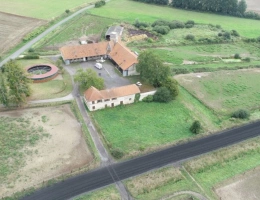
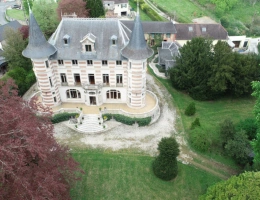
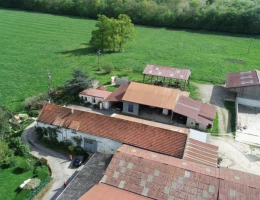
Looking for a dairy farm for sale in France, in the Hauts-de-France region? Milk here belongs to two worlds: the damp bocage of the Thiérache, the Avesnois and the Boulonnais, where grass rules, and the great arable plain, where a dairy unit sits alongside beet, wheat and potatoes. Farmers approaching retirement, rural land specialists and notaries supply the listings on this page, each one stating the forage area attached to the farmstead, how the herd is housed, the milking equipment in place and which dairy or cooperative collects. The holdings shown here belong to the wider selection of dairy farms for sale across the country.
Past the listings themselves, this page supplies what is usually missing before a first visit: regional land values, the departments where handovers come up most regularly, the real condition of the livestock buildings and the checks particular to the milk sector. If you are building a setting-up project, the white paper « Créer une exploitation agricole » (in French) sets out the whole route.
Pricing the land comes first in any plan to buy a dairy farm. On the basis of 2025 DVF sales (vineyards excluded), the median in Hauts-de-France works out at €7,976/ha and the average at €8,940/ha, across 1,365 transactions. The central range covering 80% of sales runs from €6,000 to €14,000/ha; nationally the median is €5,307/ha.
The SAFER benchmark, the market's second yardstick, gives €10,890/ha in 2025 for vacant land and pasture (-0.5% over twelve months, +9.4% over ten years), beside a national €6,460/ha; tenanted land is worth about 17% less.
Hectares tell only part of the story on a dairy holding. The rest lies in the production tool: cubicle housing or a straw-bedded barn, a herringbone parlour or a milking robot, the bulk tank and its plate cooler, slurry store and dung pad sized for a nitrate vulnerable zone, clamp silos and forage sheds. Add the dairy herd, the replacement heifers and the milk contract handed over with the farmstead. To place those items in context, use our land price observatory and our financial calculators.
The regional stock mixes older tie-stall barns, either converted or awaiting conversion, with loose cubicle housing put up during successive enlargements. Faced with a dairy holding on the market, buyers measure building width and roof height, judge ventilation and daylight, look at bed comfort and the state of the standings and scraper passages, then move to the milking block: number of units, automatic cluster removal, milk meters, tank capacity and age, dairy room and washing area. A robot changes the economics of the takeover, since it dictates herd organisation and a replacement timetable that has to be planned for.
The herd is valued separately. Prim'Holstein cattle dominate on the plain, while Normande and Montbéliarde cows return in the grassland districts and on farms that process their own milk. Age structure, replacement rate, health records and genetics all come into the assessment. Where the property is offered as a whole, with a farmhouse, buildings and land, ask for the asking price broken down item by item: the dwelling, the production tool, the machinery and the land neither move at the same pace nor answer to the same benchmarks.
The Aisne (02) carries the most distinctive share: the Thiérache, wooded and well watered, has lived on milk for generations and lies within the Maroilles protected designation of origin, which explains the on-farm cheese rooms and direct sales found there; further south, around Soissons and Laon, arable ground takes over and handovers more often involve a herd attached to large cropping areas. The Nord (59) continues that landscape in the Avesnois, where permanent pasture, hedgerows and brick farmsteads form a dense dairy district, while the Flanders plain combines milk, industrial crops and fiercely contested land.
The Pas-de-Calais (62) is probably the department with the steadiest supply. The Boulonnais, the Haut-Pays d'Artois, the Ternois and the Montreuillois line up medium-sized grassland holdings, with collection organised around processing sites in the Ternois and a solid cooperative network. Grass areas remain substantial, which helps feed self-sufficiency and eases the spreading plan. Closer to the coast and to the towns of Arras, Béthune and Saint-Omer, prices tighten and complete farmsteads rarely come up for sale.
The Somme (80) has two faces: the Ponthieu, the Vimeu and the Authie and Somme valleys keep dairy herds on grass, whereas the Santerre, turned towards sugar beet, potatoes and vegetables for processing, sees units thin out in favour of cropping. The Oise (60) follows a similar logic: the Pays de Bray and the Picardie verte retain grass-based units, while the Valois and the Plateau picard favour cereals under land pressure fed by the Paris basin. In practice, widening the search across several of these departments is the surest way to find a coherent production tool.
Downstream capacity is good: cooperative collection, processing plants geared to powder, butter, dairy ingredients and cheese, plus a scattering of farmhouse dairies in the bocage. A dairy unit changes hands together with its milk contract, and that deserves early attention: remaining term, contracted volume, price grid, transferability and the processor's stance on a change of operator. Where the farm is certified organic, enrolled in a non-GMO scheme or committed to a regional quality programme, check how long those commitments run and whether the premiums survive the handover.
When the holding includes a processing room or a farm shop, the valuation splits in two: the dairy tool on one side, on the other a going concern with its customers, health approval, distribution channels and staff. Such properties sell higher, but call for a hard look at how much of the turnover actually transfers once the seller leaves. A handover period of a few months often decides whether the transition works.
The whole region is classified as a nitrate vulnerable zone: effluent storage capacity, closed periods for spreading, soil cover requirements and the spreading plan all need to be verified with the paperwork in hand, because outstanding upgrading work weighs heavily on a takeover budget. Depending on herd size, the holding falls under the French classified installations regime, by declaration or registration, and a change of operator must be notified to the prefecture. Ask for the order currently in force, the inspection records for the installations and the history of work carried out on the buildings.
On the land side, a large share of the area is farmed under tenancy: the rural lease continues with the incoming farmer, subject to the landlord's agreement, and the transaction goes through the structures control, the French authorisation regime for taking over farmland, as well as SAFER's pre-emption right. Where the business is held by a GAEC or another farming company, entry means buying shares and calls for a separate financial audit. Basic payment entitlements, the agricultural professional qualification and the timetable for setting-up aid are all arranged with the seller well before signature.
Private sellers, rural estate agencies and notarial offices post their properties here, from a complete farmstead with herd and machinery to a single livestock building with its pastures. Narrow the selection by area, budget or milking system, then set an alert so that new listings reach you as they appear. To look beyond milk, browse the farms for sale in Hauts-de-France.