

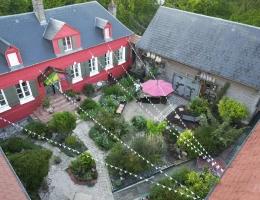
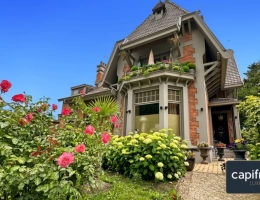
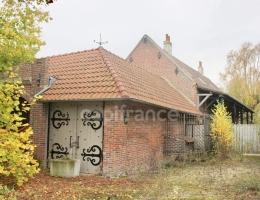
Finding a farm for sale in Hauts-de-France takes patience: on the deep loams of the Santerre, the Vermandois and inland Flanders, land rarely changes hands and every release draws the neighbours at once. What passes from one generation to the next is often as much the buildings, the company shares and the beet, flax or potato contracts as the hectares themselves. Alongside the big lowland structures, the Thiérache, the Boulonnais and the Avesnois offer more conventional grassland units with their livestock buildings. The instructions published here come from farmers ending their careers, from notaries, from rural property agencies and from succession advisers. All of them feed our picture of farms for sale in France.
The rest of this page sets out what decides a purchase in this region: what a hectare is worth department by department, which productions dominate each district, where the available supply comes from and what to check before putting an offer in writing. Our white paper « Créer une exploitation agricole » (in French) follows the path of a first entry step by step.
Land forms the base of a farm's value. DVF, the property sales database published by the French tax administration (vineyards excluded), records a 2025 median of €7,976 per hectare in Hauts-de-France, an average of €8,940 and 1,365 sales; four transactions in five fall between €6,000 and €14,000, against a national median of €5,307.
The SAFER land value benchmark sets €10,890 per hectare for vacant land and pasture offered for sale in the same year, -0.5% over one year and +9.4% over ten, against €6,460 nationally. Land sold with a tenancy in place is valued at €7,650, a discount of about 30%.
These figures place regional land values; they do not price a farm, which depends first on its buildings, its herd and its outlets. For department-level detail, see our land price observatory, then cost your purchase with our financial calculators.
| Department | DVF sales 2025 | Median price/ha | SAFER vacant land |
|---|---|---|---|
| Aisne (02) | 251 | €7,769 | €11,340 |
| Nord (59) | 347 | €7,910 | €13,560 |
| Oise (60) | 174 | €7,927 | €10,740 |
| Pas-de-Calais (62) | 326 | €7,500 | €13,070 |
| Somme (80) | 267 | €8,655 | €10,100 |
The deep loams of the northern Paris basin and the Picardy plateaux carry high-value arable systems: milling wheat, winter barley and oilseed rape, but above all sugar beet, ware and starch potatoes, textile flax and field vegetables grown for processing. That industrial orientation sets the region apart: the value of a holding rests as much on its contracts, delivery entitlements and harvesting machinery as on its area. Specialist crops — chicory, endive, fibre plants — and the market gardening of the marshes and urban fringes extend the same logic on small areas.
Livestock holds the grassland of the north and east. Dairy farms in the Thiérache, the Avesnois, the Boulonnais and inland Flanders work hedged pastures and supply protected cheese sectors; suckler herds and mixed farming systems occupy the thinner soils of the slopes and valleys. A working farm is judged here on its cropping plan, on how much of the land is owned rather than rented, and on the condition of its livestock and storage buildings.
Nord (59) and Pas-de-Calais (62) hold the most sought-after land in France: the Lys plain, the Pévèle, maritime and inland Flanders, the Artois and the Ternois carry beet, potatoes, flax and processing vegetables, while the Avesnois, the northern Thiérache and the Boulonnais remain dairy country. The Audomarois marshes add market gardening of a kind found nowhere else. Proximity to cities and ports keeps land pressure permanently high and holdings heavily fragmented.
Somme (80) and Aisne (02) offer the largest structures and the steadiest supply. The Santerre, the Vermandois, the Picardy plateau and the Noyonnais concentrate beet and vegetable systems; the Ponthieu, the Vimeu and the Marquenterre mix crops, pasture and wetland; the Thiérache of the Aisne and the Laonnois keep dairying and mixed farming, with Champagne vineyards in the south of the department. Oise (60) combines the cereal plains of the Picardy plateau, the Valois and the Vexin with the hedged country of the Pays de Bray.
The widest supply comes from the Somme, the Aisne and eastern Oise, where retirements are numerous and areas large enough for a complete takeover. Nord, Pas-de-Calais and southern Oise concentrate the highest values, through the combined effect of soil quality, farm density and competition from urban growth. The livestock districts of the Thiérache and the Avesnois remain the most affordable, with buildings that often need work.
Scarcity of land is the first regional constraint. Buyers wanting to expand are numerous, released blocks rarely come up in one piece, and building development takes the best soils along the main roads and around the towns: check planning zoning, reserved sites and infrastructure schemes before making an offer. Almost all of the region lies in a nitrate vulnerable zone, which calls for compliant effluent storage and a tightly managed fertilisation plan.
Livestock buildings often fall under the classified installations regime: check the operating order, the headage thresholds and the separation distances from neighbouring dwellings, which are demanding in a densely populated region. Add drainage, erosion of loam soils on the slopes, the wetlands of the valleys and the Picardy coast, and water catchment protection perimeters, common on the plateaux.
Land here is rented more often than it is sold. When a let parcel goes on the market, the tenant comes before any other buyer and, if he stands aside, keeps his lease to its term; many handovers therefore take the form of a share transfer in a farming company rather than an outright sale. Tenure sets the price as much as the quality of the loam does.
The notary reports every intended sale to SAFER Hauts-de-France, which may take the buyer's place and reallocate the property after calling for applications; files built around a new entrant or the consolidation of a fragile holding are served first. Working the land acquired also means staying under the thresholds of the regional structure plan, or obtaining the matching authorisation. An agricultural property is therefore worth only what its buyer will actually be allowed to farm.
In a region where supply stays thin, price is rarely the filter that matters: start with the department and the soil, then look at how much of the area is owned rather than rented, whether a farmstead comes with it and what condition the buildings are in. An e-mail alert does the rest, since the good sites do not stay visible for long. Retiring farmers, notaries and rural agencies across the five departments publish their instructions here, and putting a listing online takes them a few minutes. The search widens in one click to farms for sale in France.


