

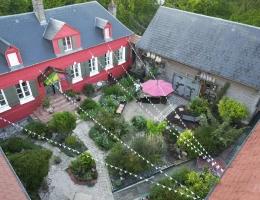
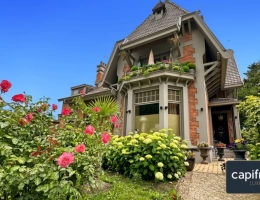
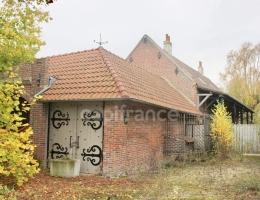
The phrase farms for sale in the Aisne covers two markets with almost nothing in common. In the north, the Thiérache bocage offers medium-sized dairy farms — pasture, hedges and buildings included — that a single buyer can still take on. Elsewhere, on the loams of the Soissonnais, the Laonnois and the Vermandois, the soil supports heavily capitalised businesses built around sugar beet, potato and vegetable processing contracts, which rarely change hands other than through company shares. Sellers here are farmers close to retirement, joint estates settled before a notary, and companies disposing of a site; listings set out the acreage, whether the land is owned or let, the buildings and the commitments in force. See also the full range of farms for sale in France.
Several things have to be weighed before an offer is made: what a hectare is worth in each farming district, which sectors dictate the rotations, where properties still circulate and what paperwork to anticipate. In a department dominated by tenancy, occupation status counts as much as soil quality. Our white paper « Créer une exploitation agricole » (in French) sets out the route to a first purchase.
Land forms the base of a farm's value. DVF, the property sales database published by the French tax administration (vineyards excluded), records a 2025 median of €7,769 per hectare in Aisne (02), an average of €8,841 and 251 sales; four transactions in five fall between €5,737 and €14,000, against a national median of €5,307.
The SAFER land value benchmark sets €11,340 per hectare for vacant land and pasture offered for sale in the same year, +0.6% over one year and +27.0% over ten, against €6,460 nationally. Land sold with a tenancy in place is valued at €7,770, a discount of about 31%.
Against the Hauts-de-France region, whose median is €7,976 per hectare, this department sits 3% lower. For commune-level detail and comparisons with neighbouring areas, see our land price observatory, then cost your purchase with our financial calculators.
On the loamy plateaux, arable holdings grow wheat, winter barley and oilseed rape, but draw their income from sugar beet, potatoes and vegetables for processing. The value of such a business lies less in hectares than in delivery contracts, harvesting machinery and storage capacity. In the Thiérache the landscape flips: dairy farming dominates, tied to Maroilles cheese and a tradition of orchard pasture, while beef herds occupy the wetter bottoms. A few market gardens hold on along the Oise and Marne valleys.
The two models call for neither the same capital nor the same skills. Setting up on the plain means buying a place in a supply chain, usually through an existing company; setting up in the bocage means accepting daily livestock duty and buildings to bring up to standard. A buyer without family capital will more readily find a working farm in the north of the department, provided he accepts tighter margins.
The Thiérache, around Vervins and Hirson, keeps its network of hedges and meadows: supply returns most regularly there and the entry ticket stays lowest. The Vermandois and the Saint-Quentin country in the north-west, the Laonnois and the Soissonnais further south, line up the deep loams that buyers want most. At the southern tip, the Tardenois and the Omois towards Château-Thierry live partly off the Champagne vineyard, which lifts every land value around it. Between these blocks, the Souche marshes and the Oise valley impose their own drainage constraints.
The rule is easy to remember: the further south towards the Marne and the further west onto the loams, the fiercer the competition between neighbours and the more land comes free in small lots. The north and north-east, by contrast, concentrate complete units, farmstead and grazing in one block. That is where most purchases outside the family circle are done, and where an agricultural property can be financed without contortions.
Land in the Aisne is let far more than it is sold, and that changes everything. The tenant of a parcel put up for sale ranks ahead of every other candidate; if he does not buy, he keeps his lease to its term, which can leave a purchase without effect for years. So have the list of tenancies drawn up parcel by parcel, with expiry dates and the name of each tenant. Farmland-holding partnerships are a common route to carry the land when outright purchase exceeds borrowing capacity.
The notary then notifies SAFER, which may pre-empt and reopen the property to applicants, new entrants ranking among its priorities. Approval to farm depends on the Hauts-de-France regional structure plan. Finally, the whole department is classed as a nitrate-vulnerable zone: manure plans, cover crops, slurry storage capacity and catchment perimeters tightly govern practice, on the plain as in the bocage.
Start from the farming district rather than the budget: Thiérache, Vermandois, Laonnois and Omois do not open the same doors. Then specify area, production and how the land is held, and switch on the e-mail alert, because plain holdings do not stay visible for long. A retiring farmer in the Aisne can publish his own listing. For a wider view, browse farms for sale in Hauts-de-France.


