

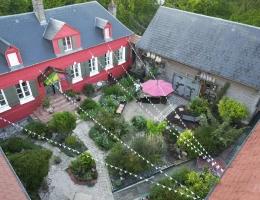
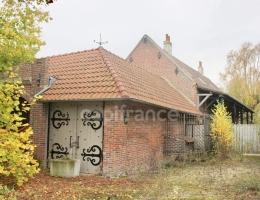
Farms for sale in the Oise trade under the direct influence of the Paris region. The southern plateaux carry some of the most heavily capitalised arable businesses in the country, on deep loams that have never left the top of the ranking; all around them, housing demand, logistics platforms and vast state forests eat into the space available. The result is little supply, firm prices, and handovers that run more often through buying into a company than through purchasing a whole holding. Sales come from partners leaving a business, landowning families rebalancing their assets, notaries and rural brokers; the listing gives area, ownership status, buildings and machinery included. All of them enlarge the choice on our page of farms for sale in France.
Deciding takes more than a listing: land values plateau by plateau, the production that shapes each district, where properties still circulate, and the checks to run, planning included. Proximity to the capital makes that last point sharper here than elsewhere. To build a set-up project, our white paper « Créer une exploitation agricole » (in French) describes the successive stages.
Land forms the base of a farm's value. DVF, the property sales database published by the French tax administration (vineyards excluded), records a 2025 median of €7,927 per hectare in Oise (60), an average of €8,723 and 174 sales; four transactions in five fall between €6,000 and €13,118, against a national median of €5,307.
The SAFER land value benchmark sets €10,740 per hectare for vacant land and pasture offered for sale in the same year, +14.1% over one year and +27.3% over ten, against €6,460 nationally. Land sold with a tenancy in place is valued at €7,430, a discount of about 31%.
Against the Hauts-de-France region, whose median is €7,976 per hectare, this department sits 1% lower. For commune-level detail and comparisons with neighbouring areas, see our land price observatory, then cost your purchase with our financial calculators.
Arable holdings run the department: wheat, winter barley, oilseed rape, sugar beet, ware potatoes and field vegetables, on units usually grouped around the farmstead and equipped for storage. To the west, the Bray country is the exception, with its clays, its meadows and a dairy sector that is holding on, backed by suckler beef on the slopes. The south, between the Valois and the Vexin, also hosts many equestrian businesses tied to the forests and to Parisian custom, which take up grassland and buildings.
For a buyer, the equation differs radically from one end of the territory to the other. On the plateaux, getting in demands heavy investment capacity or a partnership with farmers already established. In the Bray the entry ticket falls, but the dairy system needs labour and buildings that often require work. Vacant farmland free of any occupation is the most sought-after commodity here, and a working farm with no tenancy sells fast.
The Picardy plateau, between Breteuil, Saint-Just-en-Chaussée and Clermont, forms the arable heart of the department and the district where competition between neighbours is keenest. The Noyon country extends that model eastwards to the edge of the Oise valley. In the south, the Valois and the Multien, around Crépy-en-Valois and Nanteuil, combine arable farming with Paris-region pressure; the Vexin, at the south-western tip, shows a comparable profile. The Bray, by contrast, keeps its hedged landscape and its livestock farms. The Thelle bridges the two worlds.
Available supply logically concentrates in the west and north-west, where agricultural value has not yet taken the full force of the capital's pull. On the southern plateaux, expect files built around company shares or lots of parcels; an agricultural property offering house, buildings and land in one block is the exception there.
The Oise is crossed by large-scale schemes, starting with the new high-capacity waterway linking the Oise valley to the northern basin, whose land take, parcel reorganisation and compensation measures already affect holdings around Noyon and Compiègne. Add the business parks strung along the trunk roads and the steady growth of the market towns. Before any offer, read the local planning document, the reserved sites and the study perimeters: they govern how long parcels will stay farmland, as much as what they are worth.
The usual farming rules apply in full alongside. Every sale reaches SAFER, which may step in as the buyer. Approval to farm falls under the Hauts-de-France regional structure plan, whose thresholds penalise excessive expansion. A sitting tenant keeps his priority right to buy. The department is classed as a nitrate-vulnerable zone, which governs nitrogen use and cover crops, and farmland-holding partnerships are widely used to carry the land.
The right reflex is to follow several districts at once rather than one: supply is too thin to watch only the Picardy plateau or the Bray. Set your criteria on area, type of production and how the land is held, then leave the tracking to the e-mail alert. A retiring farmer in the Oise posts his own listing in a few minutes. Widen the search where needed to farms for sale in Hauts-de-France.


