

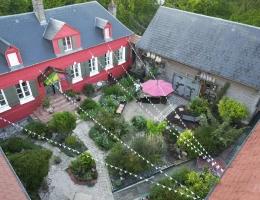
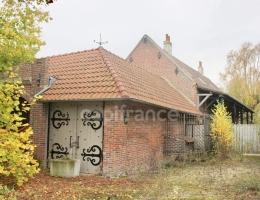
Looking at farms for sale in the Somme leads towards the largest holdings in northern France, shaped by the loams of the Santerre and the Picardy plateau around sugar beet, potatoes and field vegetables. The department stands out for a steady turn of generations, which puts whole units back on the market, farmstead included, rather than broken-up parcels. Properties reach us from farmers preparing to step back, from Picardy notaries, from agencies specialising in rural property and from succession advisers; each listing sets out the cropped area, soil depth, tenure, buildings and machinery included. They sit alongside every other department in our record of farms for sale in France.
Listings alone leave gaps: this page adds what land is worth in the Somme, how the production districts are laid out, where holdings genuinely come free and which checks to run before committing. While a project is still on paper, our white paper « Créer une exploitation agricole » (in French) sets out the corporate form, the equity expected and how to put together a funding case a bank will accept.
Land forms the base of a farm's value. DVF, the property sales database published by the French tax administration (vineyards excluded), records a 2025 median of €8,655 per hectare in Somme (80), an average of €9,402 and 267 sales; four transactions in five fall between €6,364 and €13,926, against a national median of €5,307.
The SAFER land value benchmark sets €10,100 per hectare for vacant land and pasture offered for sale in the same year, -2.1% over one year and +4.8% over ten, against €6,460 nationally. Land sold with a tenancy in place is valued at €7,730, a discount of about 23%.
Against the Hauts-de-France region, whose median is €7,976 per hectare, this department sits 9% higher. For commune-level detail and comparisons with neighbouring areas, see our land price observatory, then cost your purchase with our financial calculators.
Arable holdings form the dominant model: a classic cereal rotation enriched with sugar beet, ware and starch potatoes, flax and vegetables delivered to canneries. That orientation shifts value towards the intangible and the equipment — delivery entitlements, harvesters, ventilated stores, handling platforms — as much as towards the hectares. Specialist crops, chiefly chicory and endive, often round out the rotation on small areas while absorbing labour all year.
Livestock has not vanished, it has moved to the valley pastures and the shallower ground: suckler herds in the Ponthieu and the Bresle valley, mixed farming units kept on in the Vimeu and around Amiens. On the black soils of the marshes and the edge of Amiens, a long-established and very small-scale form of market gardening survives. An agricultural property is therefore judged less on its acreage than on the fit between its soils, its contracts and its harvesting equipment.
The Santerre, around Roye, Chaulnes and Nesle, holds the most productive loams in the department and its largest holdings; land there is contested and rarely released. The Picardy plateau and the local Vermandois, towards Montdidier and Péronne, show a similar profile with somewhat more affordable structures. To the west, the Vimeu and the Bray margins combine cash crops, pasture and fragmented field patterns inherited from a district long split between farming and workshop trades.
The Ponthieu, behind Abbeville, opens onto mixed units where grass regains ground, and the Marquenterre carries that through to the salt meadows of the bay. The Somme valley itself, peaty and flood-prone, is not cropped: it is grazed or mown. Complete takeovers cluster in the Ponthieu, the Vimeu and the eastern plateau, while the core of the Santerre mostly changes hands between established neighbours.
The department's defining constraint is water, in both senses. In the valleys and along the coast, plots fall under protected wetland status, European conservation designations and flood-risk plans that restrict drainage, ploughing up pasture and building: have the classification confirmed plot by plot. On the plateau, it is the irrigation resource that governs the value of a potato or vegetable area — abstraction licence, declared borehole, allocated volume and the restrictions applied during recent low-flow summers.
Add the whole department's nitrate vulnerable zone status, which frames fertilisation and effluent storage, and classified-installation rules for livestock buildings. Legally, three mechanisms stack up: the transaction is reported to SAFER, which can buy in your place and then choose the recipient itself; an administrative consent to work the land, weighed against the farm structure plan adopted for the region; and the priority given to a tenant already in occupation, to be verified before any discussion of the price of a working farm opens.
Three habits save time on this market. Filter by farming country rather than by distance from a town, since potential varies enormously between plateau and valley. Look next at the share of land held freehold, which shapes the financing. Then set an e-mail alert, because sound structures do not stay online long. Sellers can publish a listing in a few minutes. To look further afield, see farms for sale in Hauts-de-France.


