
Finding a dairy farm for sale in Île-de-France is a matter of catching a rare opportunity: the region keeps only a very small number of dairy cattle holdings, nearly all of them on the rural fringes to the east and west, within a farmed landscape taken over by arable cropping. What comes free arises from retirements with no successor, from partners going separate ways, or from a dairy enterprise being dropped in favour of cereals. Such holdings reach the market through rural agencies, country notarial practices, or privately between neighbours. They add to the national picture of dairy farms for sale.
Because departmental pages would have little to say here, this regional page brings everything together: farmland values around Paris, the departments where herds genuinely remain, how to read a livestock building and its milking equipment, the routes to adding value to milk, and the duties to anticipate. Anyone starting from scratch will find the route mapped out in our white paper « Créer une exploitation agricole » (in French).
Pricing the land comes first in any plan to buy a dairy farm. On the basis of 2025 DVF sales (vineyards excluded), the median in Île-de-France works out at €7,465/ha and the average at €7,932/ha, across 214 transactions. The central range covering 80% of sales runs from €5,253 to €10,940/ha; nationally the median is €5,307/ha.
The SAFER benchmark, the market's second yardstick, gives €8,190/ha in 2025 for vacant land and pasture (+5.7% over twelve months, +7.5% over ten years), beside a national €6,460/ha; tenanted land is worth about 17% less.
Here land explains only part of the price. What counts is the housing and the quality of the lying area, the parlour or robot, the tank and its cooling, the slurry store and muck pad measured against the herd, the cattle and their replacement heifers, the grass genuinely usable around the buildings, and how the milk is turned into income: sold to a collector or processed on the farm. To put figures behind those criteria, open our land price observatory and test your plan with the financial calculators.
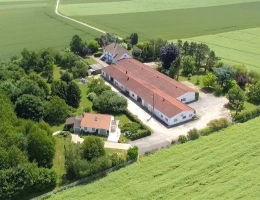
Holdings here usually occupy large courtyard farms of the plain, where the dairy enterprise has grown inside older buildings taken over and extended: a converted byre, cubicle housing added on, a storage barn given a new use. Buyers check the roof frame and covering, summer ventilation, lying comfort, watering, the number of places against the cows present, then slurry and muck storage capacity against the closed periods for spreading. The milking equipment, a herringbone parlour or a robot, gets its own assessment: age, service history, tank, plate cooler and dairy room. A concrete apron that the collection lorry can reach is a point not to overlook.
The herd is priced apart from the buildings: cows in milk, replacement heifers, milk recording results, health status and the breed kept. As holdings in this region are frequently owned through a company, handover often takes the form of buying shares, which shifts the analysis towards the accounts, the loans outstanding and the leases the company holds. Where a dwelling forms part of the package, it must be valued separately: around Paris, the residential worth of a farmhouse can eclipse that of the working unit.
Seine-et-Marne (77) holds most of what is left: it is the region's farming department, and although arable cropping dominates, the Brie, the Provinois, the Montois and the Grand Morin valley still carry herds, sometimes alongside on-farm cheesemaking. This is where the most complete units come up, with buildings, pasture and occasionally a processing room. Yvelines (78) comes next: the plaine de Versailles, the upper Chevreuse valley and the Mantois keep a few livestock holdings, often diversified, where milk sits beside other enterprises and selling on the farm matters a great deal.
Val-d'Oise (95) is the third pocket, essentially in the Vexin français, whose Epte, Viosne and Sausseron valleys keep grassland bottoms suited to cattle; the plaine de France, further north-east, is turned almost wholly to cereals and sugar beet. Essonne (91) now offers only a scattered presence: the Hurepoix, the Gâtinais français and the Orge and Juine valleys hold local holdings on fragmented ground under strong pressure from building, where milk is more often a sideline than the main enterprise.
The three inner departments follow a different logic. Val-de-Marne (94) keeps a few holdings on its Brie edge, but they are mainly horticultural and market gardening businesses, and a commercial dairy herd there would today be the exception. In Seine-Saint-Denis (93) and Hauts-de-Seine (92), farmed space comes down to a few islands and to urban farms with an educational or community purpose: this is not where a working dairy unit is to be found. Anyone genuinely set on a herd should therefore concentrate on the outer departments, or look across the boundary into Normandy, Picardy or Champagne.
The first constraint is running livestock at the edge of a city. The whole of Île-de-France is classified as a nitrate vulnerable zone: the spreading plan, effluent storage capacity and the application calendar must be checked with the paperwork in hand. Depending on herd size, the holding falls under the departmental health rules or under the classified installations regime, with statutory separation distances from dwellings that, in a built-up setting, often rule out any extension. Complaints from neighbours and moving machinery on busy roads are subjects to raise plainly with the seller.
The second subject is land. A high share of it is rented, the rural lease continues with the landlord's agreement, and the takeover remains subject to the structures control, the prefect's authorisation to farm, and to SAFER's pre-emption right. Check how each parcel is zoned in the local plan, since ground inside a future development perimeter has neither the same value nor the same agricultural future. What happens to basic payment entitlements and to any environmental agreements in force should also be settled before signing.
The scarcity of herds has a counterpart: the consumer market is right there, and many surviving holdings have built their balance on processing and direct sales rather than on deliveries to a dairy alone. Yoghurts, fresh and matured cheeses, a farm dairy shop, vending machines, producer-run stores and supplying school and workplace canteens are all real outlets. In Seine-et-Marne, the designated areas for Brie de Meaux and Brie de Melun cover part of the department, which opens a further route for the holdings concerned.
A processing unit is bought with its health approval, its equipment, its working routine and its customers: treat it as a business in its own right, separate from the herd. Conversely, if the farm sells its milk to a collector, weigh how fragile a collection round serving few farms can be, and ask the buyer about taking over the contract before you commit.
What you see here is offered by farmers arranging their retirement, by rural estate agencies and by notarial offices around Paris. Given how few holdings appear, set up an alert now rather than coming back to check the list, and widen your acreage criteria. Our wider listing of farms for sale in Île-de-France is worth a look as well.