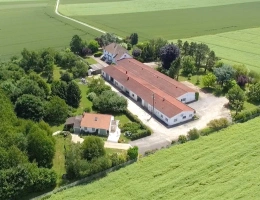
A farm for sale in Île-de-France turns up where few buyers think to look: on the arable plateaux of the Brie and the Vexin français, in the Hurepoix, the Gâtinais or the Mantois, a short drive beyond the last suburban stations. The region remains extensively farmed, with some of the largest and best-equipped holdings in the country, and a generational handover that regularly opens the door to a purchase. These properties reach us from growers planning their exit, from rural agencies, from notaries and from specialist advisers; every listing states the cropping pattern, the soil potential, the legal status of the parcels and the machinery included in the sale. They form part of our nationwide coverage of farms for sale in France.
Beyond the listings themselves, what follows sets out land values department by department, the productions that hold the territory together, the districts where holdings genuinely change hands and the points to verify before making an offer, in a region where proximity to the capital alters every step. A takeover project is prepared long in advance: our white paper « Créer une exploitation agricole » (in French) spells out how the business is structured and how a purchase is funded, stage by stage.
Land forms the base of a farm's value. DVF, the property sales database published by the French tax administration (vineyards excluded), records a 2025 median of €7,465 per hectare in Île-de-France, an average of €7,932 and 214 sales; four transactions in five fall between €5,253 and €10,940, against a national median of €5,307.
The SAFER land value benchmark sets €8,190 per hectare for vacant land and pasture offered for sale in the same year, +5.7% over one year and +7.5% over ten, against €6,460 nationally. Land sold with a tenancy in place is valued at €7,000, a discount of about 15%.
These figures place regional land values; they do not price a farm, which depends first on its buildings, its herd and its outlets. For department-level detail, see our land price observatory, then cost your purchase with our financial calculators.
| Department | DVF sales 2025 | Median price/ha | SAFER vacant land |
|---|---|---|---|
| Seine-et-Marne (77) | 126 | €7,015 | €7,600 |
| Yvelines (78) | 36 | €7,398 | €8,410 |
| Essonne (91) | 32 | €8,000 | €8,260 |
| Hauts-de-Seine (92) | 214 | €7,465 | n/a |
| Seine-Saint-Denis (93) | 214 | €7,465 | n/a |
| Val-de-Marne (94) | 214 | €7,465 | n/a |
| Val-d'Oise (95) | 20 | €8,872 * | €8,810 |
Wheat, barley, oilseed rape and sugar beet take up most of the regional acreage: arable crops are the dominant system here, on deep loess soils among the most fertile in Europe. Livestock has thinned out but survives in the dairy Brie and along the Bassée, where a few units still supply the cheese makers working under the Meaux and Melun appellations; a dairy farm is a sought-after exception.
Alongside that open-field farming, a food belt turned towards the capital has held on: market gardening in the open and under glass, watercress beds in the Essonne and Juine valleys, orchards in the Vexin and the Marne valley, plus nurseries and ornamental horticulture. These specialist crops trade on small areas, yet their value rests on the local outlet, the water available and the packing facilities included in the sale.
Seine-et-Marne (77) alone carries the largest share of the regional farmed area: the central and wooded Brie, the Multien, the Goële, the Bassée floodplain and the Gâtinais line up large arable holdings and account for most of the supply on the market. Yvelines (78) extends those plateaux west into the Mantois, the Houdan country and the plaine de Versailles, where mixed farms sit next to shooting estates and period properties.
Essonne (91) combines the Étampes Beauce, the Hurepoix and the French Gâtinais, with valley market gardening and fine vegetable crops. Val-d'Oise (95) covers the Vexin français and the plaine de France, arable districts under constant urban pressure and major development schemes. Paris (75), Hauts-de-Seine (92), Seine-Saint-Denis (93) and Val-de-Marne (94) retain only residual farming, horticultural and vegetable-based, on the Brie plateau and a few protected plains.
Supply therefore concentrates in the outer ring, and above all in Seine-et-Marne. The closer to the conurbation, the more contested the land, cut through by infrastructure and shadowed by development prospects; further out, the edges of the Brie, the Beauce and the Vexin offer holdings in one block, better maintained and easier to read for a buyer arriving from another region.
Nowhere else is farmland so heavily coveted for other uses. Before committing, read the local planning document, check how each parcel is zoned, and identify reserved sites, infrastructure corridors and deferred development perimeters that may eventually take part of the acreage out of production. A working farm in a good location commands a higher price precisely when its agricultural future is secure.
Day-to-day constraints then come from the neighbours: spreading distances, restricted hours for machinery, busy farm tracks, fly-tipping and trespass on peri-urban parcels. Add the classification of the whole region as a nitrate vulnerable zone, which frames fertiliser use and requires storage capacity for livestock units and cover crops between harvests. Those obligations show up in the outgoing farmer's nutrient plan and spreading record, papers to request alongside the cropping history of recent seasons.
The notary notifies every agricultural sale to SAFER Île-de-France, which may pre-empt and resell the property to a candidate of its choosing, favouring new entrants and viable holdings. Presenting a project in advance, rather than discovering the procedure once the preliminary contract is signed, genuinely affects the outcome. The agency also arranges tenancy intermediation and temporary land carrying, two routes worth knowing when capital is short at the outset.
Farming the land also requires an authorisation to farm, assessed against the regional farm structure plan. Check the tenancy position last: the tenant in place enjoys first refusal, and a rural lease is notoriously hard to bring to an end; an agricultural property let almost in its entirety is not financed like a vacant one. A farmland holding company sometimes allows several partners to carry the land together.
Sellers, rural agencies and notaries across the eight departments publish their instructions here as handovers arise. Narrow the list by department, by sector, by working area or by the budget available, then switch on an e-mail alert: anything matching your search is flagged to you on the day it appears. Selling the business you built? Putting a listing online takes a few minutes. To open the search to the rest of the country, browse farms for sale in France.