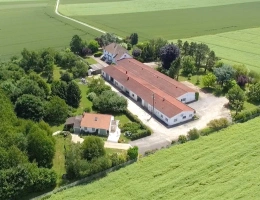
Buying one of the farms for sale in Seine-et-Marne means entering the most cultivated territory in the Paris region, which carries most of its cropped area across the Brie, Multien and Gâtinais plateaux. Buyers find large, heavily mechanised arable holdings that are seldom vacant and almost never cheap: the metropolis, its infrastructure and its development schemes weigh on every transaction. The listings gathered here come from arable farmers preparing their succession, from Brie notary offices, from rural agencies and from succession advisers; they describe the rotation, the nature of the loams, the legal status of the parcels and the working assets transferred. They complete our inventory of farms for sale in France.
A catalogue alone settles nothing. Gathered here, then, are the things that tip a decision in the Brie: what Brie farmland is worth, which districts still see holdings passed on, which sectors withstand urban pressure and what to verify first. The capital required is high, so preparation counts twice over: our white paper « Créer une exploitation agricole » (in French) covers company structure, expected equity and project timing.
Land forms the base of a farm's value. DVF, the property sales database published by the French tax administration (vineyards excluded), records a 2025 median of €7,015 per hectare in Seine-et-Marne (77), an average of €7,828 and 126 sales; four transactions in five fall between €5,009 and €11,030, against a national median of €5,307.
The SAFER land value benchmark sets €7,600 per hectare for vacant land and pasture offered for sale in the same year, -1.4% over one year and -10.2% over ten, against €6,460 nationally. Land sold with a tenancy in place is valued at €7,020, a discount of about 8%.
Against the Île-de-France region, whose median is €7,465 per hectare, this department sits 6% lower. For commune-level detail and comparisons with neighbouring areas, see our land price observatory, then cost your purchase with our financial calculators.
The Brie model rests on arable farming: wheat, malting barley, oilseed rape and sugar beet on deep loams among the most fertile in the country. Holdings are extensive, usually structured as companies and equipped to work large fields quickly; their value lies in agronomic potential, industrial contracts and the machinery fleet as much as in the buildings. Livestock has thinned out, yet the cheese-making Brie retains a few dairy holdings tied to protected-designation production, sought after precisely because they have become exceptional.
Around that field-scale agriculture, production aimed at urban demand survives: open-field and covered market gardening, orchards in the Marne valley, horticulture and nurseries along the wooded edges. These enterprises trade on modest areas, but their price depends on the outlet, on water access and on the packing facility taken over. A working farm combining field crops with direct selling is rarely financed like a purely arable one.
Central Brie, between Coulommiers, Rozay-en-Brie and Provins, holds the largest structures and the most meaningful supply; this is where units in a single block remain possible. The Multien and the Goële, north towards Meaux and Dammartin, farm excellent loams under constant pressure from airport and logistics development. The Provinois and the Montois, to the east, keep a more distinctly rural character, with lower entry prices and holdings that can be taken over in one operation.
The Bassée, in the Seine valley, combines fertile alluvial soil, flood-prone ground and gravel extraction that regularly removes parcels from farming. The local Gâtinais, south towards Nemours and the forest edge, works lighter, sandier soils. To the west, the French Brie, caught between new towns and major roads, shows a fragmented pattern in which an agricultural property lying in one block is the exception.
The first document to read is not an agricultural one: it is the local development plan. Parcel zoning, reserved sites, infrastructure routes, deferred development perimeters and quarry projects determine what will still be farmable in ten years. An apparently uniform holding can lose a meaningful share of its area over the medium term, and that uncertainty is negotiable. Check too the neighbourhood constraints that bear on day-to-day work: spreading distances, crossings of busy footpaths, machinery movement on congested roads, fly-tipping and trespass along the urban edge.
Collective arrangements matter here more than in most regions. SAFER, notified of every proposed sale by the notary, may pre-empt, but it also acts through temporary land carrying and leasing intermediation alongside local authorities, so that a buyer without the capital to own the land can still start; a farmland holding company answers the same difficulty. The usual foundations remain: administrative clearance to work the land, granted on the criteria of the Paris-region structure plan, and the purchase priority granted to a tenant, decisive where nearly all the ground is let.
Arable farmers nearing retirement, Brie notary offices and rural agencies supply this page, at the slow pace of successions. Start from the farming country you are targeting, then narrow by area worked, share of land held freehold and the presence of a usable farmstead. An e-mail alert flags every matching listing as it appears. Selling your own holding? Publishing takes minutes. Widen out to the rest of the region with farms for sale in Île-de-France.