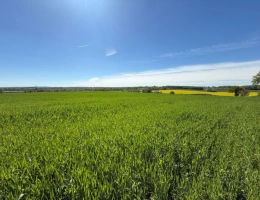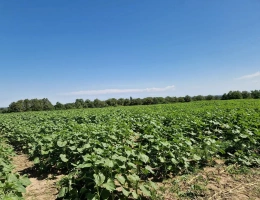
Looking for an arable farm for sale in Auvergne-Rhône-Alpes means looking at plains unlike those elsewhere in France: the Limagne and the Allier valley, the Valence plain, the Bièvre, the Forez and the plaine de l'Ain, where wheat, maize, barley, oilseed rape and sunflower are usually grown with irrigation. The holdings shown here come from farmers arranging their handover, from rural land specialists and from notaries; each listing sets out the cropping plan, the shape of the field pattern, the water available and the buildings included in the sale. You will find them among the arable farms for sale across the country.
This page goes beyond the listings: benchmarks for cropland prices in the region, the departments where handovers come up most often, how to judge a shed and a ventilated grain bin, and the checks to run before signing. Anyone preparing to start farming will find in the white paper « Créer une exploitation agricole » (in French) a stage-by-stage account, from raising finance to the farming qualification.
Pricing the land comes first in any plan to buy an arable farm. On the basis of 2025 DVF sales (vineyards excluded), the median in Auvergne-Rhône-Alpes works out at €3,887/ha and the average at €4,786/ha, across 1,230 transactions. The central range covering 80% of sales runs from €2,161 to €8,738/ha; nationally the median is €5,307/ha.
The SAFER benchmark, the market's second yardstick, gives €5,100/ha in 2025 for vacant land and pasture (+4.9% over twelve months, +3.7% over ten years), beside a national €6,460/ha; tenanted land is worth about 17% less.
Beyond the hectares, what a buyer pays for on a cereal farm is the working tool: an authorised borehole, an irrigation network in order, maintained field drains, a shed, ventilated bins, a drier, and a machinery fleet led by the combine. Add the payment entitlements transferred, the marketing arrangement with a cooperative or a grain merchant, and how tightly the fields sit around the farmstead. Our land price observatory puts those benchmarks into their local context; our financial calculators then stress-test a takeover plan.
Cropping potential shifts sharply from one plain to the next: the deep dark soils of the Limagne, the alluvium of the Allier valley, the ground of the Bièvre and the Forez, the stony land of the plaine de l'Ain that only yields when watered. Ask for soil analyses, the yield history field by field and the rotation followed over recent seasons, with milling wheat, maize, barley, oilseed rape, sunflower and pulses following one another according to available water. Irrigation then needs checking point by point: where the water comes from, whether the borehole is registered, the abstraction permit, membership of a collective scheme, the condition of reels and pivots. Drainage deserves the same attention, inspection chambers and outfalls included.
Then come the buildings. A farmstead with a sound shed, ventilated bins, a drier and a concrete yard does not trade like a site where everything has to be rebuilt, and the machinery taken over, tractors, drill, sprayer and combine, weighs heavily on the overall figure. Where a crop farm is offered with a dwelling house, break the price down from the first visit: the house, the working buildings, the machinery, the stocks and the land are financed differently and valued against different benchmarks.
Puy-de-Dôme and Allier carry the regional cereal base, with the Limagne and the Allier valley, their deep soils and their collection silos; this is where the most complete holdings appear. Drôme, from the Valence plain down to the Tricastin, and Isère, with the Bièvre and the north of the department, live on irrigated farming in which seed multiplication holds a particular place. Ain lines up the plaine de l'Ain, the Dombes and the Bresse; Rhône keeps sought-after arable land east of Lyon; Loire farms the plaine du Forez, where maize and cereals occupy the valley floors.
Elsewhere supply thins out. Haute-Loire combines upland cereals, green Puy lentils and livestock; Cantal and Ardèche keep most of their area under grass, so the few blocks of arable land that reach the market there sell quickly. In Savoie and Haute-Savoie, cultivated ground is confined to the Albanais and the foothill country, where competition from building land and price levels discourage large-scale cropping projects. A new entrant is better off starting with the west and north of the region, then widening the search area.
Every takeover goes through the structures control, the French authorisation regime that applies once a holding passes certain size thresholds, and through SAFER, the rural land agency that may pre-empt the sale. Where land is rented, the rural lease continues with the incoming farmer and rent stays due to the landlord, which changes the economics entirely: read the leases before making an offer. Water is the second hurdle, since several river basins in the region are classified as water allocation zones, with capped volumes managed by a single appointed body; a permit held by the outgoing farmer does not pass on automatically.
Technical checks follow: the actual transfer of payment entitlements and the state of the current CAP declaration, compliance of the pesticide store, the status of the silo and drier under the classified installations regime, and the upkeep of ditches and drainage collectors. Ask the seller about soil conservation practice too, and about any organic conversion under way, since the conversion period runs with the field rather than with the farmer.
Retiring farmers, rural property firms and notaries feed this page as new sales come up. Narrow your search by department, by area or by budget, save an alert so a grain farm does not slip past you, and if your plans extend to other productions, widen the search to all the farms for sale in Auvergne-Rhône-Alpes.