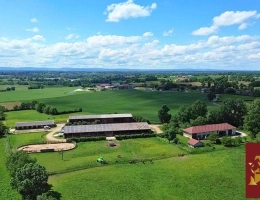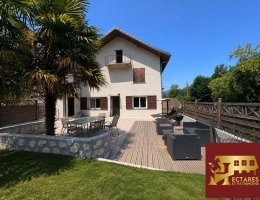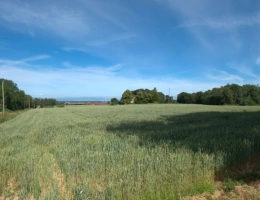
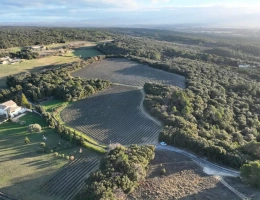
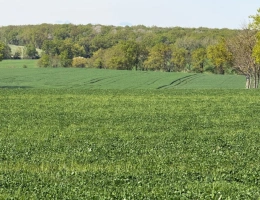

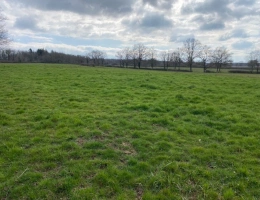
Looking for a farm for sale in Auvergne-Rhône-Alpes starts with choosing an altitude. Between arable land in the Limagne and a Savoyard summer pasture, between a Salers herd on the Cantal plateau and a lavender estate in the Drôme, neither the techniques, nor the working calendar, nor the capital required have much in common. Height of land governs what can be worked by machine, how long the winter lasts and what the grass is worth. The properties gathered on this page come from growers who are stopping, from agencies specialising in rural assets, from notarial offices and from handover consultants; every file states the altitude, the area farmed, the tenure of the land and the machinery included. All of it swells the national selection of farms for sale in France.
Next come the markers behind any decision: what a hectare costs depending on the department, the dominant enterprises of each massif, the districts that genuinely feed the market and the checks to carry out before making an offer. Our white paper « Créer une exploitation agricole » (in French) takes a project from its legal form through to cash-flow planning.
Land forms the base of a farm's value. DVF, the property sales database published by the French tax administration (vineyards excluded), records a 2025 median of €3,887 per hectare in Auvergne-Rhône-Alpes, an average of €4,786 and 1,230 sales; four transactions in five fall between €2,161 and €8,738, against a national median of €5,307.
The SAFER land value benchmark sets €5,100 per hectare for vacant land and pasture offered for sale in the same year, +4.9% over one year and +3.7% over ten, against €6,460 nationally. Land sold with a tenancy in place is valued at €4,140, a discount of about 19%.
These figures place regional land values; they do not price a farm, which depends first on its buildings, its herd and its outlets. For department-level detail, see our land price observatory, then cost your purchase with our financial calculators.
| Department | DVF sales 2025 | Median price/ha | SAFER vacant land |
|---|---|---|---|
| Ain (01) | 144 | €3,000 | €4,200 |
| Allier (03) | 239 | €3,520 | €4,220 |
| Ardèche (07) | 13 | €8,069 * | €5,140 |
| Cantal (15) | 136 | €7,381 | €6,440 |
| Drôme (26) | 63 | €8,000 | €7,190 |
| Isère (38) | 79 | €4,000 | €4,950 |
| Loire (42) | 107 | €3,400 | €3,730 |
| Haute-Loire (43) | 93 | €3,487 | €4,380 |
| Puy-de-Dôme (63) | 243 | €3,700 | €4,150 |
| Rhône (69) | 71 | €3,728 | €4,630 |
| Savoie (73) | 23 | €4,328 * | €5,100 |
| Haute-Savoie (74) | 19 | €8,000 * | €9,680 |
Grass covers the greater part of the regional area. The high ground of the Massif Central and the Alps carries suckler herds of Salers, Aubrac and Charolais cattle, dairy holdings supplying the PDO cheeses of Cantal, Livradois, Beaufortain and the Aravis, and sheep enterprises on the Monts du Forez, the Margeride and the Velay foothills. The plains and the wide valleys form a quite different farming landscape: arable and seed crops in the Limagne, the Saône valley and the Bièvre plain, orchards, walnut groves and peach plantings along the Rhône and the Grésivaudan, aromatic and perfume plants on the Drôme plateaux.
For a buyer, this geography sets value far more reliably than headline acreage. A working farm in the mountains is bought first for its PDO approval, its livestock buildings and its access to high grazing; the same budget in the lowlands buys ploughland, harvesting machinery and sometimes an irrigation right. Between the two, the mixed farming systems of the Combrailles, the Dombes, the Roannais and the Monts du Lyonnais remain the most affordable and the easiest to adapt.
On the Auvergne side, Cantal (15) lives on grass and cheese: the Planèze, the Cézallier and the Châtaigneraie combine PDO milk with suckler herds, on entry tickets that rank among the most accessible in the whole regional territory. Puy-de-Dôme (63) sets the contested arable and seed-growing Limagne plain beside the grassland districts of the Combrailles, the Livradois-Forez and the Sancy. Haute-Loire (43) joins livestock farming on the Velay and the Margeride to distinctive plateau crops, the green lentil among them. Allier (03) remains a major Charolais breeding area, extended by the crops of the Bourbonnais Limagne and its hedged pasture country.
On the Rhône-Alpes side, Ain (01) brings together the Bresse and its free-range poultry, the Dombes ponds, the crops of the Saône valley and livestock farming in the Bugey. Loire (42) is split between the farmed Forez plain and the cattle country of the Forez and Roanne uplands. Rhône (69) is dominated by the Beaujolais vineyard and by the orchards and market gardens of the Monts du Lyonnais, on land made scarce by the nearby city. Isère (38) runs from the arable Bièvre-Valloire to the walnut groves of the Grésivaudan and the livestock farms of the Vercors and Trièves. Drôme (26) and Ardèche (07) turn southern, with orchards, vines, aromatic plants, chestnut groves and goat units. Savoie (73) and Haute-Savoie (74) belong to PDO mountain systems, in a market tightened by Geneva and the resort valleys.
The steadiest supply comes from the Massif Central departments — Cantal, Allier, Haute-Loire, Ardèche — where retirements are frequent, structures affordable and land less contested. The urbanised corridors of the Rhône valley, the Lyon conurbation, the Alpine trench and the Geneva basin concentrate the highest values, the most fragmented parcels and keen competition for every plot that comes free.
Much of the region is classified as mountain area. The classification brings a natural-handicap payment and constraints with it. Before buying, measure how much land can genuinely be worked by machine, the aspect of the parcels, the length of snow cover and forage self-sufficiency. Summer pastures are often held on lease from communes, sections or pastoral groupings: they do not follow the freehold and are negotiated separately.
PDO cheese schemes add a framework of their own: permitted breeds, the share of grass in the ration, the origin of forage, the collection area and at times volume management. Confirm that the holding remains approved and that the seller's commitments will transfer, or milk value drops from the first season.
The regional farm structure plan sets the areas above which farming requires a prefectural authorisation, with thresholds adjusted for altitude and type of production. A takeover therefore has two stages: agreeing a price on one side, being able to obtain the right to farm on the other, and the second is never settled in advance.
SAFER Auvergne-Rhône-Alpes receives notice of every sale from the notary. It may pre-empt, then reallocate the property to a candidate chosen on the strength of the file, with the entry of a young farmer as its stated priority. Then there are the leases: a let parcel stays in its tenant's hands, and he buys ahead of everyone else if he chooses to. An agricultural property is read first in its contracts.
Behind every listing there is someone standing down: a mountain grazier with no family successor, a lowland arable farmer stopping at the end of his lease, a herb grower changing his life. Their instructions, carried by the rural agencies and notaries of the twelve departments, appear here as handovers happen. Filter by massif, by enterprise, by size of holding or by the budget available, then hand the monitoring over to an e-mail alert. To look beyond the region, browse farms for sale in France.