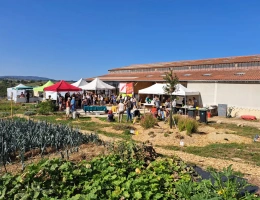
The market for farms for sale in the Loire department is organised around a plain wedged between three ranges. The river crosses the Forez from south to north before opening onto the Roannais; on either side rise the Lyonnais and Forez hills, the Madeleine range and the Pilat. That layout explains why grass and cattle dominate and why specialised crops cluster on the low ground. Many holdings change hands each year for want of a family successor, which keeps supply steady and entry prices moderate by regional standards. All of them feed our inventory of farms for sale in France.
What follows supplies what a listing never contains: what a hectare is worth on the plain compared with the heights, how the local sectors are built, which districts are most active, and what to have verified before committing. Our white paper « Créer une exploitation agricole » (in French) covers the setting-up route itself, from legal status to finance, for buyers who have not yet farmed on their own account.
Land forms the base of a farm's value. DVF, the property sales database published by the French tax administration (vineyards excluded), records a 2025 median of €3,400 per hectare in Loire (42), an average of €3,474 and 107 sales; four transactions in five fall between €2,000 and €5,313, against a national median of €5,307.
The SAFER land value benchmark sets €3,730 per hectare for vacant land and pasture offered for sale in the same year, +1.6% over one year and +9.4% over ten, against €6,460 nationally. SAFER publishes no local figure for let land, too few sales being recorded; nationally, land sold with a farm tenancy in place trades at a discount of about 17%.
Against the Auvergne-Rhône-Alpes region, whose median is €3,887 per hectare, this department sits 13% lower. For commune-level detail and comparisons with neighbouring areas, see our land price observatory, then cost your purchase with our financial calculators.
Cattle shape most of the territory. Charolais suckler herds occupy the Roannais and the Madeleine hills, running as breeders or breeder-finishers on permanent pasture, with buildings sized for winter housing and a long forage season. Dairy holdings hold on in the Forez and Lyonnais uplands, where part of the milk goes to blue-cheese making under appellation. Sheep enterprises fill in the drier slopes, frequently combined with a direct-selling outlet. Organic management is well represented, especially on grassland units whose ration already rests largely on pasture.
The Forez plain, between Montbrison and Feurs, is the exception: alluvial soil, ponds, irrigation and the proximity of Saint-Étienne have established market gardening, cereals and forage maize. The Pilat and the slopes facing the Rhône add orchards and hillside vines. A working farm on the plain is therefore paid for on agronomic potential, while one in the hills is valued on its livestock building, its grass area and its forage self-sufficiency.
The Roannais and the Madeleine hills form the richest source: complete livestock units, serviceable buildings, affordable land and an ageing farming population. The Forez uplands, as far as the communes around Noirétable, regularly release grassland holdings their owners could not pass on within the family. The belt around Saint-Étienne, the approaches to Saint-Chamond and the Pilat slopes face residential and tourist competition that thins supply and lengthens the search.
The Forez plain sits in between: neighbouring businesses want the ground in order to expand, so free area sells quickly and rarely as one block. A buyer after an agricultural property in a single ring-fenced block has better odds in the hills, accepting altitude and sloping grazing in exchange. The Lyonnais hills on the Loire side, around Saint-Galmier and Chazelles-sur-Lyon, hold a position of their own: close to the Saint-Étienne and Lyon outlets, they draw projects built on on-farm processing, which lifts the value of small, well-equipped units.
Structural control applies as soon as the area taken over passes the threshold set by the regional plan: the prefectoral authorisation is applied for in advance and validates the project independently of any agreement reached on price. SAFER, informed by the notary, may pre-empt and then reallocate the holding to a candidate selected on file. Let land, finally, stays with its tenant: his right to buy comes first and his lease continues with the purchaser.
Two local subjects recur. Depending on size, livestock buildings fall under sanitary rules or classified-installation regulations: ask for the receipts, the effluent storage capacity and the distances to dwellings. On the Forez plain, nitrate-vulnerable zoning and the sharing of water between ponds, irrigation and abstraction limit what can realistically be grown. The status of the ponds, widespread between Feurs and Boën, deserves particular attention: emptying rights, dyke maintenance and abstraction entitlements should all be verified from the deeds before any cash projection is built.
Behind these listings are Roannais cattlemen stopping without a successor, growers on the plain moving elsewhere, rural agencies and local notaries. Ranking by production, grassland area, altitude or budget shortens the list in a few clicks, and an e-mail alert flags what comes next. A seller can post a holding without an intermediary. Widen the search to farms for sale in Auvergne-Rhône-Alpes.