
In a department where grass covers nearly all the farmed ground, farms for sale in Cantal are read first through three figures: the altitude of the fields, the length of the winter housing period and the capacity of the building to hold the herd through it. Everything else follows, down to the size of the investment. These properties are entrusted to us by stockmen retiring, by family partnerships splitting up, by firms specialising in rural assets, by notarial offices in the Aurillac and Saint-Flour districts and by succession advisers. Each listing states the forage area, the share of summer grazing, the level of equipment and the tenure of the land, and rounds out our picture of farms for sale in France.
What no listing says is gathered below: what pasture is genuinely worth from one massif to the next, which productions keep local farms alive, in which districts handovers come up and which commitments follow the property after signature. Anyone still shaping a project will find in our white paper « Créer une exploitation agricole » (in French) the steps to take before the first visit.
Land forms the base of a farm's value. DVF, the property sales database published by the French tax administration (vineyards excluded), records a 2025 median of €7,381 per hectare in Cantal (15), an average of €7,166 and 136 sales; four transactions in five fall between €3,657 and €10,561, against a national median of €5,307.
The SAFER land value benchmark sets €6,440 per hectare for vacant land and pasture offered for sale in the same year, -2.9% over one year and +2.9% over ten, against €6,460 nationally. Land sold with a tenancy in place is valued at €5,540, a discount of about 14%.
Against the Auvergne-Rhône-Alpes region, whose median is €3,887 per hectare, this department sits 90% higher. For commune-level detail and comparisons with neighbouring areas, see our land price observatory, then cost your purchase with our financial calculators.
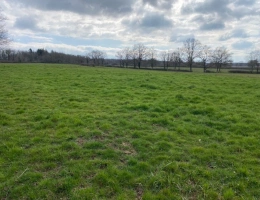
Two models share the department. Dairy holdings supply appellation cheeses whose making requires approved breeds, a ration heavy in grass and a defined collection area; some keep a farmhouse dairy and a ripening cellar that weigh in the value of the place. Suckler cattle holdings, built on hardy breeds born in these very mountains, work as calf producers, with wider areas and less demanding buildings. Both systems rest on the same resource: the quality and the carrying capacity of the pasture.
The Châtaigneraie and the lower valleys carry more flexible mixed farming systems, a few sheep enterprises and direct-selling ventures. A working farm here is therefore rarely comparable with another on area alone: approval under a quality scheme, self-sufficiency in hay and the condition of the cattle housing open gaps in value that a hectare count does not show.
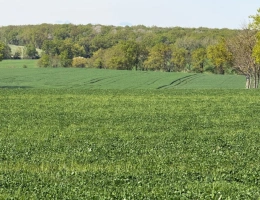
The planèze of Saint-Flour lays out wide workable areas on an even volcanic plateau, well suited to single-block units. The Cézallier and the Artense, wetter and higher, belong to summer grass and large mountain grazings. The Cantal mountains, around Murat, Salers and Riom-ès-Montagnes, concentrate appellation milk and holdings tiered between valley floor and summit pasture. The Châtaigneraie, to the south-west near Maurs and Saint-Mamet, gentler and more wooded, offers the most fragmented parcels but also the kindest climate. To the east, the Margeride and the edge of the Aubrac close the department on granite soils.
The firmest values are found on the planèze and in well-served dairy appellation areas; high ground and land-locked valley bottoms remain noticeably cheaper. For a buyer from outside the department, the Châtaigneraie and the fringes of the Margeride often strike the best balance between entry price, length of winter and distance to services.
A long housing period governs the economics: count the hay harvested in an average year, the mowable area machines can actually reach, the covered storage available and the housing capacity for stock. A holding that buys fodder every spring does not balance like a self-sufficient one, at equal herd size. Summer grazings, often rented from communes or pastoral groups, do not pass automatically with ownership: their allocation is renegotiated and should be confirmed in writing before purchase.
Legally, SAFER is notified of sales and may pre-empt, permission to farm is assessed under the Auvergne-Rhône-Alpes regional structure plan, and a sitting tenant keeps both his lease and his priority to buy. Check too the multi-year commitments signed by the outgoing farmer, agri-environment measures or mountain-related contracts: they either carry over or unwind, and that switch is prepared at the offer stage. Farmland free of tenancy is scarcer here than buyers expect.
The filters that matter in this department are not those of an arable plain: set average altitude, share of mowable ground, the existence of a grazing right and the capacity of the cattle housing before you touch the price slider. A search framed that way returns far fewer properties, but properties that genuinely compare. Add an e-mail alert, and list your own holding if you are standing down. Then widen the view to farms for sale in Auvergne-Rhône-Alpes.