


Buying an arable farm for sale in Haute-Loire means reading a department of high plateaus, where altitude dictates the rotation: wheat, barley, triticale, rape and green lentils sit in the Allier valley around Brioude, in the Le Puy basin and in the Emblavez, while the Margeride, the Meygal and the slopes of the Mézenc belong to grass and livestock. What outgoing farmers, local notaries and rural agencies put on the market here is described in terms of ploughable area, volcanic or alluvial soils, storage buildings and the machinery line-up. These holdings sit alongside our national listing of arable farms for sale.
A listing stays silent on the essentials, so here they are: what ploughland is worth in this department, which districts most often release a farm, the condition of the buildings to inspect, and the precautions that come with cropping at altitude. Our white paper « Créer une exploitation agricole » (in French) sets out the steps of a setting-up project, from funding to qualification.
Pricing the land comes first in any plan to buy an arable farm. On the basis of 2025 DVF sales (vineyards excluded), the median in Haute-Loire (43) works out at €3,487/ha and the average at €4,009/ha, across 93 transactions. The central range covering 80% of sales runs from €2,112 to €6,592/ha; nationally the median is €5,307/ha.
The SAFER benchmark, the market's second yardstick, gives €4,380/ha in 2025 for vacant land and pasture (+2.1% over twelve months, +10.1% over ten years), beside a national €6,460/ha; tenanted land is worth about 17% less.
Beyond area, value sits in precise items: the depth and stoniness of the soils, the aspect of each field, whether any water resource exists, and the distance between the blocks and the yard. Then come the bins and flat store, the machinery shed, the harvest chain, the basic payment entitlements and the collection contract. Figures are set out in the land price observatory, while the financial calculators help you build the funding plan behind an offer.
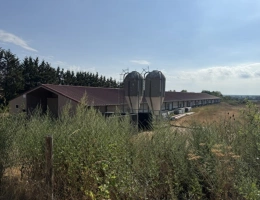
In a department far from the big port silos, on-farm storage carries particular weight: it lets the farmer deliver when the market justifies it rather than straight off the combine. Anyone buying a grain farm here therefore looks at bin capacity, ventilation, the cleaner, the condition of the concrete and whether lorries can reach the store along roads that are sometimes narrow. Older buildings in volcanic stone give volume but rarely the span that modern machines need; a recent framed shed, closed on three sides, changes the picture. Tractors, combine, drill and cultivation kit make up an item to value separately from the land itself.
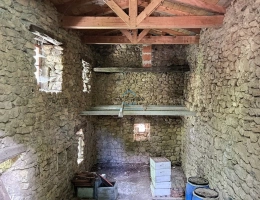
Many holdings come as a package: the seller's house, the working buildings and the fields. Each belongs to a different market. The dwelling compares with village and country houses nearby, the shed with its rebuilding cost, the land with its cropping potential. Some farms still carry a cowshed or sheepfold that has fallen out of use, and converting it into storage is worth costing before an offer is made. Where lentils or another protected crop enter the rotation, grading equipment and the registered area add value too.
The most continuous arable belt follows the river Allier, from Brioude to Paulhaguet and Lempdes, on deeper alluvial soils and in a climate warmer than the departmental average. The Le Puy basin and the Emblavez, around Vorey and Lavoûte, carry a rotation in which the green lentil of Le Puy, covered by a protected designation of origin, sits beside cereals and rape. The Devès plateau and the eastern Velay, towards Craponne and Yssingeaux, mix cropping with livestock on more scattered blocks. On the Margeride and near the Mézenc, ploughland gives way to permanent pasture and rough grazing.
Farms come onto the market mainly in the districts with the oldest farming population, where handovers outside the family remain common. Proximity to the trunk road linking Clermont-Ferrand to Le Puy is a practical criterion for grain collection, while more remote sectors, cheaper to buy into, impose travelling time that belongs in the business plan from the outset. Fragmentation, common after generations of division, is slow to undo: ask the seller what field swaps have been agreed with neighbours.
The first risk is climatic: irrigation stays marginal here and dry summers cut yields, which makes the water-holding capacity of each field a decisive piece of information. Ask for the cropping record of recent seasons, the rotation actually followed and the yields genuinely achieved rather than regional averages. On paper, taking over a crop farm goes through the structures control, the French authorisation regime that weighs the area taken on against the applicant's background, and SAFER, the rural land agency, may pre-empt a sale of farmland in order to favour a new entrant.
Then look at how the land is held. A large share is rented: the rural lease passes to the incoming farmer with the landlord's agreement, and both the rent and the remaining term shape the economics of the deal. Basic payment entitlements transfer under their own rules and should be formalised before the CAP declaration. Check as well the co-operative or merchant membership, any delivery commitments, membership of a producer organisation for lentils, and rights of way over plateau tracks serving distant fields.
Retiring owners, rural estate agencies and notarial offices keep this page supplied week by week. Sort by area, by budget or by cropping system, ask to be told by e-mail as soon as a property matches what you are after, and carry the search on to arable farms for sale in Auvergne-Rhône-Alpes.


