


Finding an arable farm for sale in Rhône is not like searching one of the great French cropping plains: this department lives mainly from vines, livestock and specialist crops, and its ploughland is concentrated in the Saône valley, on the terraces north of Lyon and across the western plateaus. Wheat, barley, maize, rape and forage crops make up the rotation, often alongside another enterprise. Offers come from farmers handing over, notaries and rural agencies, and set out the field layout, the buildings and the machinery. They appear within our national picture of arable farms for sale.
Here you will find the decision-making material that listings leave out: what ploughland is worth in the department, which areas release land, the condition of sheds and grain bins, and the checks to run in a countryside under heavy urban influence. If you are preparing to set up, read our white paper « Créer une exploitation agricole » (in French).
Pricing the land comes first in any plan to buy an arable farm. On the basis of 2025 DVF sales (vineyards excluded), the median in Rhône (69) works out at €3,728/ha and the average at €4,254/ha, across 71 transactions. The central range covering 80% of sales runs from €2,000 to €7,027/ha; nationally the median is €5,307/ha.
The SAFER benchmark, the market's second yardstick, gives €4,630/ha in 2025 for vacant land and pasture (-6.3% over twelve months, +0.4% over ten years), beside a national €6,460/ha; tenanted land is worth about 17% less.
Where available area is scarce, price is built on more than surface alone: soil quality, how well the fields group together, how easily each block is reached, and whether some crops can be irrigated. Add the working buildings, the storage bins, the harvest chain, the basic payment entitlements and the worth of any diversification or direct-selling enterprise. Weigh an asking price against the land price observatory, then test whether the deal holds together using the financial calculators.
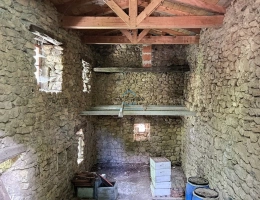
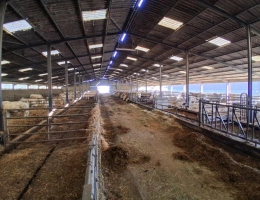
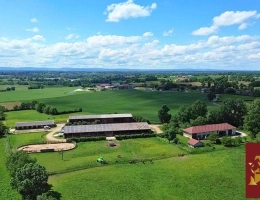
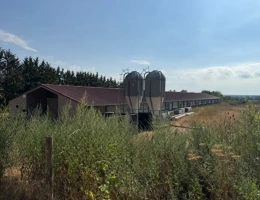
Holdings offered here are seldom pure cropping businesses: buyers often take on a mixed unit whose buildings were put up for a herd or for winegrowing. The question is what can still be used. An old timber-framed shed suits machinery but serves grain poorly, since storage calls for ventilated bins, sound flooring and an intake area lorries can reach. Anyone buying a grain farm in this department also studies access: the width of the lanes, routes through villages, and whether collection lorries can turn. Tractors, drills and cultivation equipment are valued in their own right, harvesting here being frequently done by a contractor.
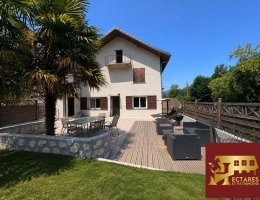
The dwelling changes a great deal locally. Close to Lyon or Villefranche it belongs to an active housing market and can account for a large share of the total price, unrelated to what the crops return. Asking for a breakdown between the house, the farm buildings, the machinery and the land is therefore simple prudence. Where the sale includes outbuildings in the local golden stone, or a farmstead with character, that separation becomes essential to obtaining sensible finance.
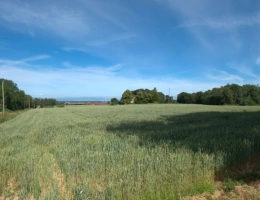
The most regular ploughland lies along the river Saône, between Anse, Villefranche-sur-Saône and Belleville, on alluvial soils carrying maize, straw cereals and spring crops. Above them the Beaujolais slopes remain vineyard country, while the Beaujolais and Lyonnais hills are given over to livestock and grassland, with cereals grown for the herd. To the west, the Arbresle country and the Mornant plateau mix field crops with orchards and vegetables on fragmented blocks. The transfer of the eastern suburbs to the Lyon metropolitan authority removed some of the department's most cultivated plains.
Competition for soil is intense everywhere: housing, infrastructure, leisure horses and non-farming buyers. A block of arable land in a single piece is therefore the exception, and most takeovers combine owned ground with tenanted fields. The more affordable sectors lie in the north of the department and along its western fringes, away from the motorway corridors, where land coming up for sale still finds fewer bidders.
In a department this sought after, planning documents come before anything else: how each field is zoned in the local plan, protection perimeters, infrastructure schemes and deferred development areas can all change what a block may become. Taking over a crop farm also falls under the structures control, the French authorisation regime that measures the area acquired against thresholds set by the regional scheme, while SAFER, the rural land agency, often uses its pre-emption right to steer land towards new entrants.
Tenancy status then needs reading in full: rural leases in force, precarious agreements, land made available to a farming company, any environmental clauses. A fair number of fields are farmed with no written title, a common arrangement but a fragile one for an incoming buyer. Check the water resource too if maize is in the rotation, along with the basic payment entitlements and their transfer before the CAP declaration. Where direct selling is part of the business, the customer base comes with obligations to serve it.
Farmers stepping back, rural estate agencies and notaries across the department post their offers on this page. Pick an area, a budget or a type of production, set up an alert so nothing new escapes you, and carry on searching among arable farms for sale in Auvergne-Rhône-Alpes.


