

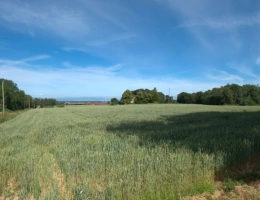
Finding an arable farm for sale in Isère means aiming at the right districts: the Bièvre and Valloire plains, the north of the department and the lower terraces of the main valleys carry maize, wheat and barley, while the alpine massifs remain grassland. Holdings reach the market here through farmers stepping back, through rural land practices and through notaries, and they set out the croppable area, access to irrigation, whether the fields are drained, the storage and the machinery included. They complete our national selection of arable farms for sale.
Alongside the listings you will find the benchmarks a decision needs: local farmland values, the districts where a cereal farm comes on the market, the condition of the buildings and irrigation equipment, and the checks specific to combinable crop systems. If your plan is to set up in farming, our white paper « Créer une exploitation agricole » (in French) describes each stage, from qualification to the takeover plan.
Pricing the land comes first in any plan to buy an arable farm. On the basis of 2025 DVF sales (vineyards excluded), the median in Isère (38) works out at €4,000/ha and the average at €4,555/ha, across 79 transactions. The central range covering 80% of sales runs from €2,497 to €7,089/ha; nationally the median is €5,307/ha.
The SAFER benchmark, the market's second yardstick, gives €4,950/ha in 2025 for vacant land and pasture (-0.2% over twelve months, +5.1% over ten years), beside a national €6,460/ha; tenanted land is worth about 17% less.
The value of a crop farm here is built on more than area: secure access to water, the state of the drainage on heavier ground, how compact the blocks are, storage and drying capacity, the quality of the machinery shed, and the machinery itself. The outlet matters too, whether through a cooperative, a merchant or seed multiplication contracts. Cross-check these headings with our land price observatory, then confirm your figures using our financial calculators.
On a grain farm the inspection starts with water. An individual borehole or a collective supply, the flow and volume authorised, the age of the pumps, the condition of the hydrants, the reels and sometimes the pivots: all of this governs the rotation that is possible and whether contract crops can be grown. On the heavier plateau soils it is drainage that plays the same role, and the layout of collectors and outfalls should be requested. Then come the buildings: the grain store and its ventilated bins, a dryer where there is one, the intake pit, the weighbridge, an enclosed machinery shed and a maintenance workshop.
The machinery line is valued separately, with hours run and servicing for each item; the combine frequently belongs to a machinery cooperative. Where a holding is offered with a dwelling house, land and buildings, a heading-by-heading split is essential, all the more so because proximity to the cities lifts the residential value without adding anything to the working tool. Basic payment entitlements, input stocks and the growing crop transfer through their own documents, which seller and buyer prepare ahead of the CAP declaration.
The Bièvre-Valloire, from La Côte-Saint-André to Beaurepaire, is the department's main pool of arable land, with free-draining soils, widespread irrigation and a strong presence of seed crops. The northern Isère, around Bourgoin-Jallieu and La Verpillière, farms between built-up areas and logistics corridors. The Isle Crémieu and the Rhône plain add to the supply. On the Chambaran plateau and the Terres froides, heavier and colder soils call for drainage and adapted rotations, while the Grésivaudan mixes cropping, grassland and walnut orchards.
Sales stay tight close to Grenoble and along the corridor towards Lyon, where land take and demand from neighbouring farms limit availability. Moving south-west, or up onto the plateaux, brings larger blocks at more reachable prices, but there water and drainage become the central questions when judging potential.
The takeover comes under the structures control, France's authorisation system for farming land, as a declaration or a prefectural authorisation depending on area and on your background, and SAFER, the rural land agency, may exercise its pre-emption right over a farmland sale. On the water side, the Bièvre-Liers-Valloire is an area where abstraction is regulated: make sure the authorisations attached to the parcels are current and that the volumes allocated match the rotation presented. Restrictions imposed in dry spells should be understood before any forecast is built.
On rented parcels the rural lease continues with the buyer: remaining term, rent, environmental clauses and the schedule of condition all repay careful reading. Check too how the land stands under the planning documents, since proximity to business zones can affect the long-term future of certain blocks. Finally, ask for the cropping history, the upkeep of the ditches and how the drainage actually performs after a wet spell.
The offers on this page come from owners, from rural estate agencies and from notaries working in the department. Rank them by area, by price or by irrigable share, set an alert so you hear about new handovers, and extend the search towards the arable farms for sale in Auvergne-Rhône-Alpes.


