

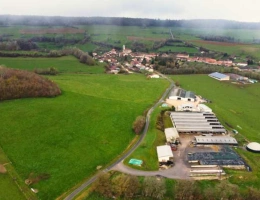
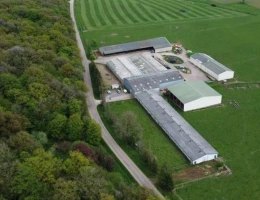
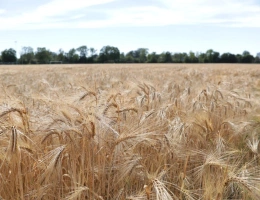
Buying an arable farm for sale in Grand Est means stepping into one of Europe's most productive cropping regions, from the chalk of Champagne across the Lorraine plateaux to the Alsace plain, with rotations that share the ground between wheat, malting barley, rapeseed, maize, sugar beet and lucerne. Farmers handing over, rural land agencies and notaries supply the files published here, stating the cropped area, the soil potential, the drainage network, the storage capacity and the machinery that stays behind. Each one adds to the national count of arable farms for sale.
This page gathers what a listing leaves out: what arable land is worth department by department, where holdings are coming free, how to read a storage complex and the checks to make before signing. If this is a first entry into farming, the white paper « Créer une exploitation agricole » (in French) walks through the sequence, from start-up support to bank funding.
Pricing the land comes first in any plan to buy an arable farm. On the basis of 2025 DVF sales (vineyards excluded), the median in Grand Est works out at €5,611/ha and the average at €7,490/ha, across 1,233 transactions. The central range covering 80% of sales runs from €3,151 to €14,830/ha; nationally the median is €5,307/ha.
The SAFER benchmark, the market's second yardstick, gives €6,510/ha in 2025 for vacant land and pasture (-4.4% over twelve months, 0.0% over ten years), beside a national €6,460/ha; tenanted land is worth about 17% less.
Beyond the cropped area, the worth of a cereal farm in this region turns on soil depth and water-holding capacity, on how compact the block is, on the drainage of the heavier ground, on the bins, dryer and handling line, on the machinery taken over and on the payment entitlements. The delivery arrangement, whether with a cooperative, a merchant or a maltings, counts just as much. Lean on the land price observatory and on our financial calculators to build your offer.
Holdings in this region usually carry serious storage: a bank of steel bins or a flat store, augers and elevators, aeration, temperature probes, a dryer for maize and a weighbridge. Check that the bins are sealed, that the handling chain is sound, that the wiring is compliant and that the capacity genuinely free once delivery contracts are met matches the harvest. The machinery shed is judged on clear height, roof span and floor strength. A fibre-cement roof, common on older farmsteads, should be spotted on the first visit, because replacing it is a heavy item.
Machinery frequently comes with the sale: high-horsepower tractors, drills, a sprayer, cultivation equipment, sometimes a combine held jointly or through a machinery cooperative. Ask for an item-by-item valuation with hours and service history rather than a single round figure. Where the farmstead includes a dwelling, often old and generously sized, keep its value clearly apart from the production tool: the thermal refurbishment such a house calls for has nothing to do with the farming budget.
Marne holds the heart of chalk Champagne, with large holdings, free-draining soils that respond well to management, sugar beet, dehydrated lucerne and malting barley; its cropland ranks among the dearest in France. Aube carries the same chalk on towards Troyes and the Barrois, with comparable farm structures and a similar cropping pattern. Haute-Marne, on the Barrois and Langres plateaux, offers shallower ground and noticeably lower entry prices. Ardennes combines the cereal plain around Rethel with a more pastoral north, where cropping gives way to livestock. Entry prices fall steadily as you move east and south of the chalk.
In Lorraine, Meuse alternates the clay, drained soils of the Woëvre with the limestone Barrois; Meurthe-et-Moselle and Moselle occupy the Lorraine plateau, where wheat, barley and rapeseed dominate on clay loams whose drying governs the working calendar. Vosges remains largely grassland: arable holdings are found mainly on the plain west of the massif, and relatively few of them come onto the market in any given year. Across Lorraine as a whole, entry prices sit well below those of Champagne, which regularly draws buyers from other parts of France looking for a larger acreage for the same budget.
Alsace follows its own logic. Bas-Rhin and Haut-Rhin farm a fertile loamy plain where maize is central, with irrigation common on the free-draining soils of the Hardt, sugar beet in the north and hops in a few districts. Fields are more fragmented and holdings smaller than in Champagne, while urban and peri-urban demand keeps the market tight.
Start with soil and water. On the heavy Lorraine ground and across the Woëvre, drainage governs the potential: ask for the plans, the date of installation, the state of the collectors and outfalls and the ditch maintenance rules. In Alsace, have the borehole status and the abstraction consent confirmed, along with the nitrate vulnerable zone classification, which frames fertiliser use and cover cropping. A recent soil analysis, field by field, is worth far more than the general reputation of a district, and it is cheap next to the sums at stake.
Then the legal frame: a rural lease in place continues with the buyer subject to the landlord's agreement, with its rent level, the structures control and the authorisation to farm, and SAFER's review. Where the business is held in a farming company, buying shares follows different rules from buying land and calls for an accounts audit. Check as well the history of sugar beet or malting barley contracts, the cooperative shares to be taken over and any agri-environmental commitments still running.
What you see here brings together sales run by farmers themselves, by agencies that specialise in rural transactions and by country notaries. Choose your criteria for area, price or department, switch on an alert to hear when a grain farm comes through, and widen the search where needed to the farms for sale in Grand Est.


