

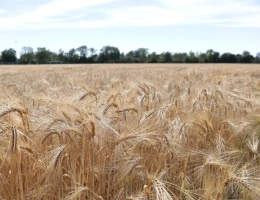
Buying an arable farm for sale in Haut-Rhin calls for an understanding of a department stretched between the Vosges crest and the Rhine, where cropping concentrates on the plain. The Hardt, the Ried and the ground around Colmar and Neuf-Brisach grow mainly grain maize, wheat and diversification crops, under one of the driest climates in France. The properties shown come from farmers arranging a handover, from rural land professionals and from notaries in Colmar, Mulhouse or Altkirch; they describe the irrigation, the drying plant, the field layout and the machinery. They add to the arable farms for sale listed across every region.
This page takes up the questions the listings leave open: where Haut-Rhin land values sit, which districts see holdings come free, how to judge a farmyard on the plain and its drying plant, and what rules govern water and local land ownership. The setting-up route is covered separately in our white paper « Créer une exploitation agricole » (in French).
Pricing the land comes first in any plan to buy an arable farm. Land transaction data does not cover this department (Alsace-Moselle land register), so the figures below are those of the Grand Est region. On the basis of 2025 DVF sales (vineyards excluded), the median in the region works out at €5,611/ha and the average at €7,490/ha, across 1,233 transactions. The central range covering 80% of sales runs from €3,151 to €14,830/ha; nationally the median is €5,307/ha.
The SAFER benchmark, the market's second yardstick, gives €7,510/ha in 2025 for vacant land and pasture (-1.2% over twelve months, +13.6% over ten years), beside a national €6,460/ha; tenanted land is worth about 17% less.
In this department, access to water counts for as much as area. A buyer examines whether the ground is gravel or silt, the borehole and its abstraction permit, the irrigation equipment, how tightly the blocks group together, drying and storage capacity, the state of the combine and the cultivation gear, the basic payment entitlements and the contracted outlet. An arable business able to dry its own maize decides for itself when to sell. Frame your offer with the land price observatory, then model the funding in our financial calculators.
The Hardt rests on gravelly alluvium with a small water reserve: maize succeeds there thanks to irrigation drawn from the Rhine aquifer, and the value of a field depends directly on the borehole that serves it. The Ried and the Ill plain, more silty, hold water better but include waterlogged pockets where drainage is decisive. In the Sundgau, clay soils and slopes call for a different approach, often combined with livestock. Ask for soil analyses, abstraction permits, the drainage plan and results by block before settling on any yield assumption.
The plant matters as much as the land. Check the capacity of the drier and how it is fuelled, bin volume and ventilation, the intake pit, the concrete apron and lorry circulation, then the condition of the reel irrigators, pumps and buried mains. An arable land holding that owns a complete harvesting and drying chain avoids depending on contractors at the busiest moment. Where a square-courtyard farm or an Alsatian house comes with the business, have it valued independently of the farming unit.
The plain, from Neuf-Brisach to Ensisheim, Fessenheim and Ottmarsheim, gathers the holdings most specialised in maize, with reorganised field blocks and established irrigation networks. Around Colmar and Rouffach, cropping shares the ground with market gardening and the foothill vineyard. The Ried, between the Ill and the Rhine, adds flood constraints and protected habitats. In the south, the Sundgau, towards Altkirch, Dannemarie and Ferrette, offers smaller and often mixed farms, where cropping supports grass and ponds. The Vosges valleys fall outside cereal country altogether.
Pressure runs high on the plain, between neighbours expanding, the growth of the Mulhouse and Colmar conurbations and the proximity of the Swiss border. A complete handover there is rare and settles quickly. In the Sundgau and the back country, the entry cost stays more accessible, but you then deal with scattered parcels and buildings designed for mixed farming.
Setting up and expanding both go through the structures control, and SAFER keeps a right of pre-emption once the sale has been notified. The department comes under the local Alsace-Moselle law: property rights are entered in the livre foncier, the local land register, which alters how title, easements and mortgage entries are verified, so have the notary confirm each parcel. Then review the rural leases one by one, with their expiry, their rent and the tenant's right of pre-emption, and have any verbal arrangement between neighbours, still common here, put on a formal footing.
Water deserves particular attention: check the validity and the volume of the permits to abstract from the aquifer, the catchment perimeters, classification as a nitrate vulnerable zone, and the requirements of the flood risk prevention plans in the Ried. Confirm the transfer of basic payment entitlements, that CAP declarations are in order, and that the graphical field register agrees with the areas advertised. A survey of the fuel tanks, the crop-protection store and the electrics completes the visit.
This selection brings together instructions given by farmers selling up, by agencies specialising in rural estates and by notarial offices in the department. Sort by area, by budget or by district, create an alert to follow each new opportunity, and then move on to the arable farms for sale in Grand Est.