

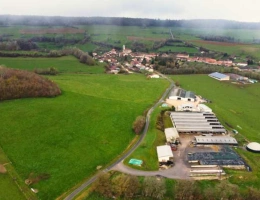
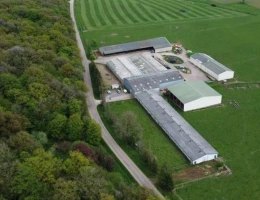
The market for an arable farm for sale in Haute-Marne differs from that of the neighbouring Champagne plain: here the limestone plateaux of Langres and the Barrois, the Vallage and the Bassigny mix cropland, grassland and forest, with often large holdings but shallower soils. Wheat, barley, oilseed rape and sunflower dominate the rotation. The properties shown come from farmers preparing a sale, rural land specialists and notarial offices in Chaumont, Langres, Saint-Dizier or Joinville; they set out the field layout, the share held under tenancy, the storage and the state of the machinery. Look at them together with the arable farms for sale listed elsewhere in France.
This page completes the listing on four counts: where land values stand in the department, the districts where sales come up most often, how to appraise a Haute-Marne farmstead and its installations, and the formalities framing a takeover. The setting-up project itself, from first budget to the paperwork of the handover, is covered in our white paper « Créer une exploitation agricole » (in French).
Pricing the land comes first in any plan to buy an arable farm. On the basis of 2025 DVF sales (vineyards excluded), the median in Haute-Marne (52) works out at €3,500/ha and the average at €4,078/ha, across 169 transactions. The central range covering 80% of sales runs from €2,500 to €6,210/ha; nationally the median is €5,307/ha.
The SAFER benchmark, the market's second yardstick, gives €4,560/ha in 2025 for vacant land and pasture (+11.2% over twelve months, +36.1% over ten years), beside a national €6,460/ha; tenanted land is worth about 17% less.
What separates two farms of comparable size rarely comes down to hectares alone: soil depth and stone content, how far the blocks are scattered across a landscape of plateaux and valleys, drainage on the colder Bassigny ground, bin volume and the presence of a drier, the state of the combine and the tractor fleet, the basic payment entitlements and the contract held with a cooperative or grain merchant. A cereal farm with grouped fields burns less time and fuel. Measure all of this with our land price observatory and our financial calculators.
On the Barrois and Langres plateaux, clay-limestone soils are frequently thin and stony: the water reserve caps potential as soon as a season dries out, and wear on cultivation equipment is an item not to be overlooked. In the Vallage and the valleys of the Marne and the Blaise, deeper silts allow higher yields. To the north-east, the Bassigny needs working drainage to open up drilling windows. Insist on soil analyses, the drainage plan and results block by block: across this relief, a whole-farm average hides sharply contrasting situations.
Many holdings are former mixed crop-and-livestock units turned over to cropping: the buildings carry that history, with disused cattle housing beside newer sheds. Assess real storage capacity, the condition of the bins and the ventilation, the load-bearing concrete apron and access for articulated lorries on sometimes narrow roads. An arable land holding with storage of its own is free of harvest-time queues. The dwelling, often present, should be valued apart from the production tool.
The north of the department holds the best ground: around Saint-Dizier, Wassy and the Vallage, towards Joinville and Doulevant-le-Château, the influence of the Champagne plain makes itself felt and holdings grow larger. The Barrois, between Chaumont and Bar-sur-Aube, combines plateau cropping with woodland. To the south, the Langres plateau pairs cereals with dairying on versatile units. Eastwards, the Bassigny and the Bourbonne-les-Bains country remain grass-dominated, and cropland appears mainly within mixed holdings.
Low population density and abundant forest explain a gentler pressure on land than in the Marne or the Aube: an incoming buyer often has genuine room to negotiate, and the entry cost stays more approachable. In exchange, you accept uneven potential and must plan for the distance to the silos. Ask about delivery distances, the co-operative branches actually within reach and the availability of skilled labour before settling on a district, because those three answers shape the working budget as much as the purchase price does.
The structures control, the administrative authorisation governing new entrants and farm expansion, applies to every takeover, and SAFER may pre-empt as soon as the notary notifies the sale. Study the rural leases field by field, paying attention to long-standing verbal arrangements, common in this department of small communes. If woodland is included in the lot, which happens often here, check for a sustainable management document, the applicable tax regime and the shooting rights granted, which may be dealt with separately from the land.
Then make sure the basic payment entitlements are transferred and declared within the CAP calendar, that environmental designations and catchment protection perimeters do not restrict practices on particular fields, and that the areas in the graphical field register match those advertised. A survey of the tanks, the crop-protection store and the electrical installation in older buildings keeps surprises to a minimum.
Retiring farmers, rural property agencies and Haute-Marne notaries entrust their files here. Select by area, budget or district, set up an alert so no sale slips past, and then move on to the arable farms for sale in Grand Est.


