

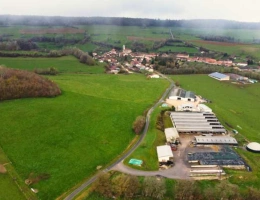
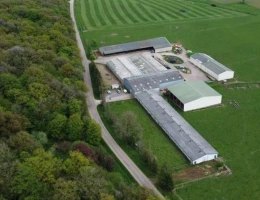
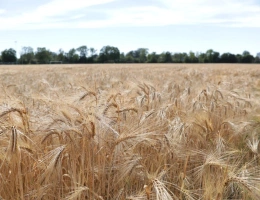
An arable farm for sale in Ardennes belongs to a department split clearly in two: to the south, the chalk Champagne, the Porcien and the Argonne roll out wide plains of wheat, barley and oilseed rape; to the north, the woodland and grass of the Thiérache and the Ardenne massif take over. The files posted here come from farmers arranging their exit, land agencies used to large holdings and notarial offices in Charleville-Mézières, Rethel or Vouziers; they state the rotation followed, how much ground is owned outright, the storage available and the age of the machinery. You will find them beside the arable farms for sale published across the country.
Beyond the sale particulars, this page brings together the land values recorded in the department, the districts where handovers cluster, how to inspect an often elderly Ardennes farmstead and the formalities that frame the arrival of a new occupier. The full route, from feasibility study to funding package, is set out in our white paper « Créer une exploitation agricole » (in French).
Pricing the land comes first in any plan to buy an arable farm. On the basis of 2025 DVF sales (vineyards excluded), the median in Ardennes (08) works out at €5,702/ha and the average at €7,559/ha, across 209 transactions. The central range covering 80% of sales runs from €4,229 to €14,812/ha; nationally the median is €5,307/ha.
The SAFER benchmark, the market's second yardstick, gives €6,850/ha in 2025 for vacant land and pasture (-1.0% over twelve months, +25.0% over ten years), beside a national €6,460/ha; tenanted land is worth about 17% less.
Acreage tells only part of the story. An asking price is also built on the depth of the chalk or the silts, on how tightly the blocks sit around the yard, on the state of the drains in the colder ground, on bin volume and the presence of a drier, on what the machinery is genuinely worth, on the basic payment entitlements and on the commitment given to a cooperative or grain merchant. A cereal farm able to hold its own harvest steers its selling far better. To position your offer, open our land price observatory and our financial calculators.
On the chalk of the southern half, the water reserve is thin and yields hang on spring rainfall; the rotation combines milling wheat, winter or malting barley, oilseed rape, sugar beet and lucerne, the last of these feeding local dehydration plants. In the Porcien and on the pre-Ardennes ridges, capping silts and heavy clays call for maintained drainage and leave narrow windows for fieldwork. Ask for soil analyses, the drainage plan and harvest records block by block rather than a whole-farm average: differences over a few kilometres are wide, and they govern the working value of the arable land as much as its price.
Buildings mix stone and brick barns, often inherited from successive reconstructions, with newer steel-framed sheds. Check the roof structure and covering, the load-bearing concrete apron, articulated-lorry access, the number and condition of the bins, the ventilation and the intake pit. A crop farm with storage of its own escapes the harvest-time queue at the intake point. Where a dwelling forms part of the lot, have it valued separately: the residential market of the Ardennes valleys answers to a logic quite unlike that of the production tool.
The southern half holds most of what comes to market. Around Rethel, Attigny and Juniville, the Porcien plain carries extensive holdings with reorganised field blocks and grain buyers within trailer distance. Towards Vouziers, Machault and the edge of Champagne, chalk dominates and the farms resemble the Champagne model. The Argonne, more wooded and wetter, offers mixed units where cropping sits alongside grassland. North of Charleville-Mézières, towards Rocroi, Signy-l'Abbaye or Sedan, arable land becomes scarce and gives way to pasture and forest.
Value follows that geography. Pressure from neighbours wanting to expand stays strong on the chalk and in the Porcien, where local bidders come forward readily, while an incomer keeps more negotiating room on the Argonne and pre-Ardennes margins. Cost out the distances between blocks before committing: scattered ground taxes every season, in fuel as in tractor hours.
Every takeover falls under the structures control, the prefectural authorisation governing new entrants and farm expansion, and SAFER, the rural land agency, may pre-empt as soon as the notary notifies the sale. Take each rural lease on its own terms, noting when it runs out, the rent applied, any environmental clauses written in and where the sitting tenant stands on pre-emption. A long-standing verbal arrangement between neighbours, common enough here, can undermine the land base of your plan. Where the farm is held in a company, the deal may transfer shares rather than assets, and the tax treatment, the warranties sought and the fate of existing debt change entirely.
Then confirm that basic payment entitlements really are transferred and declared within the CAP calendar, that any abstraction permit is valid, and that no easement arises from drinking-water catchments or valley wetlands. Compare the graphical field register with the areas advertised. Plan an inspection of the fuel tanks, the chemical store and the consumer unit as well, three items a seller close to retirement has often put off.
Retiring owners, rural land agencies and notarial offices add instructions here week by week. Refine by area, budget or district, save an alert to follow every new listing, and then widen the search to the arable farms for sale in Grand Est.


