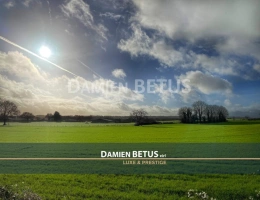

An arable farm for sale in Pays de la Loire looks nothing like one in the Paris basin. The region sets the southern Vendée plain beside the Baugeois and Saumurois plateaux, the Champagne mancelle in northern Sarthe, and a hedged bocage where wheat and maize share the rotation with forage ground. Our mandates come from farmers arranging their handover, from rural agencies and from country notaries; they state the rotation, the soil type, the condition of the drainage, how grouped the blocks are and what grain storage stands on the yard. You will find them too among the arable farms for sale across France.
This page goes further than a list of adverts: the value of cropping land in the region, the departments where handovers surface, how to assess the buildings and machinery of a crop farm, and the formalities that govern setting up. If you are studying a first acquisition, our white paper « Créer une exploitation agricole » (in French) walks through the administrative and financial steps in the order they arise.
Pricing the land comes first in any plan to buy an arable farm. On the basis of 2025 DVF sales (vineyards excluded), the median in Pays de la Loire works out at €3,267/ha and the average at €3,842/ha, across 1,873 transactions. The central range covering 80% of sales runs from €1,990 to €6,500/ha; nationally the median is €5,307/ha.
The SAFER benchmark, the market's second yardstick, gives €4,100/ha in 2025 for vacant land and pasture (+1.5% over twelve months, +11.7% over ten years), beside a national €6,460/ha; tenanted land is worth about 17% less.
On a cereal farm on the market in Pays de la Loire, acreage tells only part of the story. Drainage quality and how well the ground carries machinery, the grouping of fields around the steading, covered grain capacity, lorry access, the age of the harvesting chain, the basic payment entitlements transferred and the distance to a collection silo or an estuary port all weigh on the price. Place the asking figure with our land price observatory, then test your plan using the financial calculators.
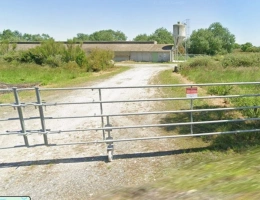
Buildings here often mix old tuffeau or schist outhouses with newer steel sheds. Check the frame and roof, how much covered space is genuinely usable for machinery, the electrical supply and its capacity, and whether there is a workshop, a pit and a compliant crop protection store. Grain storage, where it exists, changes the economics of the holding: bins, aeration, temperature probes, an intake pit and, on maize-heavy rotations, a dryer or drying bins. Plenty of farms sold in this region deliver the whole harvest to the cooperative for want of storage; having your own opens the door to merchant sales and spreads marketing through the year.
Judge the fleet by use rather than by count: hours on the clock, a proper service record, implement widths that match field size, and the exact legal status of each machine, owned outright, on lease or held jointly with neighbours. Where the sale bundles house, outbuildings and arable land, ask for a price broken down item by item, including standing crops and stocks at the date of entry: that breakdown drives the funding, the tax treatment and the fees.
Vendée offers the most plainly arable ground, in the southern plain around Luçon and Fontenay-le-Comte, where soft wheat, oilseed rape, sunflower and barley dominate deep soils, partly irrigated from hillside reservoirs. Maine-et-Loire brings together the Baugeois plateau, the Saumurois and the Loire and Layon valleys, with a seed multiplication tradition that rewards well-grouped fields. Sarthe relies on the Champagne mancelle and the Loir valley, where soils are more variable and drainage is decisive; land there stays more affordable than in the Vendée plain.
Mayenne and Loire-Atlantique belong first to bocage and livestock: cereals accompany a dairy or suckler unit and are usually sold with it, so the two values must be separated. Northern Loire-Atlantique, towards Châteaubriant and Nozay, offers mixed holdings that can be converted, while the pays de Retz and the marsh fringes come with fragmented field patterns. Proximity to the estuary port silos makes export marketing straightforward, an argument seldom stated in listings but real for a buyer who intends to sell to merchants.
Water comes first. Much of the region is classed as a nitrate vulnerable zone under the French application of the nitrates directive: catch crops between harvests, grass buffer strips along watercourses and ceilings on nitrogen applications bind the incoming farmer. Wetlands and marsh sectors add restrictions on drainage and on ploughing up grassland, which deserve a field-by-field check before any offer. Where irrigation exists, the abstraction permit, its volume and any rota transfer with conditions the vendor should supply in writing.
Then come land tenure and company matters. A great deal of ground is rented: the French farm tenancy continues with the buyer subject to the landlord's agreement, and the takeover needs an authorisation to farm under the structures control, the French regime that vets who may take on farmland. The SAFER rural land agency is notified of sales and may pre-empt. Where the business sits inside a company, the deal is a share transfer rather than a sale of assets: check liabilities, cooperative commitments and tenancies before signing.
Retiring farmers, rural estate agencies and notaries lodge their mandates here. Narrow by department, area or budget, set an alert so no new listing slips past you, and open the search to every farm for sale in Pays de la Loire if a mixed system would suit your project.