


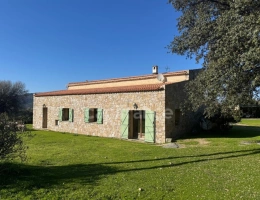
Finding an arable farm for sale in Corsica takes time and patience: the island grows few cereals on a large scale, and its durum wheat, barley, oats or maize usually sit alongside livestock, citrus or vines. Supply is concentrated in the irrigated plains and the lower plateaux. The holdings shown here come from farmers stepping back, from rural agencies and from notaries, and state the cropped area, the water supply, the farm buildings and the machinery left in place, down to the irrigation fittings and the access track. They join the national inventory of arable farms for sale.
On an island where farmland rarely changes hands, benchmarks matter before you commit: what local cropland is worth, which districts bring holdings to market, the true condition of sheds and irrigation equipment, and the formalities of taking over a crop farm. Our white paper « Créer une exploitation agricole » (in French) sets out the steps into farming, from the agricultural qualification to the funding package.
Pricing the land comes first in any plan to buy an arable farm. On the basis of 2025 DVF sales (vineyards excluded), the median in Corse works out at €5,012/ha and the average at €5,445/ha, across 19 transactions. The central range covering 80% of sales runs from €1,980 to €10,317/ha; nationally the median is €5,307/ha. * Fewer than 30 recorded sales: indicative value.
With no local SAFER average published, the French reference applies: €6,460/ha for vacant land and pasture, €5,350/ha for tenanted land.
Beyond the hectares, an island deal turns on access to water and on connection to the irrigation network, on how flat and how grouped the fields are, on the quality of the shed and the storage it offers, on machinery suited to short working windows, and on local outlets, a cooperative, a mill or neighbouring stock farmers, that can absorb a harvest without a sea crossing. Place those against the land price observatory and test several scenarios with our financial calculators.
On the island the buildings are often worth as much as the land. A roofed, aerated shed with lorry access and a sound concrete floor is a lasting asset, because farm construction is expensive here and consents take time. Look at the usable storage capacity, how grain is protected from damp and pests, the state of a roof and frame exposed to wind and salt air, and the electricity supply. Check the connection to the collective irrigation network as well, along with the meter, the subscription taken out and any reservoir or borehole on the holding itself.
Machinery deserves close attention, since specialist kit is slower and dearer to bring over than on the mainland. A tractor suited to slopes, sound cultivation equipment and access to a contractor or a shared combine at harvest are concrete advantages. Where a dwelling house forms part of the sale, press for a clear split between the house, which is often sought after in its own right, the farmland and the production tool, because those three do not follow the same market.
Haute-Corse holds most of the island's arable land. The eastern plain, running from the Casinca down past Aléria, offers deep alluvial soils, more regular field blocks than elsewhere and an irrigation network managed island-wide; cereals there sit next to citrus groves, vines and forage ground, and holdings are larger than the island average. The Balagne, around Calvi and Île-Rousse, has kept a tradition of cereals and pulses on lighter soils, though tourist demand pushes the price of any available land well beyond its farming value. Elsewhere the maquis and the relief keep mechanised ground scarce.
In Corse-du-Sud, cultivated ground is found mainly in the lower valleys and coastal plains, towards the Taravo, the Sartenais and the Figari area, where annual crops often serve as forage back-up for sheep and cattle. Cereal land coming onto the market there is occasional at best, and usually surfaces through a family handover or the reorganisation of an estate, so the sensible approach is to watch the market over time rather than wait for an immediate opening. Areas are modest and ownership is often split between several heirs, which complicates any plan to expand.
Title comes first. A share of Corsican rural property carries long-standing undivided ownership and incomplete deeds; a sale may require the title to be rebuilt beforehand, sometimes a slow process that the notary will cost and schedule. Have the cadastral position confirmed, along with rights of way and irrigation easements and the legal standing of the access track. Check the planning classification too, the wildfire exposure and the clearance obligations, which impose regular management of the surroundings and can bear on insuring the buildings.
On the farming side, the sale goes through the structures control, France's authorisation regime for taking over farmland, and comes to SAFER's attention, while any rural lease in place continues with the buyer subject to the landlord's agreement. Confirm the transfer of the basic payment entitlements, whose value varies from holding to holding, and the water actually available for the coming season. A grain farm here is only properly judged after a visit in the dry months, when the limits of the system show.
Holdings reach this page by three routes: an owner selling directly, a rural agency acting under mandate, or a notary handling an estate. Pick an acreage, a price bracket or a district, set an alert so nothing slips past you on a thin market, and browse the farms for sale in Corsica as well, where estates combine annual crops, grazing and plantations.


