

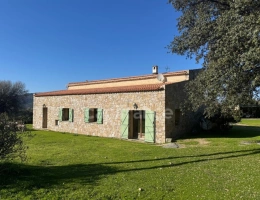
A farm for sale in Corsica rarely resembles what you find on the mainland: a flock of ewes or goats run on open grazing, free-range pigs finished under the chestnut trees, a chestnut grove in the Castagniccia, a citrus orchard on the eastern plain, an olive grove in the Balagne or a vineyard estate in the Nebbio. Island farming rests on modest-sized units, on extensive livestock and on quality-label productions that carry the added value. The holdings shown here are entrusted to us by island farmers approaching retirement, by rural property specialists and by notaries; each listing indicates the usable area, the nature of the grazing, how the land is held and the equipment taken over. They also appear in our national selection of farms for sale in France.
Four things settle the decision here: land values in both departments, the sectors that shape the island, the districts where supply comes up, and the checks that matter most — beginning with title to the land. Before committing, our white paper « Créer une exploitation agricole » (in French) lays out the legal, administrative and financial steps involved.
Land forms the base of a farm's value. DVF, the property sales database published by the French tax administration (vineyards excluded), records a 2025 median of €5,012 per hectare in Corse, an average of €5,445 and 19 sales; four transactions in five fall between €1,980 and €10,317, against a national median of €5,307. * Fewer than 30 recorded sales: indicative value.
These figures place regional land values; they do not price a farm, which depends first on its buildings, its herd and its outlets. For department-level detail, see our land price observatory, then cost your purchase with our financial calculators.
| Department | DVF sales 2025 | Median price/ha | SAFER vacant land |
|---|---|---|---|
| Corse-du-Sud (2A) | 6 | €5,435 * | n/a |
| Haute-Corse (2B) | 13 | €5,012 * | n/a |
Livestock dominates the farmed landscape. Dairy ewes and goats move between lowland and mountain with the seasons, their milk feeding a celebrated farmhouse cheese tradition. Pigs are raised outdoors and finished on chestnuts and acorns, while hardy cattle make use of the roughest grazing. Crop production is split between fruit growing and vines: clementines and kiwifruit on the eastern plain, mountain chestnut groves, olives in the Balagne and the Sartenais, almonds, and vineyards spread across Patrimonio, Cap Corse, Ajaccio, Sartène, Figari and Porto-Vecchio. Beekeeping and aromatic plants from the maquis complete the picture.
For a buyer, the island calls for a different reading of capital. The value of a working farm depends less on the area owned than on access to grazing, control of water and membership of a quality scheme. An on-farm processing unit meeting current standards, a loyal local customer base and direct-sale outlets count as much as the herd itself. Declared areas often include maquis and scrub whose real productivity has to be judged on the ground, walking the blocks with the outgoing farmer.
Haute-Corse (2B) holds most of the cultivated land. The eastern plain, from Aléria to the Casinca, concentrates citrus orchards, kiwifruit and irrigated ground; the Castagniccia carries the chestnut groves and a still living mountain livestock economy; the Balagne combines olives, vines and grazing; the Nebbio and Cap Corse live on vines and olives; the Niolu, the Corte basin and the Boziu belong to high-altitude pastoralism.
Corse-du-Sud (2A) leans more towards extensive livestock and vines. The Sartenais, the Taravo valley and the Alta Rocca carry sheep, goat and pig enterprises run over wide stretches of grazing, with a significant share of undivided or commonly held land. The districts around Ajaccio, Figari and Porto-Vecchio combine appellation vineyards, olive groves and forage crops, in a setting where farmland competes directly with residential and tourist use.
The steadiest supply comes from the interior and the valleys, where farms are given up regularly and buyers are scarce: these are often fragmented holdings, sometimes far from the farm buildings. The coast and its immediate hinterland hold the highest values and the most contested parcels. Between the two, the irrigated eastern plain is the island's best structured market, with orchards in full bearing and infrastructure already in place.
Corsica faces a land situation with no equivalent elsewhere in France. A significant share of parcels remains in undivided ownership, sometimes across several generations, or lacks a properly registered title. Before making an offer, have the notary establish the chain of ownership, the full list of co-owners and the state of any unsettled estates; title restoration has progressed a great deal, but it still has to be checked parcel by parcel. A contract signed on a poorly titled property can stall for years, freezing the whole project.
Planning constraints specific to the island come on top of that: the regional development plan protects strategic farming areas, coastal legislation frames building in seaside communes, and fire risk imposes regulated clearance around buildings and access tracks. Irrigation, supplied on the eastern plain by the regional hydraulic works, is far less certain elsewhere: the water point, its authorisation and its summer flow should all be verified before purchase.
Every agricultural sale is notified to the Corsican SAFER, which may exercise its pre-emption right and then allocate the property to the candidate it chooses, giving priority to new entrants and to keeping pastoral activity alive. Meeting the agency before the property goes on the market, with costed plans in hand, works better than negotiating alone with the seller.
Working the land also calls for an authorisation to farm: the regional plan fixes the area thresholds and ranks competing applications. Finally, actual occupation has to be checked on the ground: a written farm tenancy, a multi-year grazing agreement, or the verbal arrangement still common on the island. An agricultural property crossed by the flocks of an established grazier will not come free at the buyer's convenience, and is not financed on the same terms.
Island sellers, rural property specialists and notaries in both departments publish their instructions here. The search narrows by department, production, area or budget, and an e-mail alert warns you as soon as a matching holding appears. Selling a farm calls for a detailed listing, which you put online yourself. The mainland market can be browsed from farms for sale in France.



