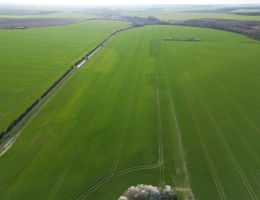
An arable farm for sale in Centre-Val de Loire sits in one of the country's major wheat, barley and rapeseed regions, stretching from the Beauce plateau down to the plains of the Berry. The files gathered on this page reach us from farmers organising their handover, from firms that deal in rural land and from notaries; each one sets out the cropping plan, the soil type, the shape of the block, the water resource where irrigation exists, and the shed, grain bins and machinery included in the deal. What you find here also belongs to the national picture of arable farms for sale.
A listing rarely says what decides a purchase. So this page adds the value of arable land across the region, the farming districts where holdings come up most often, how to judge a grain store, and the controls that go with any transfer of farmland. Our white paper « Créer une exploitation agricole » (in French) covers the route into farming, from the funding plan to the agricultural qualification.
Pricing the land comes first in any plan to buy an arable farm. On the basis of 2025 DVF sales (vineyards excluded), the median in Centre-Val de Loire works out at €5,480/ha and the average at €5,892/ha, across 1,195 transactions. The central range covering 80% of sales runs from €3,003 to €9,349/ha; nationally the median is €5,307/ha.
The SAFER benchmark, the market's second yardstick, gives €6,260/ha in 2025 for vacant land and pasture (-6.1% over twelve months, +8.3% over ten years), beside a national €6,460/ha; tenanted land is worth about 17% less.
Acreage alone never settles a price. On a crop farm in this region, value rests on the real agronomic potential of the fields, on how tightly they group around the yard, on the state of the drainage and irrigation kit, on the capacity of the bins and dryer, on the machinery taken over and on the basic payment entitlements attached to the holding. Read those against the series published by the land price observatory, then put figures on the deal with our financial calculators.
A cereal farm is weighed first on the storage it offers. Look at bin capacity measured against the harvest, aeration and temperature monitoring, whether a dryer and an intake pit are present, clear height under the shed, the strength of the concrete floor, the weighbridge and access for articulated lorries. A sound, well-aerated building lets you hold grain and sell when you choose rather than off the combine, and that freedom is priced into the asking figure. Uninsulated sheeting, an asbestos roof or dated wiring pull the other way and should be costed before you make an offer.
Machinery is a separate line, and a heavy one in arable farming: tractors, drills, sprayer, cultivators, and a combine where it is neither jointly owned nor replaced by a contractor. Ask for hour meters, service invoices and the ownership arrangement, because that figure shapes the whole funding plan. Where a dwelling house is part of the sale, insist on a line-by-line split between house, farm buildings, machinery and land: your bank, SAFER and the tax authorities each read those items differently.
Eure-et-Loir holds the heart of the Beauce, with deep loamy soils, reorganised field blocks, large holdings and some of the most contested land in France; the Perche, in the north-west, follows a more mixed pattern. Loiret carries that same plateau on towards Pithiviers and adds the Gâtinais, where sugar beet and field vegetables take a real share of the rotation. Loir-et-Cher sets the Petite Beauce, firmly arable in the north, against the sandy and wooded Sologne in the south, where cropland gives way to lakes and forest. Field blocks on the plateau are large and well served by road, which counts when grain leaves the farm by lorry.
Further south, the Champagne berrichonne covers much of Cher and Indre: clay-limestone soils, often shallow, dominated by straw cereals and rapeseed, with entry prices gentler than on the Beauce and steady handovers around Bourges, Issoudun and Châteauroux. The Boischaut, more hedged, mixes cropping with livestock, while the Brenne, west of Indre, stays a country of lakes and meadows where arable cropping holds little ground and holdings trade on quite different terms. Indre-et-Loire rounds out the region with the Champeigne and Sainte-Maure plateaux, where irrigated rotations sit alongside vines and orchards, which lifts the price of any field with a reliable water supply.
Water governs a great deal here. Part of the region works under volume-based abstraction management, notably over the Beauce aquifer: check that the borehole is properly registered, that the allocated volume passes to the buyer and that the collective management body has the holding on its books. Ask about drainage too, which is widespread on the heavier soils: request the network plans, their age, the condition of the outfalls and the ditch maintenance record. A blocked or undocumented network is expensive to put right and holds yields down for years.
Legally, much of the land is farmed under tenancy. A French rural lease continues with the buyer, subject to the landlord's agreement, and the sale remains subject to the structures control, the authorisation regime for taking over farmland, and to SAFER's pre-emption right. Settle with the seller how the basic payment entitlements transfer and when the annual CAP declaration is filed, since that deadline is unforgiving. Finally, look at commitments to the cooperative or the grain merchant, the shares to be taken over and any crop contracts still running.
Offers here are posted directly by farmers, handed to agencies that specialise in rural property, or followed through by notaries. Set the filters on the acreage, budget or department you have in mind, ask to be told by e-mail when a grain farm comes to market, and keep an eye on the farms for sale in Centre-Val de Loire, since some of them lend themselves to an arable rotation.