

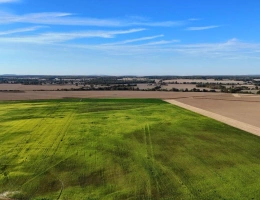
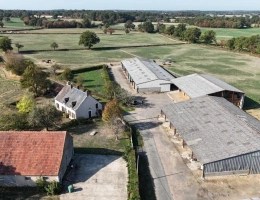
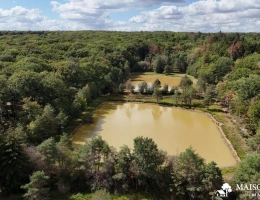
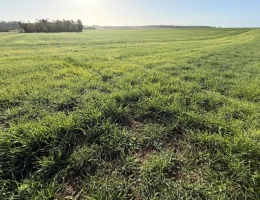
Hunting for an arable farm for sale in Cher leads first to the Champagne berrichonne, a wide open plain where milling wheat, barley, oilseed rape and sunflower share the cropping on heavily mechanised units. The files gathered here come from working farmers arranging their handover, from advisers specialising in rural land and from notaries in Bourges, Vierzon or Saint-Amand-Montrond; they give the area farmed, the balance between owned and rented ground, the irrigation kit where there is any, the storage capacity and the machinery included. You can weigh them against the other arable farms for sale offered around the country.
What follows covers what the sale particulars leave aside: where land values sit in the Berry, which small districts keep renewing the supply, how to read a plain-country silo and drier, and the obligations framing the takeover of a cereal farm. Our white paper « Créer une exploitation agricole » (in French) helps in parallel with building the funding plan.
Pricing the land comes first in any plan to buy an arable farm. On the basis of 2025 DVF sales (vineyards excluded), the median in Cher (18) works out at €4,750/ha and the average at €5,310/ha, across 199 transactions. The central range covering 80% of sales runs from €2,993 to €8,952/ha; nationally the median is €5,307/ha.
The SAFER benchmark, the market's second yardstick, gives €5,770/ha in 2025 for vacant land and pasture (+1.1% over twelve months, +7.6% over ten years), beside a national €6,460/ha; tenanted land is worth about 17% less.
The worth of a holding goes well beyond its area. It takes in the depth of soil above the limestone, how evenly agronomic potential runs from field to field, a licensed water resource and the irrigation equipment that goes with it, how tightly the blocks sit together, bin storage capacity, the output of the drier, the state of the machinery fleet, the basic payment entitlements and the commitments given to a cooperative or a grain merchant. To position your offer, lean on our land price observatory and our financial calculators.
In the Champagne berrichonne, shallow clay-limestone soils lie over fissured rock: water reserves are short and the season's outcome hangs on spring rainfall, which explains the place irrigation has taken on spring-sown crops and the premium attached to a serviceable network. Further north, the Pays Fort and the Loire terraces carry siltier ground that behaves quite differently; in the Sologne, acid sands and woodland leave little room for cash crops; to the south, the Boischaut remains grassland and suckler beef country. Ask for the analyses, the soil map, yields block by block and the record of field operations before making a move.
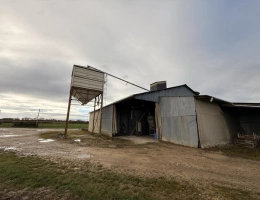
Buildings typically combine a Berry farmstead, machinery sheds and a bank of bins. Examine the slab, the ventilation, the reclaim auger, the intake pit and the weighbridge if there is one, along with access for articulated outfits. A grain farm equipped to dry and hold its own harvest gains real freedom in marketing. The dwelling, sometimes a house of some character, deserves a separate valuation: the rural residential market of the Berry answers to criteria quite unlike those of the working unit.
The Champagne berrichonne, stretching south and west of Bourges towards Dun-sur-Auron, Lignières and Charost, holds most of the large cash-cropping businesses: this is where deals involve the widest acreages, where storage is best developed and where competition between neighbours runs hottest. The Sancerrois and the Pays Fort, to the east, mix cropping, livestock and vines across sharper relief, so complete units are scarcer. The Sologne, in the north, is mainly forest, ponds and shooting country and rarely offers cropping ground. The Boischaut Sud, around Châteaumeillant and its hedged landscape, offers mixed holdings that are easier on the budget.
Values follow those contrasts: they peak on irrigable, well-grouped plain land and ease off in the southern bocage. A crop farm with a licensed borehole and adjoining fields naturally sits at the top of the range, whereas fragmented arable land some distance from the yard, with no storage of its own, leaves room for discussion and mostly draws in neighbours who are looking to expand rather than incoming buyers.
A takeover falls under the structures control, the administrative authorisation governing entry into farming and expansion, and SAFER, the rural land agency, may exercise pre-emption as soon as the notary notifies the sale. In a department where tenancy accounts for a large share of the ground, reading the rural leases is decisive, from the years still to run and the rent charged to the environmental clauses and the occupier's priority to buy. Irrigation calls for particular care: the abstraction permit, the volume allocated, any membership of the collective water management body, and the condition of the borehole and reels all decide what fields advertised as irrigable are really worth.
Check too the nitrate vulnerable zone classification and the soil cover obligations flowing from it, the protection perimeters around drinking water catchments, any conservation designations along the valleys, the transfer of basic payment entitlements and compliance of the crop-protection store. Where the farm is run through a company, decide early between buying shares and buying the land and buildings outright, because the two routes differ in tax, in the warranties you obtain and in the time they take.
This selection brings together sales entrusted by retiring farmers, by rural estate agencies and by notaries practising in the Berry. Use the area, price and location filters, set up an alert so that no new listing slips past you, then take your search further towards the arable farms for sale in Centre-Val de Loire.


