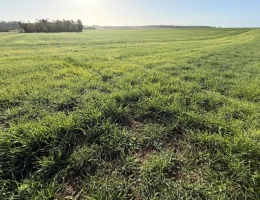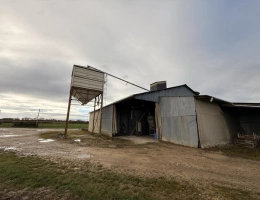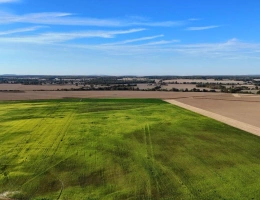
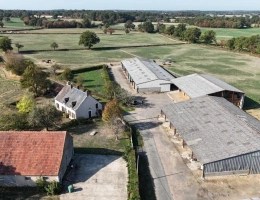
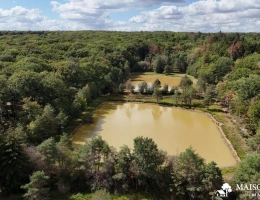
Few departments offer so much area for comparable capital: farms for sale in Cher commonly take the form of large blocks, grouped parcels and solidly built steadings, inherited from a tradition of arable cropping and extensive stock. Retirements are running well ahead of local entries, which opens the door to buyers from outside the Berry. Holdings are entrusted to us by farmers ceasing activity, by landowners, by Berry notarial offices and by specialist agencies; the listing gives the area, the soil types, how the parcels are occupied and which buildings are included. They complete our picture of farms for sale in France.
This page gathers what supports a decision: the level of land values in the Berry, the sectors carrying each farming district, the areas releasing the most holdings, and the consents to anticipate. For a takeover outside the family, common here, our white paper « Créer une exploitation agricole » (in French) sets out the steps, the grants and how to build figures a lender will accept.
Land forms the base of a farm's value. DVF, the property sales database published by the French tax administration (vineyards excluded), records a 2025 median of €4,750 per hectare in Cher (18), an average of €5,310 and 199 sales; four transactions in five fall between €2,993 and €8,952, against a national median of €5,307.
The SAFER land value benchmark sets €5,770 per hectare for vacant land and pasture offered for sale in the same year, +1.1% over one year and +7.6% over ten, against €6,460 nationally. Land sold with a tenancy in place is valued at €5,130, a discount of about 11%.
Against the Centre-Val de Loire region, whose median is €5,480 per hectare, this department sits 13% lower. For commune-level detail and comparisons with neighbouring areas, see our land price observatory, then cost your purchase with our financial calculators.
The Champagne berrichonne, covering the centre and west, belongs to arable cropping: wheat, barley, rape and sunflower on shallow limestone soils, worked in wide mechanised blocks. The south, from the Boischaut to the Lignières and Châteaumeillant country, stays given over to suckler herds of Charolais cattle on hedged pasture. The slopes of the Pays Fort and the Sancerrois carry goat enterprises whose cheeses hold recognised appellations, often with an on-farm dairy. Sheep flocks survive on the driest ground, while the Sologne corner joins woods, ponds and rough grazing.
That gradient dictates the shape of a purchase. On the limestone plains, value lies in area, in the evenness of the blocks and in heavy machinery, with few livestock buildings. In the south it lies in the herd, the quality of the swards, the fencing, the water points and the usability of the housing. A mixed working farm of the kind found on the margins calls for a check that each enterprise stands up alone, since buyers frequently drop one of them.
The Champagne berrichonne, around Bourges, Dun-sur-Auron, Charost and Saint-Amand-Montrond, holds the largest structures and the land neighbours most want for expansion. The Pays Fort and the Sancerrois, to the north-east, layer vines, goat herds and cropping over flinty clays; ground there is more divided and the market narrower. The Sologne, north-west towards Aubigny and Brinon, mixes acid sands, forest and ponds, where properties often answer a sporting purpose as much as a farming one. The Boischaut Sud and the Marche, on the Creuse border, are the grass country of the department.
It is in that hedged south, and on the edges of the Champagne, that supply renews fastest: retirements come one after another, local candidates are scarce and entry values stay well below those of the cereal plains. A medium-sized agricultural property, buildings included, remains within reach of a properly advised entrant, which is no longer true everywhere in the wider Paris basin.
On the Champagne berrichonne, water comes before everything else. The limestone soils are shallow and exposed to summer deficits; irrigation, drawn from boreholes or from the Cher, the Auron and the Arnon, depends on permits, on volumes shared among irrigators and on restrictions imposed when flows fall. A served and equipped block does not compare with a parcel farmed dry. Ask for soil analyses, working depth and yield history, which vary widely within a single commune.
On procedure, the notary informs SAFER du Centre of every sale; it may step into the buyer's place and reopen a call for candidates, new entrants being among its stated priorities. Farming the land requires an authorisation under structural control, with thresholds fixed by the Centre-Val de Loire regional plan. A sitting tenant keeps a priority right to buy and a protected lease, so on a largely let holding possession may be deferred for years. Part of the department also lies in a nitrate vulnerable zone, with compulsory soil cover and a fertilisation plan.
Listings appear as Berry careers close and farming companies are wound up, with a peak after harvest. Narrow the list by production, by area, by the presence of livestock buildings or by budget, then have new entries sent to you by e-mail. Sellers and their advisers post directly. To set the department back in its regional context, see farms for sale in Centre-Val de Loire.