

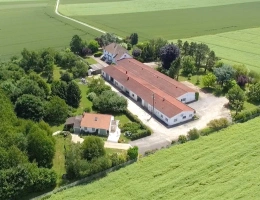
Looking for an arable farm for sale in Île-de-France means looking at the heart of the Paris Basin: broad loam plateaux under wheat, barley, oilseed rape and sugar beet, farmed by large, highly mechanised holdings with blocks of land close to the yard. The properties listed here are entrusted by farmers organising their handover, by firms specialising in rural land and by notaries; each listing states the cropped area, whether the land is owned or rented, the machinery included in the sale and the storage capacity on site. They also appear among the arable farms for sale throughout France.
This page adds what the listings leave out: cropland price levels across the region, the departments and plateaux where holdings come up, how to judge a shed, a dryer or a run of storage bins, and the checks to make before offering. The route to setting up in farming is set out step by step in our white paper « Créer une exploitation agricole » (in French).
Pricing the land comes first in any plan to buy an arable farm. On the basis of 2025 DVF sales (vineyards excluded), the median in Île-de-France works out at €7,465/ha and the average at €7,932/ha, across 214 transactions. The central range covering 80% of sales runs from €5,253 to €10,940/ha; nationally the median is €5,307/ha.
The SAFER benchmark, the market's second yardstick, gives €8,190/ha in 2025 for vacant land and pasture (+5.7% over twelve months, +7.5% over ten years), beside a national €6,460/ha; tenanted land is worth about 17% less.
Land is only part of the value. What is really negotiated is the agronomic potential of the soils and how steady their yields are, the drainage on the heavier plateaux, any borehole and irrigation network, the size of the blocks and their distance from the farmstead, then the storage buildings, the machinery, the basic payment entitlements attached to the holding and the strength of the outlet, co-operative or grain merchant. Place the local market with our land price observatory, then cost your project with our financial calculators.
Everything starts with the land. The deep loams of these plateaux are among the most productive arable land in the country, yet their value rests on details a listing rarely spells out: working depth, water-holding capacity, how well the soil carries machinery in autumn, the age of the drainage network and how far the fields lie from the yard. A cropping plan built on a long rotation, combining straw cereals, oilseed rape, sugar beet and pulses, is easier to take over than a tight run of wheat and barley that has tired the soil. Fields run under conservation agriculture, or certified organic, count as a separate asset with their own history and contracts.
The farmstead then weighs heavily on the asking price. Ventilated storage with sized bins, a working dryer and a shed housing the combine and the cultivation train give marketing freedom that delivery straight to a co-operative silo never provides. Machinery, often sold separately, should be taken over item by item. Where a dwelling house is included, sometimes an old Brie courtyard farm, it is wise to have the house, the working buildings and the land valued apart, since the three answer to quite different markets.
Seine-et-Marne carries most of the region's crop production: the Brie loams, the Multien to the north, the Gâtinais and the Loing valley to the south, with large cereal and sugar beet businesses and a reasonably active handover market. The Yvelines combine the Mantois, the Drouais and the Saclay plateau with sustained pressure on land, which makes complete holdings scarce. The Essonne carries the Beauce northwards around Étampes, on wheat land with a long reputation, while the Hurepoix mixes cropping with urbanised edges. The Val-d'Oise rests on the Vexin français and the plaine de France, continuing the plateaux of the Oise.
The three inner departments, Hauts-de-Seine, Seine-Saint-Denis and Val-de-Marne, are largely built up: what comes on the market there is marginal, limited to a few cultivated blocks, notably on the Brie plateau in Val-de-Marne, and almost never amounts to a crop farm that can be taken over as it stands. Everywhere, urban growth and planning projects govern how much land is available: the further you move from the conurbation, east into Seine-et-Marne or north into the Val-d'Oise, the more regularly coherent units come up with land and buildings together. Widening the search to the neighbouring departments is often the realistic answer.
The first check concerns the status of the land. A large share of the regional area is rented: the rural lease carries on with the new farmer, subject to the landlord's agreement, so every lease should be read, along with the rent paid, the renewal dates and any notice already served. The transaction goes through the structures control, the French prior-authorisation regime governing how far a holding may be enlarged, and through SAFER's pre-emption right. Transferring the basic payment entitlements calls for explicit clauses in the deed, as do the commitments already made under the Common Agricultural Policy for the season under way.
Technical and environmental checks follow: the real output of any borehole and its abstraction licence, the upkeep of drainage collectors, rights of way, no-spray buffers along dwellings, protected water catchments and local rules on cover crops and fertilisation. A local plan under revision, or an infrastructure project nearby, can change what certain blocks are worth. Finally, ask for clarity on the supply contracts running with the co-operative or the merchant, and on multi-year commitments attached to individual fields.
Retiring farmers, rural estate agencies and notaries feed this Île-de-France selection, which turns over as generations hand on. Narrow it by cropped area, by department or by budget, say whether the yard and buildings must be included, set an alert so new listings reach you as they appear, and carry your search on through all the farms for sale in Île-de-France if you need a wider view.


