

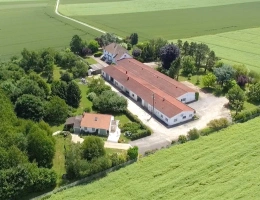
Hunting for an arable farm for sale in Val-d'Oise means looking at open-field farming on the doorstep of Paris: milling wheat, barley, oilseed rape, sugar beet and pulses share the silt plateaux of the Vexin français, the Pays de France and the ground above the Oise valley. What reaches the market comes from farmers arranging their handover, from firms specialising in farmland around the capital and from notaries in Pontoise, Magny-en-Vexin or Luzarches; the particulars set out the cropping plan, the share held on tenancy, the storage buildings and the machinery included. Each one also sits among the arable farms for sale listed nationwide.
Beyond the listings, this page frames the decision: where local land values sit, which districts genuinely release holdings, how to judge a bank of bins and a drier, and what to verify where building land keeps advancing. Our white paper « Créer une exploitation agricole » (in French) covers the legal and financial side of setting up.
Pricing the land comes first in any plan to buy an arable farm. On the basis of 2025 DVF sales (vineyards excluded), the median in Val-d'Oise (95) works out at €8,872/ha and the average at €9,484/ha, across 20 transactions. The central range covering 80% of sales runs from €6,991 to €12,121/ha; nationally the median is €5,307/ha. * Fewer than 30 recorded sales: indicative value.
The SAFER benchmark, the market's second yardstick, gives €8,810/ha in 2025 for vacant land and pasture (+3.6% over twelve months, -20.1% over ten years), beside a national €6,460/ha; tenanted land is worth about 17% less.
Once the acreage is counted, the asking price rests elsewhere: the depth of the silt and how evenly results run, block size and distance from the yard, drainage on the colder ground, the ability to hold grain rather than move it straight off the combine, an intake pit and a weighbridge, the age of an inevitably heavy machinery fleet, the basic payment entitlements and any commitment given to a co-operative or grain merchant. Measure all of that against our land price observatory and the projections in our financial calculators.
The plateaux here carry deep silts over limestone, with a generous moisture reserve and steady yields provided spring rainfall behaves: irrigation stays marginal and most rotations are run dry. Sugar beet and industrial crops sit alongside combinable cereals and oilseed rape, which calls for load-bearing soils and fields the processors' harvesting fleets can reach. On lower slopes and valley floors the ground turns heavier and needs drainage kept in working order. Ask for soil analyses, block-by-block results, the delivery contracts in force and a plan of the drains before you put an offer forward.
Buildings usually take the form of large courtyard farmsteads, limestone walls and deep barns inherited from centuries of plateau farming. Inspect roof timbers and covering, access for articulated lorries through narrow village streets, then the real storage capacity: flat store, ventilated bins, temperature monitoring and a drier where one exists. A cereal farm able to keep its harvest for months chooses its own selling windows. Value the dwelling separately: residential demand from the Paris employment area pushes it to levels unrelated to the working unit.
The Vexin français, shielded by its regional nature park, holds the largest open-field units around Magny-en-Vexin, Marines and Vigny: wide landscapes, plateau farmsteads, infrequent transactions and neighbours who pay close attention as soon as a handover is in prospect. The Pays de France, from Luzarches down to Viarmes and Fosses, has first-rate soils but takes the pressure of the airport, logistics estates and development schemes. The Oise valley, towards Persan and Beaumont-sur-Oise, mixes cropping, market gardening and built-up land. The Pierrelaye plain, long used for waste water spreading, is now the subject of a major afforestation project that shrinks the cropped area.
Those contrasts show in the money: out on the Vexin plateau a holding in one block trades firmly, simply because so little comes up. Eastwards, the expectation of a change of use weighs on parcels close to infrastructure, and agronomic worth has to be separated from planning hope value. Bare arable land without buildings almost always feeds a neighbour's expansion rather than a newcomer's project.
Taking over goes through the structures control, the prefectoral authorisation required before entering farming or expanding past set thresholds, and SAFER, the rural land agency, may pre-empt once the notary notifies the sale. Work through every rural lease: expiry, rent, environmental clauses and the sitting tenant's right of pre-emption, since tenancy covers a wide share of the ground. Planning deserves close attention in this department: how parcels are zoned in the local plan, reserved sites, road and rail schemes, and the collective agricultural compensation payable when a development consumes farmland.
Agronomically, ask about each parcel's history: districts that received treated waste water carry metal residues restricting some food crops. Check the nitrate vulnerable zone classification and the soil cover obligations flowing from it, the protection perimeters around water catchments, the noise exposure plan where a building lies under flight paths, the transfer of basic payment entitlements and the match between the graphical field register and the advertised areas.
Retiring farmers, rural property agencies and notaries based in the department entrust their instructions to this section. Set the filters on area farmed, budget or district, switch on an alert so a new listing reaches you the day it appears, and widen the search across the arable farms for sale in Île-de-France.


