

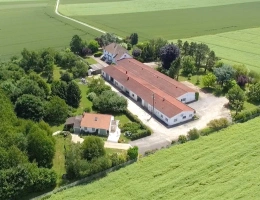
The south of this department has stayed deeply agricultural, and an arable farm for sale in Essonne is found above all on the Étampes Beauce, around Angerville, Méréville and Dourdan, and in the Gâtinais towards La Ferté-Alais and Milly-la-Forêt. Milling wheat, barley, oilseed rape, sugar beet, maize and field vegetables shape the rotation on deep silty soils. What is offered comes from farming families preparing their exit, from rural land advisers and from notarial offices in Étampes and Dourdan; the particulars give the cropping plan, the irrigation available and the storage capacity. All of them join our national record of arable farms for sale.
Here you will find what a listing leaves aside: ploughland values recorded across the department, the districts still releasing area, the condition of the grain bins and the irrigation gear, and the checks imposed by land on the outer edge of the capital. Our white paper « Créer une exploitation agricole » (in French) supports the building of the project itself.
Pricing the land comes first in any plan to buy an arable farm. On the basis of 2025 DVF sales (vineyards excluded), the median in Essonne (91) works out at €8,000/ha and the average at €8,011/ha, across 32 transactions. The central range covering 80% of sales runs from €5,903 to €10,380/ha; nationally the median is €5,307/ha.
The SAFER benchmark, the market's second yardstick, gives €8,260/ha in 2025 for vacant land and pasture (-9.1% over twelve months, -22.4% over ten years), beside a national €6,460/ha; tenanted land is worth about 17% less.
Beyond area, several things make the difference: the agronomic potential of the Beauce silts, the security and volume of the water abstraction, drains on the wetter fields, how the blocks group around the farmstead, bin volume and any drier, the state of the harvest chain and the tractor fleet, the basic payment entitlements, cooperative shares and delivery contracts, and the worth of a vegetable or direct-selling enterprise. Outlets around the capital matter. Place the asking price with our land price observatory, then confirm your structure in our financial calculators.
On the Essonne Beauce, irrigation underwrites sugar beet, maize and field vegetables, crops that carry a large share of the turnover. Have the number of boreholes confirmed, along with their declaration, the annual volume allocated to the holding and whether it passes to a buyer, then the condition of the reels, the pivots and the electricity supply. On the building side, measure the storage available against an average harvest, and check the ventilation, the weighbridge, the cleanliness of the bins and lorry access. A washing area or a packing line signals a vegetable enterprise to be valued in its own right.
Machinery is judged on hours, servicing and how it is owned, harvesting and beet lifting often being carried out by a contractor. Where the farm includes an old house or a range of millstone buildings, have it costed apart from the land: at this distance from Paris and close to the railway stations, a cereal farm sees its overall price shaped by an active housing market, unrelated to what the rotation returns.
The Beauce in the south of the department, between Angerville, Méréville, Étampes and Dourdan, holds the best ploughland: deep silts, reorganised blocks, extensive holdings and a market kept tight by neighbours expanding. The valleys of the Juine, the Essonne and the Chalouette carry specialist production, notably watercress beds around Méréville, on wet ground that has nothing in common with the plateaus. To the east, the Gâtinais français, towards Milly-la-Forêt and La Ferté-Alais, mixes lighter soils, woodland and niche crops, with arable land within easier reach.
To the north, the Saclay plateau and the Hurepoix remain cultivated but sit within a dense urban fabric: farmland there enjoys long-term statutory protection, though that makes sales no more frequent and prices no gentler. The rule stays simple, then: the further south you go in the department, the more strictly agricultural the reasoning behind a price becomes, and the larger the areas on offer.
Water is checked first. The aquifer feeding the Beauce is under volumetric management: verify the declaration of each borehole, the volume notified to the holding, its transfer to the buyer and membership of the collective management body. Then look at catchment perimeters and their feeder zones, which sometimes restrict practices, and at the farmland protection introduced in the north of the department, which fixes agricultural use over certain areas. Finally, ask for the drainage plans and the record of ditch maintenance.
Handing over a crop farm goes through the structures control, an authorisation to farm granted against regional thresholds, and through notification of the sale to SAFER, the rural land agency, which may pre-empt. Go through the rural leases one by one, term, rent, environmental clauses, the tenant's right of pre-emption, then arrange the transfer of basic payment entitlements before the CAP declaration. A certified organic grain farm calls for a check on how long each field has been in conversion.
Owners stepping back, agencies specialising in rural property and notaries across the area feed this page day by day. Narrow by area, by budget or by type of production, put an alert in place so you hear about new offers, then carry on through all the arable farms for sale in Île-de-France.


