

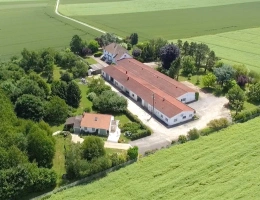
Finding an arable farm for sale in Val-de-Marne is very much the exception: the department belongs to the inner ring of Paris and its farmed ground is confined to a fringe of the Brie plateau in the south-east, around Santeny, Mandres-les-Roses, Marolles-en-Brie and Périgny-sur-Yerres. A handful of open-field businesses still grow wheat, barley and oilseed rape there, sometimes alongside specialised crops, but they seldom change hands. What you can consult here therefore comes mainly from the neighbouring departments, placed by farmers handing over, by rural agencies and by notaries. The national picture of arable farms for sale completes the view.
What this page adds to the listings: the price levels observed on farmland around Paris, the districts of the outer ring where holdings genuinely come up, the condition to expect of buildings and storage, and the checks specific to buying on the urban fringe. Our white paper « Créer une exploitation agricole » (in French) sets out the route to establishing a business.
Pricing the land comes first in any plan to buy an arable farm. This department has no rural communes in the statistical sense, so the figures below are those of the Île-de-France region. On the basis of 2025 DVF sales (vineyards excluded), the median in the region works out at €7,465/ha and the average at €7,932/ha, across 214 transactions. The central range covering 80% of sales runs from €5,253 to €10,940/ha; nationally the median is €5,307/ha.
With no local SAFER average published, the French reference applies: €6,460/ha for vacant land and pasture, €5,350/ha for tenanted land.
On so tight a market, worth turns on things acreage never shows: how evenly the agronomic potential runs, drainage on the heavy plateau soils, fields hemmed in between housing and infrastructure, the storage available, the age of the machinery, basic payment entitlements, the collection contract and, above all, the planning hope value attaching to certain parcels. The farmhouse, for its part, follows a stretched residential market. To place these orders of magnitude, lean on our land price observatory and our financial calculators.
The cropped ground in the south-east of the department continues the Brie plateau: silt resting on clay, sound potential but a sensitivity to waterlogging that makes drainage decisive. Fields are frequently bounded by housing, expressways or railway lines, which lengthens machinery movements and complicates harvest work. Ask for soil analyses, results block by block, a plan of the drains with the date they were last maintained, and an exact map of the accesses. In this setting an arable business is judged as much on its logistics as on its agronomy.
The buildings combine old Brie farmsteads, sometimes embedded in the village fabric, with more recent sheds. Check roof timbers and covering, access for articulated lorries, the real storage capacity, and whether a wash-down area and a compliant crop-protection store exist. A cereal farm equipped with ventilated bins remains uncommon this close to Paris. Value the dwelling separately: residential demand in the south-eastern suburbs prices it independently of the working unit.
Within the department, cropped land clusters on the plateau between Villecresnes, Mandres-les-Roses, Santeny and Marolles-en-Brie, on the boundary with Seine-et-Marne and Essonne. Elsewhere the Marne valley, the Seine valley and the western edge of the plateau are entirely built up. The search consequently moves east, into the Brie of Seine-et-Marne around Brie-Comte-Robert, Tournan-en-Brie and Rozay-en-Brie, then towards the Provinois; to the south, Essonne opens the Hurepoix, the Beauce and the Gâtinais, where open-field units are far more numerous.
The further you move from the departmental boundary, the more the fields consolidate, the easier prices per hectare become and the more coherent the holdings look. The trade-off lies in the daily journey and, more often than not, in moving house altogether. With handovers scarce across the whole eastern side of the region, following the market continuously beats waiting for the right listing.
Taking over falls under the structures control, the prefectoral authorisation required before establishing or expanding a business, and SAFER, the rural land agency, may pre-empt as soon as the notary notifies the sale. On the urban fringe, reading the local plan is decisive: protected agricultural zoning, land intervention perimeters, reserved sites, road or transport schemes. A parcel zoned for development no longer answers to the same pricing logic or the same buyer. Study the rural leases in place too, their expiry, the rent and the tenant's right of pre-emption.
Ask about the history of the soils, since some fringe districts have taken infill or earlier uses that warrant a survey. Check the nitrate vulnerable zone classification, water catchment perimeters, and rights of way and utility easements, which are common in such a heavily serviced area, then the transfer of basic payment entitlements and the consistency of the graphical field register. Anticipate the neighbourhood constraints as well: spraying distances, working hours and machinery movements through inhabited areas.
Owners at the end of their careers, rural estate agencies and notaries lodge their instructions here. State the area you are after, the budget and the geography you will cover, switch on an alert so a rare listing does not slip past, and carry your exploration into the arable farms for sale in Île-de-France.


