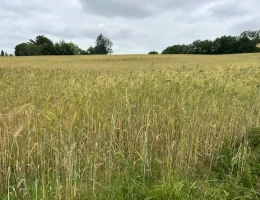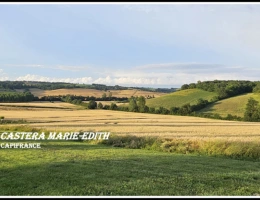
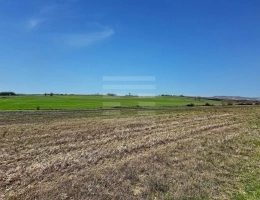
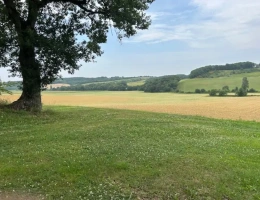
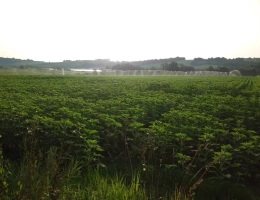
Looking for an arable farm for sale in Occitanie? Cropping here sits in scattered plains and hillsides rather than on one broad plateau: the Lauragais and the Toulouse basin for durum wheat and sunflower, the Gascon slopes of the Gers, the irrigated terraces along the Garonne for maize, and the Costières of the Gard. The holdings listed on this page reach us from growers preparing their handover, from rural agencies rooted in the area and from notaries; each advertisement sets out the cropping plan, the field layout, the irrigation equipment and the storage on site. All of them also appear among our arable farms for sale nationwide.
Past the listings, this page gathers what a buyer weighs up: the value of cropping land across the region, the departments where handovers come up most often, and the buildings and machinery to inspect before bidding on a crop farm on the market in Occitanie. Anyone preparing to set up will find the full route, from funding plan to the French farming qualification, in our white paper « Créer une exploitation agricole » (in French).
Pricing the land comes first in any plan to buy an arable farm. On the basis of 2025 DVF sales (vineyards excluded), the median in Occitanie works out at €7,015/ha and the average at €7,653/ha, across 995 transactions. The central range covering 80% of sales runs from €3,913 to €11,825/ha; nationally the median is €5,307/ha.
The SAFER benchmark, the market's second yardstick, gives €7,260/ha in 2025 for vacant land and pasture (-0.3% over twelve months, +6.1% over ten years), beside a national €6,460/ha; tenanted land is worth about 17% less.
The hectare figure never captures the whole value of an arable farm. The machinery shed and its clearance, the grain bins, the dryer, the intake pit, the age of the equipment fleet, a registered borehole or a share in a collective irrigation network, the grouping of fields around the yard and the basic payment entitlements attached to the cropping plan often count for more than the acreage advertised. Weigh what is asked against the figures in our land price observatory, and run the borrowing through our financial calculators before you commit.
A viewing starts at the yard: machinery shed, headroom and door width, condition of the concrete, workshop, wash-down area, a compliant fuel tank and a lockable crop protection store. Next comes the grain chain, which frequently separates two otherwise similar holdings: bins or steel silos, an intake pit, a cleaner, aeration, temperature probes and, in maize country, a dryer in working order. A farm able to hold a full harvest can wait for a favourable selling window instead of delivering straight off the combine, and its price reflects that. The state of the fleet, tractors, cultivation equipment, drill and combine, rounds off this first assessment.
Water comes next. A registered borehole, an abstraction permit, a share in a collective network or a pumping station on the Garonne cannot be replaced and clearly lift the value of the fields they serve; conversely, old drainage with silted collectors means work that few vendors mention unprompted. Where the property is offered with the farmhouse, ask for the price to be split between dwelling, farm buildings, machinery and arable land: these items are neither funded nor written down in the same way.
Cropping land on the market clusters first in the Lauragais, shared between Haute-Garonne and Aude: this is the regional heartland of durum wheat and sunflower, where land stays sought after and handovers are prepared well in advance. The Gers lines up clay and limestone slopes under durum wheat, sunflower, oilseed rape and soya, on comfortably sized holdings where reduced tillage is widely practised. Tarn-et-Garonne and Tarn combine irrigated alluvial terraces along the Garonne and the Tarn, seed multiplication contracts and drier hillside fields. The Gard brings in the Costières and the Rhône plain, where crops sit alongside vines and orchards.
Elsewhere, arable farming is quieter but real. Ariège grows maize and straw cereals in the lower plain, around Pamiers and Saverdun. Hautes-Pyrénées works the Adour plain, largely irrigated, with maize dominating the rotation. Hérault and Pyrénées-Orientales leave most of their land to vines and orchards, so listings there are occasional. Aveyron, Lot and Lozère belong mainly to mixed farming, where cereals are frequently fed on the holding and sold together with a herd. Widening the search across neighbouring departments remains the surest way to find a coherent block of fields.
A large share of the regional cropping area is rented rather than owned. The French farm tenancy continues with the incoming farmer, but the handover needs the landlord's agreement and a close look at the rent, the renewal date and any environmental clauses. The deal then passes the structures control, France's permit system for farmland takeovers, which measures the area held against a regional policy document, and through notification to the SAFER, the rural land agency that may pre-empt sales of bare land. Share transfers, common on cropping businesses, follow rules of their own and deserve professional advice before anything is signed.
Two further points are settled on the ground. First, the Common Agricultural Policy: confirm that basic payment entitlements actually transfer, that the declared cropping plan matches what is grown, and that cover crops and buffer strips are in order. Second, water: in catchments classed as under pressure, abstraction volumes are shared out by a single management body, and an allocation revised downwards changes the economics of an irrigated holding. Finally, ask for the soil analyses and the field-by-field yield history, rarely included in the sale file.
Owners handing over, rural estate agencies and notaries feed this page as mandates come in. Sort by area, price or department, save an alert to be told of fresh mandates, and look beyond to farms for sale in Occitanie if your project can accommodate another farming system.