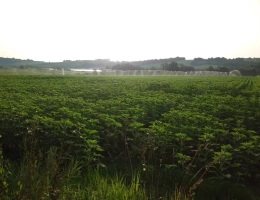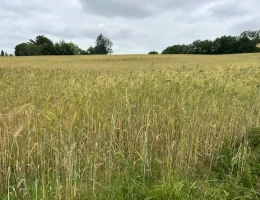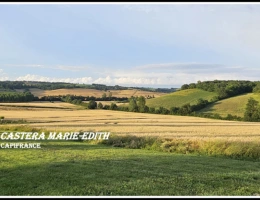
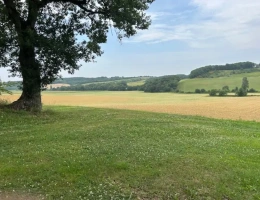
Taking over an arable farm for sale in Gers means buying into a landscape of rolling hills: the department is cultivated almost from end to end, with no real plain, growing sunflower, soft wheat, durum, rape, soya and irrigated maize in the valley bottoms. Mixed farming remains the rule, often with a duck or goose enterprise or a few hectares of vines alongside. The holdings offered come from farmers preparing to step back, from local notaries and from rural transaction specialists, with detail on the field layout, the storage and the machinery. They join our national picture of arable farms for sale.
This page carries the listings further on the points you cannot judge from a distance: the level of local ploughland values, the districts where a grain farm is released, the condition of sheds, reservoirs and equipment, and the clearances that come before signature. Our white paper « Créer une exploitation agricole » (in French) covers every stage of setting up.
Pricing the land comes first in any plan to buy an arable farm. On the basis of 2025 DVF sales (vineyards excluded), the median in Gers (32) works out at €6,897/ha and the average at €6,763/ha, across 248 transactions. The central range covering 80% of sales runs from €4,063 to €9,500/ha; nationally the median is €5,307/ha.
The SAFER benchmark, the market's second yardstick, gives €7,100/ha in 2025 for vacant land and pasture (-2.1% over twelve months, +6.4% over ten years), beside a national €6,460/ha; tenanted land is worth about 17% less.
On this kind of ground, the asking price reflects slope, the shape of the blocks and the distance back to the steading, then soil type, clay-limestone terreforts or boulbènes that cap easily under rain. Add access to water through a hillside reservoir or a river topped up from the Pyrenees, storage capacity, the dryer, the harvest chain, the payment entitlements and the collection contract. Weigh all of it against our land price observatory, then test whether the project holds together using our financial calculators.
Irrigation here looks nothing like that of the great plains: it rests largely on private or shared hillside reservoirs and on rivers kept topped up with water brought down from the Pyrenees. Have the volume held, the soundness of the dam, the condition of the pumping station, the length of buried main and the number of reels all confirmed. Storage follows: ventilated bins and flat stores, a dryer where maize counts in the rotation, an intake pit, a concrete apron and a machinery shed. On holdings that are often large and scattered, decent storage avoids total dependence on the collection silo at the height of harvest.
Machinery is judged against the terrain: tyres, implement width and the ability to work steep ground matter as much as raw horsepower. Part of the workload is usually covered by labour sharing or by a machinery co-operative, and those arrangements rarely pass on by themselves. Where the sale includes a restored Gascon farmhouse, tower or dovecote, the residential value can become substantial, since this market attracts buyers from well beyond the region: ask for it to be valued separately from the working unit.
The Lomagne, in the north-east around Fleurance, Lectoure and Mauvezin, holds the most sought-after arable land: deeper soils, a durum wheat, garlic and melon tradition, and wider blocks. The Savès, east towards Gimont, Samatan and L'Isle-Jourdain, feels the pull of Toulouse and sees prices climb accordingly. The Armagnac and the Ténarèze, around Éauze and Condom, share the ground between cereals and vines grown for distilling. The Astarac and the south of the department, towards Mirande and Masseube, mix cropping with livestock on narrower hills, where values stay more affordable.
Gers is among the most organically farmed departments in France, and a real share of the holdings on the market is already certified or in conversion, which means taking on a farming system and a customer base as well as the ground. Supply is steadier here than elsewhere in the region, since the farming population is ageing, but the better units in the Lomagne and the Savès are often settled between neighbours before anything is ever published.
On cultivated slopes, erosion is the first technical question: ask about the history of gullying, the state of ditches, hedges and grass margins, and the cultivation system in use, because reduced tillage can only be judged in the field. The second question is water: the abstraction permit, the volume allocated by the collective water management body, the rules governing a shared reservoir, and summer restrictions. The third is legal: the structures control, France's authorisation regime for taking on farmland, and SAFER's right of pre-emption over any farmland sale.
Then look hard at what is actually being sold. Many holdings here are held through a farming company, which changes everything: the deal may concern shares rather than assets, with quite different tax and legal consequences. Ask for the rural leases and their amendments, an inventory of machinery and stocks, the schedule of payment entitlements, the CAP declaration under way, and the certification body's paperwork where the farm is run organically.
Sometimes it is the farmer announcing a handover directly, sometimes a notary or a firm specialising in rural land that entrusts a property to us. Set the filters for area, budget and farming system, put an alert in place to follow what comes on the market, then widen the view to arable farms for sale in Occitanie.